Biochemistry — Enzyme Kinetics
Learning objective: See how Petri nets naturally model chemical reactions, recovering classical equations.
The previous chapters applied Petri nets to domains where the mathematical formalism is borrowed — resource flows, games, puzzles, optimization. This chapter returns to the domain where the formalism originated: chemistry. Enzyme kinetics is the study of how enzymes catalyze reactions, and the Michaelis-Menten equation that describes it is one of biochemistry’s most important results.
Textbooks derive Michaelis-Menten with steady-state assumptions and algebraic manipulation. We don’t need any of that. A 4-place Petri net with mass-action kinetics produces the same equation automatically. The structure produces the behavior.
Substrate, Enzyme, Product
An enzyme catalyzes the conversion of substrate to product in three steps:
- Binding: enzyme and substrate combine to form a complex (rate )
- Unbinding: the complex falls apart without producing product (rate )
- Catalysis: the complex converts substrate to product, releasing the enzyme (rate )
The enzyme is not consumed — it cycles between free and bound states. This cycling is the hallmark of catalysis, and it maps perfectly to Petri net token flow.
The Petri Net
Four places, three transitions:
| Place | Initial | Role |
|---|---|---|
substrate | 100 | Free substrate molecules |
enzyme | 10 | Free enzyme molecules |
complex | 0 | Enzyme-substrate complex |
product | 0 | Converted product |
| Transition | Rate | Arcs |
|---|---|---|
bind | substrate + enzyme → complex | |
unbind | complex → substrate + enzyme | |
catalyze | complex → product + enzyme |
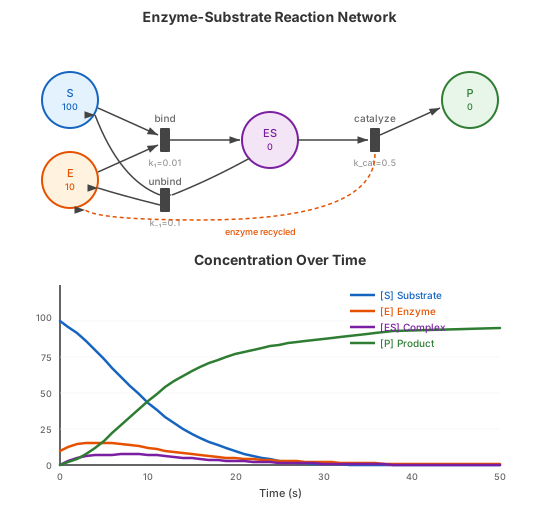
The arc structure encodes the chemistry directly:
substrate --> bind --> complex --> catalyze --> product
enzyme -->          /              enzyme <--+
             unbind
complex --> unbind --> substrate
                  --> enzyme
The enzyme appears as both input and output of catalyze — it’s consumed when the complex forms and returned when the product is released. This cyclic flow is the structural signature of catalysis.
In Code
net, rates := petri.Build().
    Place("substrate", 100).
    Place("enzyme", 10).
    Place("complex", 0).
    Place("product", 0).
    Transition("bind").
    Transition("unbind").
    Transition("catalyze").
    Arc("substrate", "bind", 1).
    Arc("enzyme", "bind", 1).
    Arc("bind", "complex", 1).
    Arc("complex", "unbind", 1).
    Arc("unbind", "substrate", 1).
    Arc("unbind", "enzyme", 1).
    Arc("complex", "catalyze", 1).
    Arc("catalyze", "product", 1).
    Arc("catalyze", "enzyme", 1).
    WithRates(map[string]float64{
        "bind":     0.01,
        "unbind":   0.1,
        "catalyze": 0.5,
    })
The net is complete. Four places, three transitions, nine arcs. Every biochemistry textbook’s enzyme kinetics chapter is encoded in this structure.
Mass-Action Kinetics as Native Semantics
With mass-action kinetics, each transition fires at a rate proportional to the product of its input concentrations:
The ODE system follows directly from the Petri net topology. Using the incidence matrix and rate vector :
We didn’t write these equations. They emerged from the net structure and mass-action kinetics — exactly the process described in Chapter 3. The incidence matrix encodes all the stoichiometry. The mass-action rate law provides the dynamics. The ODE solver does the rest.
Emergent Michaelis-Menten Behavior
At steady state (), the complex concentration stabilizes:
Solving for the reaction rate and using :
where and .
This is the Michaelis-Menten equation. The algebra above is only confirmation — the ODE solver produces the saturation curve directly from the Petri net without it. Running the simulation with increasing initial substrate concentrations traces out the classic hyperbolic curve: rate increases linearly at low [S], then levels off as enzyme becomes saturated.
The Saturation Effect
Why does the rate saturate? The Petri net makes it visible through token flow.
At low substrate, most enzyme tokens are in the enzyme place (free). Increasing [S] means more bind events, so the rate climbs linearly. But at high substrate, almost all enzyme tokens are tied up in complex. Adding more substrate can’t speed things up — there’s no free enzyme to bind with.
is the substrate concentration at half-maximum rate. It measures binding affinity. With the default parameters: . You need 60 substrate molecules to reach half the maximum rate.
is the theoretical maximum rate when all enzyme is saturated. With 10 enzyme molecules and : .
Both constants emerge from the simulation without being computed algebraically.
Simulation Predictions
The ODE solver computes several predictions from the initial conditions and rate constants:
| Prediction | Default Value | What It Means |
|---|---|---|
| Time to 50% conversion | ~17s | When half the substrate is consumed |
| Peak reaction rate | ~2.95 | Maximum d[P]/dt, approaches Vmax |
| Final yield | ~70% | Percentage of substrate converted |
| / | 60 / 5.0 | The Michaelis-Menten constants |
The concentration curves show the classic pattern: substrate depletes as product accumulates, with the enzyme-substrate complex rising quickly then falling as substrate runs out.
Conservation Laws from P-Invariants
The Petri net enforces conservation laws automatically through its structure:
Enzyme conservation:
Free enzyme plus bound enzyme always equals the initial enzyme count. This isn’t coded as a constraint — it’s a structural property of the net. The enzyme token circulates through enzyme → complex → enzyme but never leaves the system.
Check via P-invariant: the weight vector (for places [substrate, enzyme, complex, product]) satisfies :
bindcolumn:unbindcolumn:catalyzecolumn:
Mass conservation:
Substrate is either free, bound in complex, or converted to product. Mass is conserved because every arc that removes a token from one place adds it to another.
These invariants are verified at every timestep of the ODE simulation. If they ever fail, something is wrong with the model — a missing arc, an incorrect weight, a bug in the solver. Conservation laws are free structural correctness checks.
Parameter Exploration and Sensitivity
The model invites exploration by changing rate constants:
High enzyme, low substrate (): The reaction completes almost instantly. All substrate is converted because there’s plenty of enzyme. The rate curve is a sharp spike.
Low (): Binding becomes the bottleneck. shoots up to 600, meaning enormous substrate concentrations are needed for half-max rate. The enzyme is effectively less efficient.
High (): The enzyme turns over faster. increases to 20, but also increases to 210. Faster catalysis means the complex is consumed faster, so more substrate is needed to keep it populated.
Equal and (): Half the binding events are “wasted” on unbinding. — higher than default. The enzyme is less efficient.
Each parameter change is a different set of rate constants on the same net. The structure stays the same. The dynamics change. This is the pattern throughout the book: one model, many scenarios.
From Chemistry to Everything
The Michaelis-Menten pattern appears far beyond biochemistry. Anywhere a limited resource cycles between free and occupied states, the same saturation dynamics emerge:
- CPU scheduling: processes (substrate) compete for cores (enzyme), creating context-switch overhead (complex formation)
- Customer service: customers (substrate) wait for agents (enzyme), with a queue (complex) that saturates
- Manufacturing: raw materials (substrate) need machines (enzyme), with work-in-progress (complex) limited by machine count
In each case, the Petri net structure is identical — only the labels change. Four places, three transitions, nine arcs. The same and characterize the system’s capacity and responsiveness.
This is the ComputationNet pattern from Chapter 4 in its purest form: continuous quantities, rate-based firing, conservation laws, and emergent behavior from structure. The enzyme kinetics model is the smallest non-trivial example — small enough to understand completely, yet producing one of the most important results in biochemistry.