Preface
Petri nets were invented in 1962. They predate Unix, the internet, and object-oriented programming. For most of their history, they lived in academic papers — a formalism known to theorists but invisible to working programmers.
This book argues they deserve wider use, and it makes one claim about why. A Petri net is a small, fixed alphabet — place, transition, arc, guard — and a model written in it is a value, not a program. It is a document: it can be hashed, diffed, composed with another model by sharing a place, and checked by a machine that has never seen any of our code. From that one fact everything else follows. The same document is a state machine that handles concurrency, a workflow engine with formal guarantees, a simulation model that converts to differential equations, and a specification from which a running application, a kernel-checked theorem and a zero-knowledge proof can all be derived rather than written.
We call that claim Metamodel. The plain definition is the literal one: a model for making models. The four primitives are not a model of any particular thing — not a coffee shop, not a token — they are the fixed vocabulary every such model is written in, and the rules for how two of them fit together. Not one system that swallows every domain, but four primitives whose local composition rules generate an unbounded space of specific, checkable systems. The pflow ecosystem is where it is tested. You draw a net in a browser editor, simulate it, generate an application, and hold twenty implementations in four languages to one golden trace — all from the same JSON-LD model. The formalism provides the guarantees. The tools make the formalism accessible. And the domains the same alphabet has already been tiled across — a coffee shop, a token standard, a poker game, a drum machine, and the infrastructure that serves this book — are the evidence.
Who This Book Is For
You know how to program but haven’t encountered Petri nets before — or you’ve seen the formalism and wondered what it’s good for in practice. Either way, this book meets you where you are.
The examples are in Go and JavaScript. The mathematics uses standard notation — vectors, matrices, differential equations. When a concept requires math, the math appears alongside working code so you can verify every claim by running it.
How to Read This Book
There are two paths through the material:
- Theory track: Read Parts I and III for the mathematical foundations and advanced topics — formal definitions, incidence matrices, ODE solvers, invariants, and the categorical reasons composition works.
- Hands-on track: Skim Part I for vocabulary, then dive into Part II’s worked examples (coffee shops, games, biochemistry) and Part IV’s tooling guides.
Both tracks converge — the theory explains why the tools work, and the tools make the theory tangible.
Part I: Foundations
Chapters 1-4 introduce the formalism. Places, transitions, arcs — structure — and tokens, the state that moves through it. Then firing rules, incidence matrices, and conservation laws. Then the key insight: converting discrete nets to continuous ODE systems via mass-action kinetics. Finally, the token language DSL, which adds the fourth primitive — the guard — and typed composition.
Part II: Applications
Chapters 5-10 apply the formalism to six domains: resource management (coffee shop), game mechanics (tic-tac-toe), constraint satisfaction (sudoku), combinatorial optimization (knapsack), biochemistry (enzyme kinetics), and complex state machines (Texas Hold’em). Each chapter builds a complete model from scratch, simulates it, and analyzes the results.
Part III: Advanced Topics
Chapters 11-16 push the formalism further. Process mining discovers nets from event logs. Topology alone derives strategy. Exponential weights encode scoring systems. JSON-LD makes nets self-describing and content-addressable. Zero-knowledge proofs appear here too, as what you get for free once the incidence matrix is the constraint system — a derived artifact, not a destination.
Part IV: Building with pflow
Chapters 17-20 cover the ecosystem tools. The visual editor for designing nets interactively. The code generator that turns models into full-stack applications. The Go library’s API and package structure. And the parity discipline that keeps every implementation honest — two at first, twenty by the end. The Epilogue names the claim the whole book has been making.
The pflow Ecosystem
The projects referenced throughout this book form a unified ecosystem:
| Project | Purpose | URL |
|---|---|---|
| go-pflow | Core library — ODE simulation, reachability, process mining | github.com/pflow-xyz/go-pflow |
| pflow.xyz | Visual browser-based editor for designing nets | pflow.xyz |
| petri-pilot | Code generator — turns net models into running applications | pilot.pflow.xyz |
| pflow-polyglot | One model, five forms, ten languages, one golden trace | github.com/pflow-xyz/pflow-polyglot |
| sim.pflow.xyz | Business operations as calibrated what-if models | sim.pflow.xyz |
All of them share the same JSON-LD model format. A net designed in the editor can be simulated by the library and compiled by the code generator without format conversion. The model is the source of truth.
Conventions
- Code examples appear inline for short snippets and in separate files for longer programs
- Mathematical notation uses standard linear algebra: bold lowercase for vectors (), uppercase for matrices ()
- Cross-references link between chapters: “the coffee shop model (Chapter 5)” or “mass-action kinetics (Chapter 3)”
- Go code uses the
go-pflowlibrary API; JavaScript uses the pflow.xyz browser modules - JSON-LD snippets use
@context: "https://pflow.xyz/schema"throughout
Acknowledgments
This book grew from blog posts, documentation, and working code written over two years. The pflow ecosystem is open source, and the ideas draw on sixty years of Petri net theory — from Carl Adam Petri’s 1962 dissertation through the process mining work of Wil van der Aalst and the categorical semantics of Meseguer, Montanari and Sassone.
The best way to learn is to build. Open pflow.xyz in a browser, draw a net, and press play. The mathematics follows.
Why Petri Nets?
Learning objective: Understand what Petri nets offer over flowcharts, state machines, and ad-hoc modeling.
You already know how to model systems. You’ve drawn flowcharts on whiteboards, sketched state machines in design docs, and built ad-hoc abstractions in code. These tools work for small systems. This chapter is about where they break, and what Petri nets offer instead.
The Problem with Informal Models
Every software project starts with a model, whether the team knows it or not. Someone draws boxes and arrows on a whiteboard. Someone else writes a state machine in an enum. A third person embeds the workflow directly in if-else chains. All three believe they’re describing the same system.
They usually aren’t.
Informal models fail in predictable ways:
Flowcharts can’t express concurrency. A flowchart is a sequence with branches. It handles “do A then B” and “do A or B” well enough. But “do A and B at the same time, then wait for both to finish” requires awkward workarounds — swim lanes, join bars, footnotes — and real systems are concurrent.
State machines explode. A state machine with boolean variables has possible states. A system tracking 10 independent conditions has 1,024 states. Most of those states are meaningless combinations, but the machine doesn’t know that. You end up either enumerating impossible states or pretending they can’t happen.
Ad-hoc models can’t be analyzed. When the workflow lives in code — scattered across handlers, middleware, and database triggers — there’s no way to ask “can this system deadlock?” or “is this queue bounded?” You find out in production, at 3am.
The root problem is the same in each case: the model doesn’t capture the structure of the system it represents. Concurrency, resources and state are left implicit, and you can’t analyze what you haven’t modeled.
A Brief History
In 1962, Carl Adam Petri submitted his doctoral dissertation, Kommunikation mit Automaten (Communication with Automata), to the Technical University of Darmstadt. He was 36 years old, and he had been thinking about the problem for over a decade — his first sketches of what would become Petri nets date to 1939, when he was thirteen.
Petri’s insight was simple to state: concurrent systems need a model where multiple things can be true at the same time. State machines force you to enumerate every combination of conditions as a single global state. Petri’s nets decompose the state into independent pieces — places — each holding its own local truth. The interactions between these pieces are explicit in the structure of the net.
The formalism found its first serious applications in hardware design, where concurrency is unavoidable. By the 1980s they were in wide use for manufacturing systems and communication protocols, and workflow modeling took them up in the 1990s. Business process notations such as BPMN describe their execution in terms of tokens moving through a diagram, and a common way to analyze such a diagram formally is to translate it into a Petri net, even though most practitioners never see that net.
Petri spent his career at the GMD (German National Research Centre for Computer Science) in Bonn, refining the theory and advocating for precise models of concurrent systems. He died in 2010. The formalism he created — places, transitions, and the flow of tokens between them — is still the base that colored, timed and stochastic Petri nets extend, and it is the base this book builds on.
Places, Transitions, Arcs, Tokens
A Petri net has exactly four kinds of things:
Places are drawn as circles. A place represents a condition that can be true or false, a resource that can be available or consumed, a state that a piece of the system can be in. Think of a place as a container.
Tokens are drawn as dots inside places. Tokens represent the current state of the system: which conditions hold, how many resources are available, where entities are in a process. The distribution of tokens across all places is called the marking — it’s the complete snapshot of the system at a moment in time.
Transitions are drawn as rectangles (or bars). A transition represents an event, an action, something that happens, such as registering a user or brewing a coffee. A transition changes the state of the system by moving tokens around.
Arcs are arrows connecting places to transitions and transitions to places. An arc from a place to a transition means “this transition needs a token from this place.” An arc from a transition to a place means “this transition produces a token in this place.” Arcs define the flow — who needs what, and who produces what.
That is the whole vocabulary of an ordinary Petri net. A traffic light, a biochemical pathway and a poker game are all built from these four elements.
One distinction is worth fixing now, because the rest of the book leans on it. Places, transitions and arcs are structure — they are what a model is. Tokens are state — the marking is what a model is doing right now, and it changes on every firing while the structure does not. The alphabet this book builds with is therefore three structural terms plus one more that arrives in Chapter 4: the guard, a condition on when a transition may fire. Place, transition, arc, guard — four primitives, and no fifth. Everything else, from balances to brew to the tic-tac-toe move X00, is what a domain sounds like once it has been written in them. The guard is not on the same footing as the other three, though. The incidence matrix of Chapter 2 records places, transitions and arcs; a guard is a predicate on the marking that the matrix does not see, so a property that depends on a guard is checked by exploring states rather than by linear algebra. Appendix E states exactly where that line falls.
The Firing Rule
The one rule that makes the whole thing work:
A transition fires when every input place has at least one token. When it fires, it removes one token from each input place and adds one token to each output place.
This single rule gives you sequencing (token moves from A to B), concurrency (two transitions can fire independently if they don’t share input places), synchronization (a transition with two input places waits for both), and resource management (a place with tokens represents available resources).
Weighted Arcs
Sometimes a transition needs more than one token from a place, or produces more than one. A number on an arc — its weight — specifies how many tokens are consumed or produced. An arc with weight 3 from a place to a transition means “this transition needs 3 tokens from this place to fire.” The firing rule generalizes accordingly: a transition is enabled when each input place holds at least its arc’s weight, and firing removes that many tokens and adds each output arc’s weight to its place. The rule above is the case where every weight is 1; Chapter 2 gives the formal version.
Your First Net: A Traffic Stoplight
A traffic light cycles through three states: green, yellow, red. At any moment, exactly one light is on. Here’s the Petri net:
    *
   [Green]--> [go_yellow] --> [Yellow]--> [go_red] --> [Red]--> [go_green]
      ^                                                              |
      +--------------------------------------------------------------+
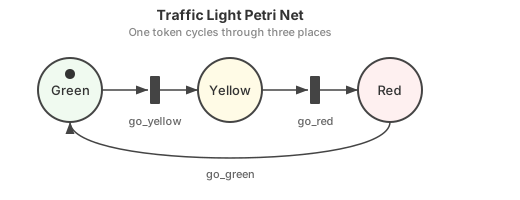
Three places: Green, Yellow, Red. Three transitions: go_yellow, go_red, go_green. One token, starting in Green.
The token’s position tells you which light is on. Fire go_yellow and the token moves from Green to Yellow. Fire go_red and it moves from Yellow to Red. Fire go_green and it cycles back to Green.
The same net is in go-pflow as examples/stoplight/petri_net.go, with the token starting in Red and the transitions named RedToGreen, GreenToYellow and YellowToRed; its test checks the shape — three places, three transitions, six arcs (petri_net_test.go).
This is almost trivially simple — a state machine would work just as well. But notice what the Petri net gives you for free:
Conservation. Each transition takes one token from one place and puts one token into the next, so no firing changes the sum . It starts at 1 and stays at 1: exactly one light is on in every reachable marking. That follows from the arcs alone, with no runtime check. Chapter 2 restates the argument in matrix form, as a P-invariant with and .
Impossible states are unreachable. A hand-written state machine for this light keeps the color in a variable, and a bug can set it to something outside the three valid values. In the net you can write down a marking with tokens in both Green and Red, but its token sum is 2, so the conservation law rules it out of every run that starts from the initial marking. The bad state is excluded by a property you can check rather than by a convention you have to keep.
Composability. Want to model an intersection? Add a second traffic light net. Connect them with a coordination mechanism — a shared place that ensures one direction is red when the other is green. Each light keeps its internal structure; the coordination is explicit in the arcs between them.
An Intersection
Two lights need to coordinate. To keep the example small, each light here has only red and green. We add a shared place Intersection_Free that acts as a mutual exclusion lock. Written as each transition’s inputs and outputs:
go_green_A:  Red_A + Intersection_Free  -->  Green_A
go_red_A:    Green_A                    -->  Red_A + Intersection_Free
go_green_B:  Red_B + Intersection_Free  -->  Green_B
go_red_B:    Green_B                    -->  Red_B + Intersection_Free

initial marking:  Red_A = 1, Red_B = 1, Intersection_Free = 1
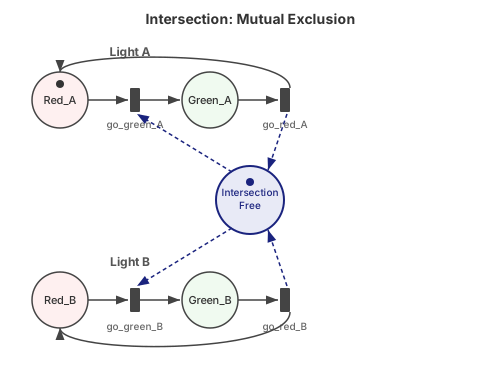
The token in Intersection_Free is consumed when one light turns green and returned when it turns red. Every transition moves that one token between Intersection_Free and a Green place, so the token count of Intersection_Free, Green_A and Green_B together stays at its initial value of 1, and the two lights are never green together. As with the single light, this is derived from the arcs by hand. The same net, with idle/busy in place of Red/Green and sem in place of Intersection_Free, is the mutexNet fixture in go-pflow’s verify/verify_test.go: TestMutualExclusionProvedStructurally requires the verifier to prove “at most one of busy1, busy2” from the semaphore invariant rather than by enumerating states, and TestMutualExclusionRefutedWithCounterexample removes the semaphore arcs from one client and requires a replayable firing sequence that makes both busy (the tests are cited, not re-run for this chapter).
This pattern — a shared resource place controlling access — models mutexes, semaphores, limited capacity, and turn-taking. It returns as turn control in Chapter 6: Game Mechanics — Tic-Tac-Toe.
Small Models, Not Large Language Models
Say “model” in a meeting today and most people hear “large language model”: billions of parameters, opaque weights, probabilistic outputs. Petri nets are a different kind of model, small and executable, and inspectable all the way down.
A coffee shop with five ingredients and five recipes is ten places and five transitions (Chapter 5). petri-pilot’s Texas Hold’em model, a simplified five-player table with all four betting rounds, has 18 places and 32 transitions (services/texas-holdem.json). A Sudoku solver is larger but still finite and fully visible.
Small models offer properties that large models cannot:
| Property | Large Language Models | Petri Nets |
|---|---|---|
| Inspectable | No | Yes — read the topology |
| Composable | Awkward | Native — connect shared places |
| Provable properties | No | Yes — invariants from the structure; reachability and deadlock by exploring states |
| Executable | Via code generation | Directly — tokens flow |
| Deterministic | Not in general | Yes, given the same firing sequence |
A Petri net model lets you answer questions before writing implementation code:
Reachability: “Given this initial state, can the system reach that target state?” This tells you whether a workflow is completable, whether a game has a winning move, whether an order can be fulfilled from current inventory.
Boundedness: “Does the system stay within limits?” This tells you whether a queue can overflow, whether a resource pool is properly managed, whether your system is closed or leaking.
Deadlock and liveness: “Can the system get stuck?” Deadlock-freedom means no reachable marking leaves every transition disabled. Liveness is stronger: every transition can always fire again, from every reachable marking. go-pflow’s pflow verify checks deadlock-free directly, and its live property is the weaker check that every transition fires from some reachable marking; the code’s own comment warns that a proved live does not imply deadlock-freedom (verify/property.go).
These are questions about the model’s state space, so they can be asked before the implementation exists. They are answered in two different ways. Invariants come from the incidence matrix by linear algebra and hold for any initial marking. Reachability, boundedness and deadlock are decided by exploring the reachable markings (reachability/graph.go), which finishes for a bounded net of modest size and is cut off at a configurable state limit otherwise; an unbounded net is caught instead by a finite witness, a firing sequence that strictly grows the marking (the Karp–Miller criterion; reachability/coverability.go).
Models as Specification
Here’s the workflow this book advocates:
- Sketch the net — places for states and resources, transitions for events
- Simulate — run the ODE solver to see if tokens flow the way you expect
- Analyze — check invariants, reachability, boundedness
- Generate code — derive the implementation from the validated model
The model becomes the specification. The code becomes a derived artifact. When the model changes, the code changes with it. When model and implementation disagree, the model wins, because it is the artifact whose properties you checked.
In most software the code is the model, and the specification, if there is one, drifts out of date. Here the model is the artifact that is executed and analyzed, and it stays authoritative for the life of the project.
The rest of this book shows what this looks like in practice — from a coffee shop inventory system to a running application, a kernel-checked theorem and a zero-knowledge proof of a game move — all derived from the same four primitives: places, transitions, arcs, and guards.
Try it live: See the Stoplight for a cyclic state machine or the Dining Philosophers for mutual exclusion — both generated from Petri net models at pilot.pflow.xyz. The live stoplight is petri-pilot’s
services/stoplight.json: the same three-place cycle, starting in red, with transitions namedgo,slowandstop.
The Mathematics of Flow
Learning objective: Read and write the formal notation; understand firing rules and state equations.
Chapter 1 introduced Petri nets informally — circles, bars, arrows, dots. That’s enough for intuition, but not enough for analysis. To prove that a system can’t deadlock, or that a resource pool never goes negative, or that a workflow always terminates, you need precise definitions. This chapter provides them.
The notation looks heavy at first. It isn’t. Everything here follows from two ideas: a net is a bipartite graph with weights, and a marking is a vector of integers. The rest is matrix arithmetic.
The Formal Definition
A Petri net is a 5-tuple:
Where:
- is a finite set of places
- is a finite set of transitions
- is the flow relation — the set of arcs
- is the arc weight function
- is the initial marking
Two constraints keep things clean: (nothing is both a place and a transition) and (the net isn’t empty).
That’s the entire definition. Five things. Places are where tokens live. Transitions are what moves them. Arcs say who connects to whom. Weights say how many tokens an arc carries. The initial marking says where tokens start.
Presets and Postsets
Every transition has inputs and outputs. The notation for these is compact and worth memorizing:
- — the preset of (input places)
- — the postset of (output places)
The same notation works for places:
- — transitions that feed into
- — transitions that feeds into
The bullet notation reads naturally: means “what comes before ,” and means “what comes after .”
Markings and the State Vector
A marking assigns a non-negative integer to each place — how many tokens it holds. Since a net has places, we can write the marking as a column vector:
This is the state vector. It captures everything about the system’s current state. Two markings are equal if and only if every place has the same token count in both. There’s no hidden state, no side channels, no context beyond the vector.
The initial marking is the starting state. For the traffic light from Chapter 1:
Every marking you can reach by firing transitions is a point in — non-negative integer coordinates, one per place. The set of all reachable markings, starting from , is the reachability set . For the traffic light, contains exactly three points: the token in Green, the token in Yellow, the token in Red.
Firing Rules and Reachability
A transition fires by consuming tokens from its input places and producing tokens in its output places. But it can only fire when it has enough tokens to consume. The enabling condition is:
Every input place must have at least as many tokens as the arc weight demands. If any input place is short, the transition is blocked.
When an enabled transition fires, the new marking is:
For every place : subtract the tokens consumed (arc from to ) and add the tokens produced (arc from to ). If isn’t connected to , both weights are zero and — unconnected places are unaffected.
A Worked Example
Consider a simple three-place chain:
[p1] -> t1 -> [p2] -> t2 -> [p3]
With initial marking (one token in ).
Step 1: Is enabled? Its only input is , and . Yes. Fire :
Step 2: Is enabled? Its only input is , and . Yes. Fire :
The token has moved from through to . The reachability set is . Three reachable markings, matching intuition — the token can be in exactly one of three places.
Firing Sequences
A firing sequence is an ordered list of transitions: . The sequence is valid from marking if each transition is enabled when it’s supposed to fire — is enabled at , is enabled at the marking after fires, and so on.
We write to mean “firing sequence is valid from and leads to .” The reachability set is then:
Nondeterminism
When multiple transitions are enabled simultaneously, either one could fire. The Petri net doesn’t prescribe which. This nondeterminism is a feature, not a bug — it models real concurrency where the order of independent events is genuinely unspecified.
In the traffic light, only one transition is ever enabled at a time, so there’s no nondeterminism. But in the intersection model from Chapter 1, when the shared token is available, both lights could claim it. The net structure constrains what’s possible; it doesn’t dictate the schedule.
The Incidence Matrix
Computing markings by hand gets tedious. The incidence matrix makes it mechanical.
The incidence matrix has one row per place and one column per transition. Each entry is the net effect of firing that transition on that place:
Positive means the transition produces tokens in that place. Negative means it consumes. Zero means no effect.
Building the Matrix
For the three-place chain:
Reading column : firing removes one token from and adds one to . Reading column : firing removes one from and adds one to . Each column is a change vector — the delta applied to the marking when that transition fires.
The State Equation
This is the payoff. With the incidence matrix, the firing rule becomes matrix multiplication:
Where is the firing count vector — how many times each transition fires. For a single firing of , :
Fire both transitions once () to go directly from to :
The state equation is powerful because it’s linear. Given any firing count vector, you can compute the resulting marking with one matrix multiplication. But there’s a caveat: the state equation doesn’t check enabling. A firing count vector might describe a sequence that isn’t valid — some transition might need tokens that aren’t there yet. The state equation gives you a necessary condition for reachability, not a sufficient one.
A Richer Example
Consider a net where a transition has two inputs — the synchronization pattern:
[p1] --> t1 --> [p3]
[p2] --/
Transition needs a token from both and to fire. The incidence matrix:
With , firing gives . With , is not enabled — has no token. The synchronization is enforced by the structure.
P-Invariants and Conservation Laws
The incidence matrix reveals something deeper than individual firings. It reveals what cannot change, no matter what sequence of transitions fires.
A P-invariant (place invariant) is a non-zero vector such that:
The vector assigns a weight to each place such that the weighted sum of tokens is preserved by every transition. If is a P-invariant, then for any reachable marking :
This is a conservation law. No matter what fires, no matter what order, the weighted token count stays constant.
Finding P-Invariants
For the three-place chain, try :
It works. The invariant says:
The total number of tokens is always 1. We proved this for the traffic light informally in Chapter 1 — now we’ve proved it with linear algebra, and the proof works for any net where .
What Conservation Laws Tell You
P-invariants answer practical questions:
“Can tokens leak?” If is an invariant, the total token count is constant. The net is closed — nothing is created or destroyed. This is the Petri net equivalent of conservation of mass.
“Is this resource pool managed correctly?” If two places (available) and (busy) satisfy for some constant , then resources are always either available or busy, never duplicated or lost.
“Is the net bounded?” If every place appears in at least one P-invariant with a positive coefficient, then no place can accumulate unbounded tokens. The net is structurally bounded — it stays within limits regardless of the initial marking.
Partial Invariants
Not every net has a P-invariant covering all places. A net with a “source” transition (one that produces tokens from nothing) or a “sink” transition (one that consumes tokens into nothing) breaks total conservation. But subsets of places may still be conserved.
For example, in a producer-consumer system:
[source] -> t_produce -> [buffer] -> t_consume -> [sink]
The total token count isn’t conserved — creates tokens and destroys them. But if you add a capacity limit by looping tokens back:
[empty_slots: 5] -> t_produce -> [buffer] -> t_consume -> [empty_slots]
Now is an invariant. The buffer can never exceed 5.
In Code
The go-pflow library computes incidence matrices and checks invariants directly:
analyzer := reachability.NewInvariantAnalyzer(net)
matrix, places, transitions := analyzer.IncidenceMatrix()
invariants := analyzer.FindPInvariants(initialMarking)

for _, inv := range invariants {
    fmt.Printf("Conserved: %v = %d\n", inv.Coefficients, inv.Value)
}

// Check if total tokens are conserved
isConservative := analyzer.CheckConservation(initialMarking)
The IncidenceMatrix method builds the matrix from the net’s arc structure. FindPInvariants solves to find conservation laws. CheckConservation tests whether the all-ones vector is an invariant — whether total token count is preserved.
Putting It Together
The mathematics of this chapter — the 5-tuple, the state equation, the incidence matrix, P-invariants — forms a complete toolkit for structural analysis. Given a Petri net, you can:
- Write the incidence matrix from the arc structure
- Compute reachable markings using the state equation
- Find conservation laws by solving
- Prove boundedness from positive P-invariants
- Check for deadlocks by finding markings where no transition is enabled
All of this is static analysis — you don’t run the net, you reason about its structure. This is what distinguishes Petri nets from simulation frameworks: the topology itself is a proof.
But there’s a limit. Discrete Petri nets track individual tokens and individual firings. For large systems — thousands of tokens, complex topologies — the reachability set can be enormous. The next chapter shows how to break through this limit by letting tokens be real numbers and transitions fire continuously, turning the state equation into a differential equation.
From Discrete to Continuous
Learning objective: Convert a Petri net into an ODE system and understand why this is powerful.
The previous chapter gave you a toolkit for analyzing Petri nets: incidence matrices, state equations, P-invariants. All of that works by tracking integer tokens through discrete firing events. This chapter shows what happens when you let go of the integers — when tokens become real-valued concentrations and transitions fire continuously at rates determined by the net’s structure. The state equation becomes a differential equation, and the entire apparatus of calculus becomes available.
Why Discrete Event Simulation Hits Walls
Discrete Petri net simulation is straightforward. Pick an enabled transition. Fire it. Update the marking. Repeat.
For small nets this works fine. But as systems grow, three problems compound:
Event volume scales with population. A hospital ER with 10 patients might generate 50 events (arrivals, triages, consultations, discharges). The same ER with 10,000 patients generates 500,000 events. Each event must be processed sequentially — check which transitions are enabled, choose one, fire it, update the marking, record the event. The cost scales linearly with the number of tokens moving through the system.
State space explodes. The reachability set grows combinatorially with the number of tokens and places. A net with 10 places and 100 total tokens can have astronomical numbers of reachable markings. Enumerating them becomes infeasible long before the model is “large” by real-world standards.
Individual identity is usually irrelevant. Discrete simulation tracks which specific token moved where. But for capacity planning, bottleneck analysis, or throughput estimation, you don’t care about Patient 47. You care about how many patients are waiting, on average, and how fast the queue drains. Tracking individuals is expensive bookkeeping for information you don’t need.
The continuous approach addresses all three. Tokens become real numbers — concentrations, not counts. Transitions fire continuously at rates determined by the current state. The evolution of the system is described by a set of ordinary differential equations (ODEs), one per place, and the cost of solving them does not grow with the number of tokens the way event-by-event simulation does.
Mass-Action Kinetics
The bridge from discrete to continuous comes from chemistry, where it’s called mass-action kinetics: the rate of a reaction is proportional to the product of the concentrations of its reactants.
Consider a transition with rate constant and two input places and :
[p1] --> t[k] --> [p3]
[p2] --/
In the discrete world, fires when both and have at least one token. In the continuous world, fires at a rate that depends on how many tokens are in its inputs:
More tokens in the input places means a higher firing rate. Zero tokens in any input place means zero rate — the transition stalls. This is the continuous analog of the enabling condition: instead of a binary enabled/disabled, you get a smooth rate that goes to zero as inputs deplete.
The General Rate Law
For a transition with rate constant and input places , go-pflow’s solver uses:
Each input place enters the rate once, to the first power, whatever its arc weight. The weight appears only in the stoichiometry: while flows at rate , it drains at and fills each output place at that arc’s weight times . A transition that consumes two tokens of per firing empties twice as fast as one that consumes one, but its rate is still linear in . This is the law in go-pflow’s solver/ode.go (buildVecODEFunction), which also sets a transition’s flux to zero whenever any of its input places is at or below zero.
Textbook chemical mass action differs on this point: it raises each concentration to its stoichiometric coefficient, , so a reaction is quadratic in . go-pflow does not. The two agree when every input arc has weight 1 and diverge otherwise; “When the Relaxation Doesn’t Apply” below returns to what that means when two engines are compared.
Why This Works
Mass action is the natural rate law when transitions fire at random with probability proportional to the availability of inputs. If a transition needs one token from and one from , and tokens are selected at random, the probability of a successful firing scales as .
Chemistry discovered this in the 19th century. The same logic applies to any system where events happen stochastically and depend on resource availability: customers joining queues, orders consuming inventory, players taking turns.
The Continuous Relaxation
With mass-action rates defined, we can write the ODE system for any Petri net. Recall the incidence matrix from Chapter 2, where is the net change in place when transition fires. Collect all transition rates into a vector:
The continuous state equation is:
This says: the rate of change of the marking is the incidence matrix times the rate vector. Each place’s token count changes by the weighted sum of all transition rates affecting it; the weights are the entries of , which is where arc weights enter the continuous model. Tokens flow in from transitions that produce, and flow out to transitions that consume.
Example: Three-Place Chain
The simplest non-trivial example:
[p1] -> t1[k1] -> [p2] -> t2[k2] -> [p3]
Incidence matrix and rate vector:
The ODE system:
Starting from with and :
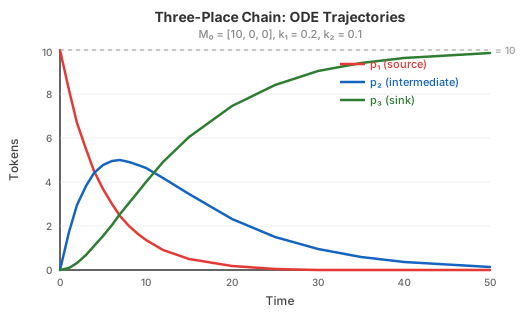
Because the system is linear, it has a closed form, which we derived by hand rather than from a solver run:
and . Tokens drain from exponentially; fills, peaks at with exactly 5 tokens, then drains into , which approaches 10. The figure plots these formulas. go-pflow checks its own solver against the same kind of closed form: TestConsistencyLinearChain in stochastic/consistency_test.go runs a three-place chain (100 tokens, rates 1 and 0.5) and requires the ODE to stay within 0.1 token of , and their complement.
The conservation law still holds — for all time — because . Tokens aren’t created or destroyed, just redistributed continuously.
What Changes, What Stays
The continuous relaxation changes the execution model (real-valued tokens, rate-based firing) but preserves the structural properties:
- Conservation laws still hold. If in the discrete case, the same identity holds in the continuous case, and the weighted token sum is constant for all time.
- The incidence matrix is identical. The structure of the net doesn’t change.
- Boundedness from P-invariants still applies.
What you gain is speed at scale. The cost of a solve depends on the number of places and transitions and on how quickly the rates make the marking change, not on how many tokens there are to move one at a time; for a linear net like the chain, multiplying the initial marking by 1,000 multiplies the solution by 1,000 without changing its time scales. And the solution gives you a smooth trajectory — the entire evolution of the system, not just a sequence of discrete snapshots.
What you lose is individual identity. Token 47 no longer exists. You have 4.3 tokens in — a concentration, an average, a continuous quantity. For capacity and throughput questions that is usually the trade-off you want; “When the Relaxation Doesn’t Apply” below covers the cases where it is not.
Numerical Integration
Most ODE systems can’t be solved analytically. Even the three-place chain above has a closed-form solution only because it’s linear. Add a synchronization transition (two inputs) and the system becomes nonlinear — the rate depends on the product of two state variables. Analytical solutions vanish.
Instead, we solve numerically: start at the initial marking, compute the derivatives, step forward in time, repeat.
Euler’s Method (and Why It’s Not Enough)
The simplest numerical method is Euler’s method:
Where is the timestep and is the derivative function. Compute the slope, take a step in that direction.
Euler’s method works but is inaccurate. Its global error is — to halve the error, you must halve the timestep and double the work. For Petri net simulations with rates spanning several orders of magnitude, tiny timesteps are needed, making Euler impractically slow.
Runge-Kutta Methods
The standard remedy is to evaluate the derivative at multiple points within each step and combine them for a better approximation. These are Runge-Kutta methods, and they’re classified by their order — the power of in the error term.
A 4th-order method (RK4) has local error per step and global error ; a 5th-order method has local error . Higher order means fewer steps for the same accuracy.
Tsit5: What go-pflow Uses
The default solver in go-pflow is Tsit5 — a 5th-order Runge-Kutta method published by Charalampos Tsitouras in 2011 (solver/tsit5.go carries the reference and the coefficients). go-pflow evaluates its seven stages every step to compute both a 5th-order solution and an embedded 4th-order one. The difference between them estimates the error.
This error estimate enables adaptive timestep control. In go-pflow’s Solve (solver/ode.go) each step goes like this:
- Compute both the 5th-order and 4th-order solutions
- Scale each place’s error estimate by and take the largest:
- If : accept the step and grow the next one by , at most fivefold and never past
Dtmax - If : reject the step and retry with a smaller one (a step already at
Dtminis accepted regardless)
The solver takes large steps where the solution is smooth and small steps where it changes rapidly. You specify the error tolerance, not the timestep, so one solver covers both a slow-draining reservoir and fast kinetics without hand-tuning the step.
In code, the three-place chain above:
net, rates := petri.Build().
    Place("p1", 10).Place("p2", 0).Place("p3", 0).
    Transition("t1").Transition("t2").
    Arc("p1", "t1", 1).Arc("t1", "p2", 1).
    Arc("p2", "t2", 1).Arc("t2", "p3", 1).
    WithCustomRates(map[string]float64{"t1": 0.2, "t2": 0.1})

prob := solver.NewProblem(net, net.SetState(nil), [2]float64{0, 50}, rates)
sol := solver.Solve(prob, solver.Tsit5(), solver.DefaultOptions())

final := sol.GetFinalState()
// closed form at t = 50: p1 ≈ 0.0005, p2 ≈ 0.13, p3 ≈ 9.87
The builder calls are those in go-pflow’s petri/builder.go, and NewProblem builds the mass-action derivative from the net’s arcs. We have not re-run this snippet for the book; the comment gives the closed-form values at , which DefaultOptions() (relative tolerance ) should reproduce to about that precision. The caller specifies the net, the rates and the time span; the solver chooses the steps.
Other Solvers
go-pflow provides several Runge-Kutta methods for different use cases:
| Solver | Order | Use Case |
|---|---|---|
Tsit5() | 5(4) | Default — best balance of speed and accuracy |
RK45() | 5(4) | Dormand-Prince — the classic MATLAB ode45 |
BS32() | 3(2) | Bogacki-Shampine — faster per step, less accurate |
RK4() | 4 | Classic fixed-step — no adaptive control |
Euler() | 1 | Forward Euler — educational only |
For most Petri net simulations, Tsit5 is the right choice. On a simple decay, go-pflow’s TestSolverMethodsProduceSimilarResults (solver/solver_test.go) requires Tsit5, RK45 and BS32 to agree within 5%. RK4() and Euler() carry no error estimator, so under adaptive options they run at a fixed step of Dt. The lower-order methods exist for comparison and for systems where function evaluations are extremely expensive.
Solver Presets
Rather than manually tuning tolerances, go-pflow provides presets for common scenarios:
solver.DefaultOptions()    // General purpose (Dt=0.01, Reltol=1e-3)
solver.FastOptions()       // Game AI, interactive (Dt=0.1, Reltol=1e-2)
solver.AccurateOptions()   // Research, publishing (Dt=0.001, Reltol=1e-6)
solver.JSParityOptions()   // Match pflow.xyz JS solver exactly
The FastOptions preset trades precision for speed, for game AI where you need many evaluations per second; its doc comment in solver/ode.go estimates a tenfold speedup, and TestFastOptionsSpeed checks only that it takes fewer steps than AccurateOptions on an SIR net. AccurateOptions tightens tolerances for publication-quality results. ode.go defines further presets (StiffOptions, EpidemicOptions, WorkflowOptions and others).
Equilibrium Detection
Many systems settle into a steady state where nothing changes anymore. The ODE solver can detect this automatically.
Equilibrium means:
All derivatives are zero. Tokens still exist, but the flow in equals the flow out at every place. The system has reached a balance.
For the three-place chain, equilibrium is , all tokens in . The trajectory approaches it as without reaching it: under the product rate law neither input place empties exactly, but both rates decay toward zero. This is a terminal equilibrium — the system winds down to a stop.
Other nets reach dynamic equilibrium where transitions still fire but the marking doesn’t change. A net with a cycle:
[p1] -> t1[k1] -> [p2] -> t2[k2] -> [p1]
reaches equilibrium when — the flow from to equals the flow back. The tokens are still moving, but the concentrations are stable.
Why Equilibrium Matters
Equilibrium tells you the long-run behavior of the system:
Capacity planning. A hospital ER at equilibrium has stable queue lengths. Those lengths tell you whether you have enough doctors, whether patients wait too long, whether the system is overloaded.
Bottleneck identification. At equilibrium, tokens accumulate before the slowest transition. A place with a high equilibrium concentration is a bottleneck — work piles up there because the downstream transition can’t keep up.
Optimization. The equilibrium value of an objective function (profit, throughput, win probability) tells you how good a configuration is. Change a rate constant, re-solve to equilibrium, compare.
In Code
go-pflow can solve until equilibrium is detected, stopping early instead of integrating to an arbitrary end time:
prob := solver.NewProblem(net, initialState, [2]float64{0, 1000}, rates)

sol, result := solver.SolveUntilEquilibrium(
    prob,
    solver.Tsit5(),
    solver.DefaultOptions(),
    solver.DefaultEquilibriumOptions(),
)

if result.Reached {
    fmt.Printf("Equilibrium at t=%.2f\n", result.Time)
    fmt.Printf("Final state: %v\n", result.State)
    fmt.Printf("Max rate of change: %e\n", result.MaxChange)
}
The equilibrium detector in solver/equilibrium.go checks the maximum absolute derivative across all places at regular intervals of accepted steps, once a minimum time has passed. When that maximum is below a tolerance (default ) at several consecutive checks, the solver declares equilibrium and stops. Presets control the sensitivity:
solver.DefaultEquilibriumOptions()  // Tolerance 1e-6, 5 consecutive checks, every 10 steps
solver.FastEquilibriumOptions()     // Tolerance 1e-4, 3 checks, every 5 steps
solver.StrictEquilibriumOptions()   // Tolerance 1e-9, 10 checks, every step
TestSolveUntilEquilibrium in solver/solver_test.go exercises this on a single decaying place and requires equilibrium to be declared before the end of the time span.
When the Relaxation Doesn’t Apply
Everything above rests on one assumption: that a transition’s firing rate is a smooth function of the current marking. That assumption is false for four common modeling constructs.
Read arcs, inhibitor arcs, reachable capacities, and guards all depend on a firing instant — a specific moment where the marking is checked against a threshold. Mass action has no such moment. It treats every input as a continuous flow, all the time, so there is no point at which it can ask “is this inhibitor’s threshold exceeded right now?” or “did this firing just hit the capacity bound?” go-pflow’s stochastic.Forecast, the continuous engine in its stochastic package, calls Model.Gating() (metamodel/firing.go) first. Gating() names these four, plus two rarer constructs (non-kinetic input arcs and fixed delays), and a capacity counts only if some transition can raise its place. When the list is not empty, Forecast refuses rather than guess (stochastic/stochastic.go):
result, err := stochastic.Forecast(model, marking, stochastic.Options{})
// Diverged: true
// Reason: this model constrains firing in ways a continuous solution cannot
// express... Use the discrete engine (Simulate).
The refusal is deliberate: the ODE has no instant at which to ask the question. A model with a capacity that the net’s own transitions can actually reach needs the discrete engine, stochastic.Simulate, which fires one event at a time and can check the bound at the instant it matters. Chapter 5 shows both sides of this line. The go-pflow coffee shop net built there declares no capacities and no guards, so the relaxation applies to it; petri-pilot’s coffee shop model, which declares shelf capacities that its restock transitions can reach, is the kind Forecast refuses. Chapter 5’s “A Caveat About the ODE” works through the difference.
Below the four gating constructs, a second and separate question is population size. On an ungated net whose input arcs all have weight 1, the discrete engine’s average over many runs follows the ODE: exactly when every transition has a single input (the chain), and approximately when a transition multiplies two inputs together, with the gap shrinking as the population grows. go-pflow’s stochastic/consistency_test.go checks both: the linear chain against its closed form, and an SIR epidemic at 1,000 and 10,000 individuals, where the relative gap must fall below 2% and shrink with size. A thousand customers served one at a time behave like a smooth curve; the discreteness averages out. Three baristas and a milk supply that runs dry five orders into a rush are a different regime. There, the variance is the answer you’re after — how often does the shop actually run dry, not what it does on average — and the ODE has no ran-dry event to count. The rule of thumb: large populations and you want the average, use the ODE; small counts and you want the distribution of outcomes, or “how often does X happen,” run the discrete engine and look at the spread across realizations.
An arc weight above 1 is not the same law, more or less precisely computed, in the two engines. The ODE’s mass-action rate multiplies the input place’s concentration into the flux once per input arc, no matter the weight — a transition that consumes 20g of beans per firing still contributes to the rate, not or any combinatorial term in 20. The discrete engine’s propensity, by contrast, uses the full combinatorial count, — the number of distinct ways to draw 20 indistinguishable tokens from however many are on hand, which is the stochastic (Gillespie) form of chemical mass action (the package comment at the top of stochastic/stochastic.go states both laws). The two conventions coincide exactly at weight 1, where there’s only one way to draw one token, and diverge for any recipe that consumes more than a single unit of an ingredient per firing. Neither is wrong — “what does the concentration do on average” and “how many indistinguishable tokens can I draw” are different questions once more than one token is consumed per firing — but don’t expect a weight-20 arc to produce quantitatively matching numbers from both engines, even on a net the ODE doesn’t refuse. go-pflow pins this disagreement in a test: on the dimerisation with 200 tokens of , TestConsistencyPreconditionIsHonest requires the discrete mean and the ODE to differ by more than one token.
A third engine sits between the two. The chemical Langevin equation — a stochastic differential equation built from the same propensities the discrete engine uses, but with continuous state — gives intrinsic firing noise: a variance band, cheap enough to sweep like the ODE because its cost does not grow with the population. go-pflow implements it as stochastic.SimulateSDE (stochastic/sde.go), and like Forecast it refuses a gated net. That is a different thing from the volatility petri-pilot’s older petri_sde tool (pkg/mcp/sde.go) adds: that tool layers exogenous geometric Brownian motion onto user-chosen “volatile” places on top of the ODE — the right tool for a DeFi price feed or an external demand shock, but noise imposed from outside the model rather than noise the net’s own structure produces. Use the SDE path when the population is too large for the discrete engine’s per-firing cost to be worth paying, but small enough that the ODE’s zero-variance answer would be misleading, and the model has no gating for the ODE to refuse over in the first place.
Choosing an Engine
| Your model has… | Use |
|---|---|
| a read arc, inhibitor, reached capacity, or guard | the discrete engine (or the ODE, and read the refusal) |
| large populations, no gating, you want the average | the ODE |
| small counts, you want the distribution or “how often does X happen” | the discrete engine |
| any input arc with weight > 1 | expect the two engines to disagree quantitatively — decide which rate law your model actually means |
| exogenous continuous uncertainty (price, demand) on top of the ODE | the volatility layer, not the relaxation itself |
| intrinsic firing noise, cheap enough to sweep | the chemical Langevin SDE |
Discrete, stochastic and continuous engines answer three different questions about the same net, and a model that answers one honestly may have nothing to say about another.
The Full Picture
The continuous relaxation transforms the Petri net from a discrete-event system into a dynamical system. The incidence matrix becomes the stoichiometry matrix. The firing rule becomes mass-action kinetics. The state equation becomes a differential equation.
The incidence matrix and every P-invariant carry over unchanged. Read arcs, inhibitors, reachable capacities and guards do not, which is why the engines above refuse nets that use them. Where it applies, the continuous form is much cheaper to simulate at large populations and opens the door to equilibrium analysis, sensitivity analysis, and gradient-based optimization.
The pattern for using continuous Petri nets is:
- Build the net — places, transitions, arcs (same as discrete)
- Assign rates — a rate constant for each transition
- Solve the ODE — from initial marking to final time or equilibrium
- Read the results — token trajectories, equilibrium values, conservation checks
The remaining chapters in this book use this pattern extensively. The coffee shop in Chapter 5 uses equilibrium analysis for capacity planning. The knapsack problem in Chapter 8 uses continuous relaxation to approximate discrete optimization. The enzyme kinetics in Chapter 9 recover classical biochemistry equations directly from the net’s structure.
In each case the mathematics is ; what changes from chapter to chapter is the net and its rates.
The Token Language
Learning objective: Use the pflow DSL to define nets with guards, roles, and typed arcs.
The first three chapters built Petri nets from mathematical primitives — places, transitions, arcs, tokens, rate constants. That’s sufficient for analysis but awkward for specification. You wouldn’t write a web application by specifying its state machine as a 5-tuple. You’d want a language.
This chapter introduces the token language — a small, interpreted DSL for defining Petri net models with rich data semantics. It extends the mathematical foundation with guards, typed state, invariants, and categorical net types, while keeping the vocabulary to exactly four terms.
The Four-Term Primitive
The token language distills to four primitives:
| Term | Maps To | Purpose |
|---|---|---|
cell | State / Place | Containers for tokens or data |
func | Action / Transition | Operations that transform state |
arrow | Arc | Flow connections with optional bindings |
guard | Predicate | Boolean conditions gating actions |
Every token model — from an ERC-20 token standard to a poker game to a hospital workflow — is expressed with these four terms. cell defines what exists. func defines what happens. arrow defines what flows where. guard defines what’s allowed.
This isn’t minimalism for its own sake: four terms is the smallest vocabulary that captures the essential structure of executable schemas. Fewer terms would lose expressiveness. More terms would add redundancy. The four-term primitive sits at the same sweet spot as Petri nets themselves: just enough structure to be useful, not so much that it obscures the model.
S-Expression Syntax
The DSL uses an S-expression syntax. Here’s a complete token model for a simplified ERC-20 token:
(schema ERC-20
  (version v1.0.0)

  (state totalSupply :type uint256)
  (state balances :type map[address]uint256 :exported)
  (state allowances :type map[address]map[address]uint256)

  (action transfer :guard {balances[from] >= amount && to != address(0)})
  (action approve)
  (action mint :guard {to != address(0)})
  (action burn :guard {balances[from] >= amount})

  (arc balances -> transfer :keys (from))
  (arc transfer -> balances :keys (to))
  (arc mint -> totalSupply)
  (arc totalSupply -> burn)

  (constraint conservation {sum(balances) == totalSupply}))
Each form declares structure:
statedeclares a cell with a name and type. The:exportedkeyword marks states that are visible across schema boundaries.actiondeclares a func, optionally with a guard expression in braces.arcdeclares an arrow between a state and an action (or vice versa). The->is syntactic sugar for the direction.:keysspecifies map access paths for data states.constraintdeclares an invariant — a property that must hold after every state transition.
The syntax is deliberately simple. No variable declarations, no control flow, no modules. The structure of the model is visible in the shape of the text.
In Go
The same model can be constructed with a fluent builder API:
schema := dsl.Build("ERC-20").
    Version("v1.0.0").
    Data("totalSupply", "uint256").
    Data("balances", "map[address]uint256").Exported().
    Data("allowances", "map[address]map[address]uint256").
    Action("transfer").Guard("balances[from] >= amount && to != address(0)").
    Action("approve").
    Action("mint").Guard("to != address(0)").
    Action("burn").Guard("balances[from] >= amount").
    Flow("balances", "transfer").Keys("from").
    Flow("transfer", "balances").Keys("to").
    Flow("mint", "totalSupply").
    Flow("totalSupply", "burn").
    Constraint("conservation", "sum(balances) == totalSupply").
    MustSchema()
Both representations — S-expression and builder — produce the same executable schema. The S-expression is better for reading and sharing. The builder is better for programmatic construction and code generation.
Guards and Conditional Firing
In a basic Petri net, a transition fires whenever its input places have enough tokens. Guards add a second condition: even if tokens are available, the transition fires only when its guard expression evaluates to true.
Expression Syntax
Guards support a familiar expression language:
Comparison:    balances[from] >= amount
               to != address(0)

Logical:       condition1 && condition2
               condition1 || condition2
               !condition

Indexing:      balances[key]
               allowances[owner][spender]

Field access:  schedule.revocable
               data.timestamp

Functions:     sum(balances)
               count(owners)
               address(0)
The evaluator uses short-circuit evaluation — && stops on the first false, || stops on the first true — so guards with early-exit conditions are efficient.
Guard vs. Invariant
Both guards and invariants are boolean expressions, but they serve different purposes and fire at different times:
| Aspect | Guard | Invariant |
|---|---|---|
| When checked | Before action fires | After state update |
| On failure | Action is blocked | Transaction rolls back |
| Purpose | Precondition | System property |
| Scope | Single action | Entire schema |
A guard asks: “Is this action allowed right now?” An invariant asks: “Did this action break anything?”
For the ERC-20 transfer, the guard balances[from] >= amount prevents overdrafts. The invariant sum(balances) == totalSupply catches any bug that would create or destroy tokens. The guard is the first line of defense; the invariant is the safety net.
Evaluation Context
Guards evaluate against a context containing three things:
- Bindings — variable values from the action’s parameters (
from,to,amount) - Functions — built-in aggregates and custom functions (
sum,count,address) - State — the current snapshot for data access
When the guard balances[from] >= amount runs, from is resolved from the bindings, balances is resolved from the current state, and >= performs the comparison. Missing map keys default to zero — accessing balances[nonexistent] returns 0 rather than an error.
Weighted Arcs and Inhibitor Arcs
Basic arcs have an implicit weight of 1 — one token consumed, one token produced. Weighted arcs generalize this.
Weighted Arcs
An arc with weight from a place to a transition means “this transition consumes tokens from this place when it fires.” An arc with weight from a transition to a place means “this transition produces tokens in this place when it fires.”
In the token language, arc weights appear in the schema definition. A coffee recipe that requires 2 units of water and 1 unit of grounds:
(state water :kind token :initial 10)
(state grounds :kind token :initial 5)
(state coffee :kind token :initial 0)

(action brew)

(arc water -> brew :value 2)
(arc grounds -> brew :value 1)
(arc brew -> coffee :value 1)
The brew action consumes 2 water and 1 grounds, producing 1 coffee. The enabling condition requires and .
Inhibitor Arcs
An inhibitor arc is the opposite of a normal arc: it prevents a transition from firing when the source place has tokens, rather than when it doesn’t. Drawn as an arc with a small circle instead of an arrowhead, an inhibitor arc from place to transition means “ can only fire when is empty.”
Inhibitor arcs add expressiveness beyond standard Petri nets. They can test for zero — something that basic Petri nets cannot do. This makes inhibitor nets Turing-complete, at the cost of losing some decidability results.
In practice, inhibitor arcs model capacity limits and mutual exclusion. A buffer with maximum capacity 5:
(state buffer :kind token :initial 0)
(state empty_slots :kind token :initial 5)

(action produce)
(action consume)

(arc empty_slots -> produce :value 1)
(arc produce -> buffer :value 1)
(arc buffer -> consume :value 1)
(arc consume -> empty_slots :value 1)
This uses a complementary place (empty_slots) rather than an inhibitor arc — a common pattern that achieves the same effect while staying within the standard Petri net formalism. The P-invariant is maintained by the net’s structure.
Tokens vs. Data
The token language distinguishes two kinds of state, reflecting two fundamentally different ways that places hold information.
TokenState
Integer counters representing discrete quantities. This is classic Petri net semantics:
- Firing consumes and produces tokens
- The enabling condition checks token counts
- Tokens are fungible — we track counts, not identities
A place with kind: token behaves exactly like a mathematical Petri net place. Tokens are integers. Arcs carry weights. Conservation laws hold.
DataState
Typed containers holding structured data — maps, records, scalar values. This extends Petri nets to handle real-world state:
- Arc keys specify access paths (
balances[from]) - Data arcs read and write; they don’t consume
- Types are explicit (
map[address]uint256,bool,string)
A place with kind: data holds a value, not a count. The balances place in the ERC-20 schema holds a map from addresses to amounts. The transfer action doesn’t consume the map — it reads from one key and writes to another.
The combination of TokenState and DataState lets you model systems where both control flow (tokens tracking “where we are”) and data transformations (balances, permissions, configuration) matter. A workflow token tracks the order through pending → confirmed → shipped. Data states track the order’s contents, the customer’s address, the payment amount.
Categorical Net Types
Not all Petri nets are alike. An order-processing workflow and an epidemiological simulation both use places, transitions, and arcs, but their tokens mean fundamentally different things. Net types classify Petri nets by how their tokens behave, what invariants hold, and how they compose.
The Five Types
| Type | Token Semantics | Invariant |
|---|---|---|
| WorkflowNet | Single control-flow token (cursor) | Mutual exclusion — cursor in exactly one state |
| ResourceNet | Countable inventory tokens | Conservation — total tokens constant |
| GameNet | Turn-based tokens with player roles | Both mutual exclusion and conservation |
| ComputationNet | Continuous quantities via ODE rates | Rate conservation at steady state |
| ClassificationNet | Signal tokens with threshold activation | Threshold firing conditions |
WorkflowNet. A single token traces a path through states. An order moves through pending → confirmed → shipped → delivered. The token is a cursor — it marks where you are in a sequential process. WorkflowNets are finite state machines with the structural advantage that parallelism (multiple concurrent tokens) is expressible.
ResourceNet. Tokens represent countable, fungible things: inventory items, currency, capacity slots. A warehouse has 100 tokens in available, consumed by reserve and produced into reserved. The total is conserved — the P-invariant guarantees that nothing is created or destroyed.
GameNet. Tokens encode both game state and turn structure. In tic-tac-toe, empty cells hold tokens consumed when a player moves. A turn-control token alternates between players. GameNets combine WorkflowNet sequencing (turns) with ResourceNet accounting (board positions).
ComputationNet. Tokens are continuous, not discrete. Transitions fire at rates — mass-action kinetics from Chapter 3. An SIR epidemic model is a ComputationNet: the infection rate depends on the product of susceptible and infected populations.
ClassificationNet. Tokens accumulate as evidence. Transitions fire when enough tokens accrue — a threshold. A spam filter accumulates signal tokens from heuristics (suspicious sender, keyword matches, link density) and fires classify_spam when the threshold is met.
Why Types Matter
At the structural level, all five types are Petri nets. The type annotations matter because they constrain composition. When you connect two nets, the types determine what connections are valid:
- An EventLink connects transitions to transitions across schemas — when one fires, the other fires too
- A DataLink connects places to places — read-only observation across schema boundaries
- A TokenLink transfers tokens between schemas — resource coupling with cross-boundary conservation
- A GuardLink gates a transition in one schema on a place in another — constraint coupling
Types make the composition rules explicit. You can’t accidentally link a workflow cursor to an inventory counter. The type system prevents semantic nonsense at the structural level.
Composition
Real systems are compositions of multiple nets. An order system combines a WorkflowNet (order lifecycle) with a ResourceNet (inventory), linked by EventLinks:
Orders (WorkflowNet):    pending -> confirm -> confirmed -> ship -> shipped
Inventory (ResourceNet): available -> reserve -> reserved -> ship_out -> consumed
EventLinks:
orders.confirm → inventory.reserve— confirming reserves stockorders.ship → inventory.ship_out— shipping consumes reserved stock
Each schema carries its own verified properties. The Orders WorkflowNet guarantees mutual exclusion (the order is in exactly one state). The Inventory ResourceNet guarantees conservation (total stock is constant). These properties hold independently — adding links doesn’t invalidate either guarantee.
This is assume-guarantee reasoning: each component is verified in isolation, and composition only needs to check the boundaries. Flattening the composed net and recomputing its P-invariants recovers both component laws — pending + confirmed + shipped == 1 and available + reserved + consumed == N — from the incidence matrix of the whole, so neither guarantee was lost.
Composition is associative and commutative: the result depends on which nets and links you declared, never on the order you declared them in.
It is not monotonic, and it is worth being precise about why. Adding an unlinked schema is the monoidal product — the two nets share nothing, so each behaves exactly as it did alone. But adding a link restricts. An EventLink is a rendezvous: the fused transition fires only when every participant is enabled, so inventory.reserve can no longer fire whenever stock exists — it must wait for an order to confirm. A GuardLink gates by construction. A TokenLink introduces a shared place that constrains its consumers. Each of these removes behavior rather than adding it. In the example above, Inventory alone reaches 66 states; composed with Orders it reaches 3.
What survives is refinement: every firing sequence of the composite, projected onto a component’s alphabet, is a firing sequence of that component alone. That is the property assume-guarantee actually needs, and it is what preserves safety — invariants, mutual exclusion, conservation. It does not preserve liveness: a component that could always eventually fire may, once linked, wait forever on a partner. Adding a link cannot make a composed system reach a state its components forbid, but it can certainly stop it reaching one they allow.
The Execution Pipeline
From source text to running model, the token language follows a classic interpreter pipeline:
- Lexer — tokenizes source into
LPAREN,RPAREN,SYMBOL,GUARD,KEYWORD,ARROW - Parser — builds an AST with
SchemaNode,StateNode,ActionNode,ArcNode,ConstraintNode - Interpreter — converts the AST to an executable
Schemawith validated references - Runtime — executes actions: guard check → input processing → output processing → invariant check → commit
Each action execution follows a strict sequence:
- Guard check: evaluate the guard expression with current bindings and state
- Input processing: consume tokens from input arcs, bind data from data arcs
- Output processing: produce tokens at output arcs, update data at data arcs
- Invariant check: verify all constraints still hold
- Commit: update the snapshot with an incremented sequence number
If the guard fails, the action is blocked — nothing changes. If an invariant fails after the state update, the entire transaction rolls back. The sequence number provides an optimistic concurrency control mechanism: clients can detect stale state by comparing sequence numbers.
schema, err := dsl.ParseSchema(`
  (schema Counter
    (state count :kind token :initial 10)
    (state done :kind token :initial 0)
    (action decrement :guard {tokens(count) > 0})
    (arc count -> decrement)
    (arc decrement -> done))
`)
The ParseSchema function runs the full pipeline — lexing, parsing, interpretation, and validation — returning an executable schema or an error.
Putting It Together
The token language adds three layers on top of the mathematical Petri net:
- Guards and invariants — conditional firing and conservation enforcement
- Typed state — TokenState for discrete counts, DataState for structured values
- Net types and composition — categorical classification with typed links
These layers don’t replace the mathematics; they organize it. The incidence matrix, state equation, and P-invariants from Chapters 2 and 3 still apply. Guards add preconditions. Invariants add postconditions. Types add composition rules.
The four-term vocabulary — cell, func, arrow, guard — is the interface between human intent and the mathematical machinery. You describe the model in these terms. The machinery handles the rest.
Part II of this book uses the token language extensively. Each application chapter defines its model in this DSL, simulates it with the ODE solver from Chapter 3, and analyzes it with the structural tools from Chapter 2. The language is the common thread — the same four terms, applied to coffee shops, game boards, constraint puzzles, biochemical pathways, and poker tables.
Resource Modeling — The Coffee Shop
Learning objective: Model inventory, throughput, and bottlenecks as token flow.
The first four chapters built the machinery: bipartite graphs, incidence matrices, ODEs, a DSL. Now we use it. This chapter models a coffee shop — ingredients, recipes, orders, capacity limits — as a Petri net. The model answers operational questions: When do we run out of beans? Which drink creates the worst bottleneck? How should we staff during peak hours?
The coffee shop is a ResourceNet in the categorical vocabulary from Chapter 4. Tokens represent fungible quantities — grams of beans, milliliters of milk, cups. Conservation laws guarantee that nothing is created or destroyed without an explicit transition. The continuous relaxation from Chapter 3 turns the model into a capacity planning tool.
The Problem
A coffee shop has limited inventory. Different drinks consume ingredients at different rates:
| Drink | Beans | Water | Milk | Syrup | Cups |
|---|---|---|---|---|---|
| Espresso | 18g | 30ml | — | — | 1 |
| Americano | 18g | 200ml | — | — | 1 |
| Latte | 18g | 30ml | 180ml | — | 1 |
| Cappuccino | 18g | 30ml | 120ml | — | 1 |
| Mocha | 18g | 30ml | 150ml | 2 pumps | 1 |
Starting inventory: 1,000g beans, 5,000ml milk, 10,000ml water, 500 pumps of syrup, 100 cups.
The questions are straightforward. Which ingredient runs out first? How many drinks can we serve before something depletes? If we increase latte production, what’s the knock-on effect on bean consumption?
You could answer these with a spreadsheet. But a spreadsheet gives you static arithmetic — multiply rates by time. A Petri net gives you dynamics — rates that change as resources deplete, multiple transitions competing for the same inputs, bottlenecks emerging from structure rather than being hard-coded.
Defining the Net
The coffee shop net has three categories of places:
Ingredient places hold the current stock. Each starts with an initial token count representing the inventory on hand:
coffee_beans: 1000    (grams)
milk:         5000    (milliliters)
water:        10000   (milliliters)
cups:         100
syrup:        500     (pumps)
Consumption tracking places count what’s been used. They start at zero and accumulate as drinks are made:
beans_used:  0
milk_used:   0
water_used:  0
cups_used:   0
syrup_used:  0
Transitions represent drink preparation — one per drink type:
make_espresso
make_americano
make_latte
make_cappuccino
make_mocha
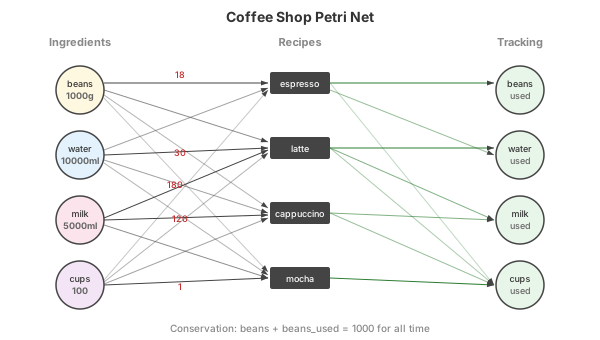
The bipartite structure is clean: ingredient places connect to transitions (input arcs), and transitions connect to tracking places (output arcs). No place connects to another place. No transition connects to another transition. The Petri net enforces this separation by construction.
In Code
The code in this chapter is adapted from NewInventoryNet in go-pflow’s examples/coffeeshop/inventory.go. That net is larger than the one built here: it adds an iced latte (200ml milk), a sugar-packet condiment and a refill transition for every ingredient. The chapter keeps the five drinks in the table above, so its numbers are for the five-drink net.
net := petri.NewPetriNet()

// Ingredient places
net.AddPlace("coffee_beans", 1000, nil, 100, 100, nil)
net.AddPlace("milk", 5000, nil, 100, 200, nil)
net.AddPlace("water", 10000, nil, 100, 300, nil)
net.AddPlace("cups", 100, nil, 100, 400, nil)
net.AddPlace("syrup", 500, nil, 100, 600, nil)

// Tracking places
net.AddPlace("beans_used", 0, nil, 300, 100, nil)
net.AddPlace("milk_used", 0, nil, 300, 200, nil)
net.AddPlace("water_used", 0, nil, 300, 300, nil)
net.AddPlace("cups_used", 0, nil, 300, 400, nil)
net.AddPlace("syrup_used", 0, nil, 300, 600, nil)
Each place gets an initial token count. The tracking places start at zero — they’re sinks that accumulate evidence of consumption. Together with the ingredient places, they form a conservation system: every bean consumed from coffee_beans appears in beans_used.
Weighted Arcs as Recipes
Each drink requires specific quantities of ingredients. The arc weights encode these recipes directly in the net’s structure.
For espresso — 18g beans, 30ml water, 1 cup:
net.AddTransition("make_espresso", "consume", 200, 150, nil)

// Input arcs (consumption)
net.AddArc("coffee_beans", "make_espresso", 18, false)
net.AddArc("water", "make_espresso", 30, false)
net.AddArc("cups", "make_espresso", 1, false)

// Output arcs (tracking)
net.AddArc("make_espresso", "beans_used", 18, false)
net.AddArc("make_espresso", "water_used", 30, false)
net.AddArc("make_espresso", "cups_used", 1, false)
For a latte — 18g beans, 30ml water, 180ml milk, 1 cup:
net.AddTransition("make_latte", "consume", 200, 350, nil)

net.AddArc("coffee_beans", "make_latte", 18, false)
net.AddArc("water", "make_latte", 30, false)
net.AddArc("milk", "make_latte", 180, false)
net.AddArc("cups", "make_latte", 1, false)

net.AddArc("make_latte", "beans_used", 18, false)
net.AddArc("make_latte", "water_used", 30, false)
net.AddArc("make_latte", "milk_used", 180, false)
net.AddArc("make_latte", "cups_used", 1, false)
The arc weight from milk to make_latte is 180. This means make_latte is enabled only when . Each firing consumes 180 tokens from milk and produces 180 tokens in milk_used. The recipe is the arc structure — no separate configuration needed.
The Incidence Matrix
The incidence matrix for the full model captures every recipe in a single data structure. Each column is a drink type. Each row is an ingredient (or tracking place). Reading column make_latte:
Negative entries are consumption. Positive entries in the tracking rows mirror them:
Conservation Laws
The paired structure — every token consumed from an ingredient place appears in the corresponding tracking place — creates P-invariants. For coffee beans:
For milk:
These hold for all time, under any firing sequence. The conservation law is structural — it follows from the arc weights summing to zero across each ingredient/tracking pair. No beans are created or destroyed. They’re consumed from stock into the “used” counter.
This is the Petri net equivalent of double-entry bookkeeping. Every debit (consumption) has a matching credit (tracking). The invariant is the balance equation.
ODE Simulation for Capacity Planning
With the net defined, the continuous relaxation from Chapter 3 turns it into a dynamical system. Each transition gets a rate constant; InventoryRates() in inventory.go labels them drinks per minute at peak:
rates := map[string]float64{
    "make_espresso":   0.5,  // 30/hr
    "make_americano":  0.3,  // 18/hr
    "make_latte":      0.8,  // 48/hr — most popular
    "make_cappuccino": 0.4,  // 24/hr
    "make_mocha":      0.2,  // 12/hr
}
go-pflow’s solver (solver/ode.go) computes each transition’s flux as its rate constant times the first power of every input place, and the arc weight scales only how much each firing consumes:
The weight 18 on the bean arc does not become an 18th power; chemistry’s mass-action law would raise each input to its stoichiometric coefficient, and go-pflow deliberately does not.
Scaling for Stability
Even with first powers, the product of four or five large stocks is enormous: 1,000 × 10,000 × 5,000 × 100 for a latte. Mass-action kinetics was designed for chemical concentrations, which are small numbers; coffee shop inventory has large integer token counts. The example’s simulation.go multiplies every rate constant by the same small factor:
scaledRates := make(map[string]float64)
for k, v := range rates {
    scaledRates[k] = v * 0.0001
}

prob := solver.NewProblem(net, initialState, [2]float64{0, duration}, scaledRates)
opts := solver.DefaultOptions()
opts.Dt = 0.001

sol, eqResult := solver.SolveUntilEquilibrium(
    prob, solver.Tsit5(), opts, nil,
)
Multiplying every rate constant by the same factor stretches the time axis and changes nothing else: the trajectory passes through the same markings in the same order, only on a different clock. The example’s comment gives numerical stability as the reason for the scaling; mathematically, it is a choice of time units.
What scaling cannot undo is the reweighting the product causes. Because the stocks multiply into the flux, a drink’s ODE flux depends on how many ingredients it uses, not just on its . At the initial marking (derived by hand from the rate law, not re-run):
- , from latte’s extra milk factor
- , from mocha’s extra syrup factor
So in the ODE the rate constants are not drinks per minute, and the drink mix is not 0.8 lattes to every 0.5 espressos. The drinks-per-minute reading belongs to the linear estimate in the next section.
What the Model Predicts
Which stock goes first follows from how much of each stock a single drink takes. A milk drink takes 120–180ml of 5,000ml milk (2.4–3.6%), 18g of 1,000g beans (1.8%), one of 100 cups (1%) and 30ml of 10,000ml water (0.3%). The ordering is:
- Milk goes first. Three of the five drinks draw on it, about 222ml per minute at the baseline rates, so 5,000ml lasts roughly 23 minutes on the linear estimate. As milk runs low, all three milk drinks stall, because milk is a factor in each of their fluxes.
- Coffee beans go next. Every drink uses 18g, 1,000g supports about 55 drinks, and once the milk drinks stall only espresso and americano still draw on them.
- Cups never come close. 100 cups at 2.2 drinks per minute would last 45 minutes if nothing else ran out, but milk and then beans run out first.
- Water lasts longest: 10,000ml, with every drink except the americano using 30ml.
Cups are the smallest number, so intuition says they go first. They do not, because the weights decide it: a latte takes 180 tokens of milk and one token of cups.
Under product kinetics no place reaches exactly zero. Each stock decays toward zero and every transition that reads it slows down with it, so “goes first” here means “falls fastest”. The minute figures above are linear estimates. A committed ODE run that gives the same order, with its own clock, is not yet part of the example.
The conservation laws hold at every point of an ODE trajectory, because the solver adds to beans_used for every it takes from coffee_beans:
Checking this sum in the solver output is a quick test that the arcs were wired correctly.
Predicting Runout
Rather than running the full ODE, we can estimate depletion times from the rates and arc weights, reading each rate constant as drinks per minute. This is a condensed version of PredictRunout in simulation.go, which also covers the iced latte, water and sugar:
consumptionRates := map[string]float64{
    "coffee_beans": 18 * (rates["make_espresso"] +
                          rates["make_americano"] +
                          rates["make_latte"] +
                          rates["make_cappuccino"] +
                          rates["make_mocha"]),
    "milk": 180*rates["make_latte"] +
            120*rates["make_cappuccino"] +
            150*rates["make_mocha"],
    "cups": rates["make_espresso"] +
            rates["make_americano"] +
            rates["make_latte"] +
            rates["make_cappuccino"] +
            rates["make_mocha"],
    "syrup": 2 * rates["make_mocha"],
}

for ingredient, rate := range consumptionRates {
    runoutTime := currentStock[ingredient] / rate
    fmt.Printf("%s depletes in %.0f minutes\n", ingredient, runoutTime)
}
With the baseline rates the arithmetic can be checked by hand:
| Ingredient | Draw per minute | Stock | Linear runout |
|---|---|---|---|
| milk | 180(0.8) + 120(0.4) + 150(0.2) = 222 ml | 5,000 ml | ≈ 23 min |
| coffee_beans | 18 × 2.2 = 39.6 g | 1,000 g | ≈ 25 min |
| cups | 2.2 | 100 | ≈ 45 min |
| water | 30(0.5 + 0.8 + 0.4 + 0.2) + 200(0.3) = 117 ml | 10,000 ml | ≈ 85 min |
| syrup | 2 × 0.2 = 0.4 pumps | 500 | ≈ 1,250 min |
The linear estimate assumes every drink keeps its rate until a stock hits zero. The ODE instead slows each transition as its inputs decline. The two should agree on the order, which follows from the per-drink fractions above, but not on the timings. In this model they do not even share a clock, because the ODE’s rate constants are not drinks per minute (see “Scaling for Stability”).
Bottleneck Analysis from Equilibrium
When the ODE reaches steady state (), the marking shows where tokens are left over, and the path to that state shows the order in which the bottlenecks hit.
In the coffee shop, equilibrium means every drink transition has stalled because at least one of its inputs is near zero. Water, cups and syrup are still on hand at that point. The bottleneck sequence is:
- First bottleneck: Milk (three drinks, heavy weights — 222ml/min at baseline)
- Second bottleneck: Beans (every drink needs 18g, and after the milk drinks stall, espresso and americano keep drawing on them)
- Cups and water never become the bottleneck at these rates
Scenario Analysis
Change the rates to model different days. The minute figures below are linear estimates, computed from the table above:
Slow day — halve all rates:
rates["make_latte"] = 0.4 // 24/hr instead of 48; likewise for the others
Every runout time doubles: milk lasts about 45 minutes and beans about 50. Halving demand delays the bottleneck but keeps it in the same place, and 5,000ml of milk still does not last a shift.
Rush hour — double all rates:
rates["make_latte"] = 1.6 // 96/hr
Milk depletes in half the time — about 11 minutes on the linear estimate. Beans follow.
Latte promotion — triple latte rate, keep others constant:
rates["make_latte"] = 2.4 // 144/hr
Milk was already the first bottleneck; now it is a sharper one. Consumption rises to about 510ml per minute, so 5,000ml lasts roughly 10 minutes on the linear estimate. Beans deplete sooner too — every extra latte costs 18g, and the other drinks keep their own (unchanged) rates — down from about 25 minutes to about 15.
Each scenario is the same net with different rate constants. The structure — places, arcs, weights — stays the same. Only the dynamics change.
Sensitivity Analysis
go-pflow includes sensitivity analysis that systematically evaluates which rate changes have the biggest impact:
scorer := sensitivity.FinalStateScorer(func(final map[string]float64) float64 {
    return final["cups_used"]  // maximize drinks served
})

analyzer := sensitivity.NewAnalyzer(net, state, rates, scorer).
    WithTimeSpan(0, 60)

result := analyzer.AnalyzeRatesParallel()
This is the core of OptimalDrinkMix in simulation.go. The analyzer perturbs each rate individually, simulates the ODE, and ranks transitions by their impact on the scoring function. A shop owner would read the ranking as a list of where added capacity buys the most throughput.
The ranking itself is not reproduced here. No test in the example pins its output, and it has not been re-run for this chapter. The flux ratios in “Scaling for Stability” also mean the ODE’s ranking need not follow the rate constants’ order of popularity, because each extra input stock multiplies into a drink’s flux.
Restocking and Capacity Limits
A real coffee shop doesn’t run until depletion — it restocks. The Petri net models this with refill transitions that move tokens from supply places into ingredient places:
// Supply places (incoming inventory)
net.AddPlace("beans_supply", 0, nil, 500, 100, nil)
net.AddPlace("milk_supply", 0, nil, 500, 200, nil)

// Refill transitions
net.AddTransition("refill_beans", "refill", 400, 100, nil)
net.AddArc("beans_supply", "refill_beans", 500, false)
net.AddArc("refill_beans", "coffee_beans", 500, false)

net.AddTransition("refill_milk", "refill", 400, 200, nil)
net.AddArc("milk_supply", "refill_milk", 1000, false)
net.AddArc("refill_milk", "milk", 1000, false)
The supply places start at zero — no restocking scheduled. When external events add tokens to beans_supply (a delivery arrives), the refill_beans transition becomes enabled and transfers 500g into the active inventory.
With refills in the net, the two-place law no longer holds: refill_beans adds 500 to coffee_beans without touching beans_used. The invariant widens to three places. refill_beans moves 500 from supply to stock and every drink moves 18 from stock to used, so for the vector that is 1 on all three bean places, :
A delivery is not a transition. It is an external change to the marking that raises . Between deliveries, the law tells you whether beans leak; comparing successive values of with beans_used tells you whether deliveries keep up with consumption.
Low-Stock Alerts
The model can trigger alerts based on inventory thresholds (abridged from CheckLowStock in inventory.go, which also watches water, sugar and syrup):
func CheckLowStock(state map[string]float64) map[string]bool {
    thresholds := map[string]float64{
        "coffee_beans": 100,  // 100g ~ 5 drinks
        "milk":         500,  // 500ml ~ 3 lattes
        "cups":         10,
    }

    alerts := make(map[string]bool)
    for ingredient, threshold := range thresholds {
        if state[ingredient] < threshold {
            alerts[ingredient] = true
        }
    }
    return alerts
}
In a guard-based formulation (Chapter 4), these thresholds would be guards on the make transitions:
(action make_latte :guard {tokens(coffee_beans) >= 118 && tokens(milk) >= 680})
The guard checks not just whether there’s enough for this drink, but whether stock is above the alert threshold plus one recipe’s worth (100 + 18 and 500 + 180). This is precautionary guarding: production stops before the resource reaches critical levels. A guard is evaluated at a firing instant, though, and that has a consequence for which engine can run the model.
A Caveat About the ODE
Everything in this chapter so far ran on the continuous relaxation from Chapter 3. The net built here qualifies for it. Its places declare no capacities (the third argument to every AddPlace is nil), and it has no read arcs, inhibitors or guards, so none of the four constructs that Chapter 3’s “When the Relaxation Doesn’t Apply” lists is present.
Two small changes would remove it from that safe ground. Adding the precautionary guard above is one. Turning the Max… constants into real shelf capacities on the ingredient places is the other: refill_beans can then push coffee_beans against its bound, which is a reachable capacity rather than a bound that is declared and never approached. petri-pilot’s coffee shop model, services/coffeeshop.json, which the live demo at the end of this chapter is generated from, has exactly this shape: its inventory places declare a capacity (2,000g beans, for example) and its restock transitions add to them. go-pflow’s stochastic.Forecast, the continuous engine in its stochastic package, checks Model.Gating() and refuses such a model, because mass action has no firing instant at which to ask “did this refill just hit the cap?” The discrete engine, stochastic.Simulate, fires one event at a time and can check the bound when it matters.
Population size matters too, even without gating. A thousand grams of beans drawn down 18 at a time is the large-population case the ODE is built for, and there the average is the useful number. A shop that stocks four shots’ worth of beans overnight and wants to know how often it runs dry before the morning delivery is asking a different question: how much a single night varies. That calls for stochastic.Simulate, run across enough realizations to see the spread, rather than one solver run. The net and the recipes stay the same, and only the question changes. As Chapter 3 notes, the two engines also handle an arc weight above 1 differently. The ODE takes once into the flux of an 18g espresso, while the discrete engine’s propensity counts the ways to draw 18 tokens, so they will not agree quantitatively on this recipe.
Full Day Simulation
The last analysis simulates a whole business day with varying demand. This is a sketch of RunDaySimulation in simulation.go, with the hourly bookkeeping folded into helper functions:
func RunDaySimulation(peakHours []int, baseRate float64) {
    currentState := initialState

    for hour := 6; hour <= 20; hour++ {
        multiplier := 1.0
        for _, peak := range peakHours {
            if hour == peak {
                multiplier = 2.5  // Rush hour
                break
            }
            if hour == peak-1 || hour == peak+1 {
                multiplier = 1.5  // Shoulder hours
            }
        }

        // each rate × baseRate × multiplier × 0.0001
        rates := scaleRates(InventoryRates(), baseRate * multiplier)

        prob := solver.NewProblem(net, currentState,
            [2]float64{0, 60}, rates)
        sol := solver.Solve(prob, solver.Tsit5(), solver.FastOptions())
        currentState = sol.GetFinalState()

        stats := computeHourlyStats(currentState)
        fmt.Printf("%02d:00  %4s  drinks: %d  beans: %.0fg  alerts: %v\n",
            hour, rateLabel(multiplier), stats.drinks, stats.beans, stats.alerts)
    }
}
The example’s command-line demo (examples/coffeeshop/cmd/main.go) calls it with peaks at 8am, noon and 5pm. Each peak hour runs at 2.5× the base rate and the hours on either side at 1.5×. Nothing adds tokens to the supply places, so the refill transitions never fire, and the day’s report shows how far the opening stock goes and in which hour the low-stock alerts start. That hourly table has not been re-run for this chapter. Given the depletion order above, the first alerts should come from milk.
The solver handles each hour independently: the final state of one hour becomes the initial state of the next. FastOptions() trades precision for speed, with looser tolerances (10⁻²) and an iteration cap of 1,000, which suits fifteen short solves in a row.
From Model to Application
The coffee shop model demonstrates a development pattern that recurs throughout this book:
- Define the net — places for resources, transitions for operations, weighted arcs for recipes
- Verify structure — check P-invariants (does the model conserve resources?), check for deadlocks (can the system get stuck?
AnalyzeInventoryReachabilityinsimulation.goruns a bounded search) - Simulate dynamics — run the ODE to see how resources flow over time, after checking that the model has nothing the ODE would have to refuse
- Analyze bottlenecks — read the depletion order and sensitivity rankings
- Build the application — use the verified model as the backend for operational decisions
The net serves as the system’s specification rather than as an approximation of it: the arc weights are the recipes and the conservation laws are the accounting rules. A change to the model is a change to the system it specifies.
This is the ResourceNet pattern: tokens count fungible things, arc weights specify recipes, conservation laws guarantee integrity, and ODE simulation answers capacity questions for large, ungated stocks. The same pattern applies wherever a system counts things, such as inventory, budgets, resource schedules and supply chains.
Try it live: The Coffee Shop model at pilot.pflow.xyz is petri-pilot’s version: three drinks, an order-to-serve workflow, and capped inventory with restock transitions. It is a different net from the five-drink one in this chapter, so its numbers will differ.
The next chapter applies a different pattern — the GameNet — to tic-tac-toe, where tokens encode board positions and turn order, and the hypothesis evaluator finds optimal moves.
Game Mechanics — Tic-Tac-Toe
Learning objective: Encode board positions, turns, and win conditions as token flow; use ODE simulation for move evaluation without game-specific heuristics.
The coffee shop modeled resources — fungible tokens flowing through recipes. This chapter models a game — structured tokens encoding board state, turn order, move history, and win detection. The Petri net is the same formalism, but the pattern is fundamentally different: a GameNet instead of a ResourceNet.
The central insight: strategic value emerges from model topology alone. We don’t code “prefer the center” or “block two-in-a-row.” The Petri net’s structure — which positions participate in more winning patterns — creates these preferences automatically through the ODE dynamics. The model discovers tic-tac-toe strategy the way mass-action kinetics discovers chemical equilibrium: by following the rates.
The Board as Places
A tic-tac-toe board has nine cells. Each cell is a place, initialized with one token meaning “available”:
P00: 1    P01: 1    P02: 1
P10: 1    P11: 1    P12: 1
P20: 1    P21: 1    P22: 1
The naming convention is P{row}{col}, zero-indexed. P00 is the top-left corner, P11 is the center, P22 is the bottom-right corner.
When a player claims a cell, the token is consumed from the position place. An empty place () means the cell is occupied. This is the enabling condition in action: a move transition for cell requires . Once the token is consumed, no other transition can claim that cell. The bipartite structure of the Petri net enforces the rule “you can’t play in an occupied cell” without any conditional logic.
Turn Control via Mutual Exclusion
Tic-tac-toe alternates between X and O. A single place Next controls whose turn it is:
Next = 0means X’s turnNext = 1means O’s turn
Each X move transition produces a token into Next:
P_ij  -->  PlayX_ij  -->  X_ij
                      -->  Next
Each O move transition consumes a token from Next:
Next  -->  PlayO_ij  -->  O_ij
P_ij  -->
X goes first (Next starts at 0, so O transitions are blocked). After X plays, Next becomes 1, enabling O. After O plays, Next returns to 0. The alternation is structural — no turn counter, no modular arithmetic, just a token bouncing between “available” and “consumed.”
This is the same mutual exclusion pattern from the traffic intersection in Chapter 1. The Next token is a shared resource that enforces sequential access, exactly like the shared token that prevents both lights from being green simultaneously.
History Places for Pattern Detection
The basic model tracks where tokens are (board state) but not where they came from (move history). Adding history places upgrades the model from “what’s on the board” to “who played where.”
For each cell, two history places record which player claimed it:
X00, X01, X02, ..., X22    (9 places — X's moves)
O00, O01, O02, ..., O22    (9 places — O's moves)
When X plays at position (1,1):
- Consume token from
P11(cell becomes occupied) - Produce token in
X11(record X played here) - Produce token in
Next(pass turn to O)
When O plays at position (0,2):
- Consume token from
Next(it’s O’s turn) - Consume token from
P02(cell becomes occupied) - Produce token in
O02(record O played here)
The history layer doesn’t change the game mechanics — it adds information without altering what moves are legal. But it enables win detection, which needs to know not just that a cell is occupied, but which player occupies it.
It also makes visible a split that every executing model in this book has, and that this net is small enough to show whole. The history places are write-once: a token arrives and never leaves. They are the model’s past — monotone, irreversible, accumulating facts that a pattern collector can AND together without ever replaying the moves. The board places and Next are the present: the marking the next step is about. The move transitions and their guards are the future: recomputed from the marking on every step, stored nowhere. The past is tropical, the future is predicate, and the marking is where they meet. Appendix E states this once, formally; here it is just three groups of places and transitions, all in the same document.
The Full Place Set
The complete model has 30 places:
| Category | Places | Count |
|---|---|---|
| Board positions | P00–P22 | 9 |
| X history | X00–X22 | 9 |
| O history | O00–O22 | 9 |
| Turn control | Next | 1 |
| Win detection | WinX, WinO | 2 |
And a conservation constraint ties them together:
Every cell is in exactly one state: available (), claimed by X (), or claimed by O (). The total is always 9 — the board size. This is a P-invariant of the move layer, verified by the incidence matrix; the pattern collectors of the next section deliberately break it, since a collector consumes history tokens without returning them. That breakage is the point made there.
In the DSL
Using the struct tag syntax from Chapter 4:
type TicTacToe struct {
    _ struct{} `meta:"name:tic-tac-toe,version:v1.0.0"`

    // Board positions (1 = available)
    P00 dsl.TokenState `meta:"initial:1"`
    P01 dsl.TokenState `meta:"initial:1"`
    // ... P02 through P22

    // X move history (0 = not played)
    X00 dsl.TokenState `meta:"initial:0"`
    X01 dsl.TokenState `meta:"initial:0"`
    // ... X02 through X22

    // O move history
    O00 dsl.TokenState `meta:"initial:0"`
    // ... O01 through O22

    // Turn control and win detection
    Next dsl.TokenState `meta:"initial:0"`
    WinX dsl.TokenState `meta:"initial:0"`
    WinO dsl.TokenState `meta:"initial:0"`

    // Move actions (18 total: 9 for X, 9 for O)
    PlayX00 dsl.Action `meta:""`
    PlayO00 dsl.Action `meta:""`
    // ...

    // Win detection (16 total: 8 for X, 8 for O)
    XRow0 dsl.Action `meta:""`  // X00, X01, X02
    XDg0  dsl.Action `meta:""`  // X00, X11, X22
    // ...
}
The flows define the arc structure:
func (TicTacToe) Flows() []dsl.Flow {
    return []dsl.Flow{
        // X moves: Position -> PlayX -> History + Next
        {From: "P00", To: "PlayX00"},
        {From: "PlayX00", To: "X00"},
        {From: "PlayX00", To: "Next"},

        // O moves: Next + Position -> PlayO -> History
        {From: "Next", To: "PlayO00"},
        {From: "P00", To: "PlayO00"},
        {From: "PlayO00", To: "O00"},

        // Win detection: 3-in-a-row -> WinX
        {From: "X00", To: "XRow0"},
        {From: "X01", To: "XRow0"},
        {From: "X02", To: "XRow0"},
        {From: "XRow0", To: "WinX"},
        // ... all 8 patterns for each player
    }
}
The total model: 30 places, 34 transitions, 118 arcs. Every rule of tic-tac-toe — valid moves, turn alternation, win conditions — encoded purely in arc structure.
Win Detection Without Search
Win detection is where the model becomes compositionally interesting. There are 8 winning patterns in tic-tac-toe: 3 rows, 3 columns, 2 diagonals. Each pattern is a transition that consumes three history tokens and produces a win token.
For the top row (X wins):
X00 --> XRow0 --> WinX
X01 -->
X02 -->
The transition XRow0 is enabled when AND AND — all three top-row cells claimed by X. When it fires, it produces a token in WinX.
This is a pattern collector: a transition that recognizes a specific configuration of history tokens. Each winning pattern gets its own collector. No conditional logic, no “check all rows and columns” procedure — just 8 independent transitions, each watching for its specific three-token combination.
The 16 pattern collectors (8 for X, 8 for O) are the complete game-over detection system. When any one fires, the game has been won. Multiple can potentially fire (if a player completes two lines simultaneously), but in practice the first one to fire determines the winner.
Why Composition Matters
Each pattern collector is independent. Adding a new win condition (say, for a variant game) means adding a new transition with three input arcs and one output arc. Removing a condition means removing a transition. The rest of the model is untouched.
The collectors are also the first place this book’s core–observer split shows up. Every collector consumes three history tokens (four, once the halting fix below adds the turn token) and produces one, so its compression ratio — tokens consumed over tokens produced — is at least 3. The move transitions sit near : in this chapter’s Next-as-a-bit encoding an X move consumes one token and produces two, an O move the reverse, and the pair of them is balanced; the symmetric two-turn-place encoding used on the blog makes each move exactly . That gap — balanced moves, compressing collectors — is what the tropical and zero-knowledge chapters detect as “observer”. The collectors break nothing categorical: they are ordinary transitions with ordinary arcs, and they compose exactly as this section says. What they break is the one-producer-one-consumer property that the throughput analysis of Chapter 13 needs, and the uniformity of the circuit in Chapter 12. Appendix E separates that boundary from the other one — guards — which is categorical and which tic-tac-toe does not have.
This is the compositional advantage of Petri nets over procedural game logic. In code, win detection is typically a function that iterates over patterns:
winPatterns := [][]string{
    {"00", "01", "02"}, {"10", "11", "12"}, ...
}
for _, pattern := range winPatterns {
    if allMarked(pattern) { return true }
}
The procedural version works, but it’s monolithic — changing the win conditions means changing the function. The Petri net version is modular — each pattern is an independent structural element that composes with the rest.
Position Value from Topology
Here’s the key insight that connects game structure to strategy. Each board position participates in a different number of winning patterns:
| Position | Patterns | Type |
|---|---|---|
| Center (1,1) | 4 | Row + Column + 2 Diagonals |
| Corners (0,0), (0,2), (2,0), (2,2) | 3 | Row + Column + 1 Diagonal |
| Edges (0,1), (1,0), (1,2), (2,1) | 2 | Row + Column |
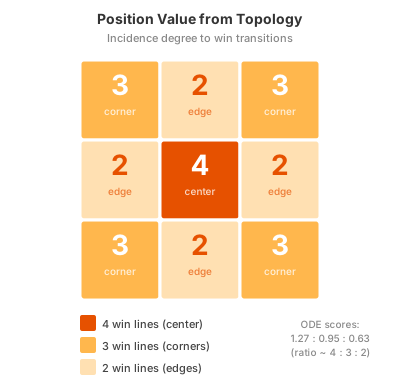
The center participates in 4 winning patterns. Corners participate in 3. Edges participate in 2. This structural fact — encoded in the arc connectivity — is the source of strategic value. More connections to pattern collectors means more paths to victory, which the ODE dynamics translate into higher scores.
No game theory is needed to derive this. It falls directly from the net’s topology.
ODE-Guided Strategy
With the model defined, we can use the continuous relaxation to evaluate moves. The algorithm is simple:
- For each available move, create a hypothetical state after making that move
- Run the ODE simulation forward from that state
- Read the final values of
WinXandWinO - Score = my_win - opponent_win
The move with the highest score is the best move.
The Scoring Function
targetPlace := "win_x"
oppPlace := "win_o"
if currentTurn == PlayerO {
    targetPlace = "win_o"
    oppPlace = "win_x"
}

for _, move := range availableMoves {
    // Create hypothetical state
    hypState := copyState(currentState)
    hypState[position] -= 1
    hypState[historyPlace] += 1

    // Run ODE
    prob := solver.NewProblem(net, hypState,
        [2]float64{0, 3.0}, rates)
    sol := solver.Solve(prob, solver.Tsit5(), opts)
    final := sol.GetFinalState()

    // Score
    score := final[targetPlace] - final[oppPlace]
}
The ODE simulation with mass-action kinetics explores all possible continuations simultaneously. When X has tokens in positions that participate in many patterns, the flow toward WinX is higher. When O can block a pattern, that flow is diverted. The final token counts in WinX and WinO represent the aggregate outcome across all possible game continuations — weighted by their structural likelihood.
What the ODE Discovers
Empty board evaluation. X evaluates all 9 positions. The ODE reveals:
- Center (1,1): score 1.27 — highest, because 4 pattern connections create the most flow toward WinX
- Corners: score 0.95 — second, 3 patterns each
- Edges: score 0.63 — lowest, 2 patterns each
The ODE has “discovered” the opening strategy: play the center. No minimax tree, no alpha-beta pruning, no opening book — just mass-action kinetics flowing through the net’s topology.
Responding to center. After X takes center, O evaluates defensive options. All scores are negative (X has the advantage), but corners (-1.04) minimize X’s lead better than edges (-1.38). The ODE discovers the defensive principle: play corners against center.
Finding winning threats. When X has center and a corner, the ODE identifies the opposite corner as the best move (score 1.39) because it creates a two-way threat — a fork that completes one diagonal while opening another. The pattern collectors naturally amplify fork positions because they have higher connectivity.
Blocking. When X has two in a row, O’s best move is the blocking position (score 0.80 vs. 0.74-0.77 for other moves). The ODE discovers blocking because the flow toward WinX is dramatically higher along the threatened pattern. Placing a token to block cuts off that flow. Note how thin the margin is: a forced block wins by hundredths where the opening preferences differ by half a point. Tactical necessities are second-order effects in the relaxed flow — a weakness the tournament results below make concrete.
Performance
Each move evaluation requires one ODE solve. With 9 possible moves on an empty board, that’s 9 solves. Using tuned solver options:
opts := &solver.Options{
    Dt:     0.2,
    Reltol: 1e-3,
}
Each solve takes roughly 4 milliseconds, making a full game (about 45 total evaluations across all moves) complete in about 1.8 seconds. Fast enough for interactive play.
How well does this evaluator actually play? Measuring that fairly requires two refinements the model does not yet have — the game must stop when someone wins, and a draw must be worth something to the defender. Both come next; the tournament follows them.
Game Halting and Draw Detection
A subtle but critical detail: what happens when a player wins? In the basic model, tokens continue flowing after a win — the ODE doesn’t know the game should stop. This distorts strategic values because the simulation averages over impossible continuations.
The fix is game halting: win transitions consume the turn token without returning it.
X00 --> XRow0 --> WinX
X01 -->
X02 -->
Next -->             (consume turn -- game stops)
When X wins, the XRow0 transition consumes Next (it was O’s turn). No turn token is returned. All further move transitions are blocked because they require either an empty position token or a turn token, and the turn token is gone. The win state becomes an absorbing state — once reached, no further flow is possible.
Draw Detection
Draw detection adds a move counter. Each play transition deposits a token into move_tokens. A draw transition fires when:
- 9 move tokens have accumulated (all squares filled)
game_activeis still marked (no winner)
The draw transition deposits into its own draw place, and the scoring objective counts it for the defender: win_x - win_o - draw, which X maximizes and O minimizes. This encodes the principle that “a draw is a win for the defender” — tic-tac-toe is asymmetric, O cannot force a win, so O’s goal is “X does not win” and a draw counts fully. (Keeping the draw in its own place, rather than crediting WinO directly, also keeps the outcome announceable: an application reading the marking can tell a draw from a win.) This changes the ODE dynamics:
Without draw detection: O’s scores are always negative. The model only sees win paths, so it favors positions with more winning lines even when blocking is essential.
With draw detection: O’s scores become positive because draws count as partial victories. Blocking a threat now has measurable value — it preserves the possibility of a draw, which has positive worth.
Tournament Results
With halting and draw detection in place, the complete model can play. The scoring function from earlier now reads the declared objective — score = win_x - win_o - draw, negated for O — and the tournament is reproducible: 100 games per matchup, the random player seeded, ODE ties broken by declared move order. The harness is examples/ch06-ttt-tournament/, pinned to a released go-pflow, and prints this table plus an ODE-vs-ODE game trace.
| Matchup | X Wins | O Wins | Draws |
|---|---|---|---|
| ODE vs Random | ~97% | 0% | ~3% |
| Random vs ODE | ~3% | ~88% | ~9% |
| ODE vs ODE | 100% | 0% | 0% |
The ODE evaluator dominates random play from either side. As O — the seat that only exists to deny X — it converts ~88% of games into wins against a random X, which the draw-blind scorer could never do: without the draw term, blocking has no measurable value.
The third row looks wrong and is the most instructive number in the table. Two identical players, and X wins every game — where a naive reading expects all draws. But “same player both sides means a tie” is a property of perfect players only. Two copies of an imperfect evaluator lose in whichever seat their shared weakness is punished, and tic-tac-toe’s seats are not symmetric: X’s job is threat creation, a strategic property the aggregate flow measures well, while O’s job is threat denial — exact, discrete, forced. So the same evaluator that goes ~88% as O against random play fumbles reliably against the one opponent that punishes a single missed block every time: itself. (An earlier edition of this table reported ~85% draws for this matchup. It was measured on the draw-blind model — score = win_x - win_o, a tie worth zero to both sides instead of counting against X — with unseeded tie-breaking on top: an artifact, not a property of the evaluator. The move sequences still vary slightly between runs, because the solver’s floating-point summation order follows map iteration and flips near-ties; the outcome never varies.) A representative game:
ply 1: X takes center        ply 2: O takes corner (2,0)
ply 3: X takes corner (0,0)  ply 4: O blocks the diagonal at (2,2)
ply 5: X takes edge (2,1), threatening column 1
ply 6: O plays (0,2) — the losing move
ply 7: X completes column 1 at (0,1)
At ply 6 the block at (0,1) is forced. Exact minimax over the same net confirms it: o_play_01 values at +1 for O (the draw) and every other move at -1 (X wins). The relaxation’s own numbers at that position show why it fails: the forced block scores 0.248 while two strategically-pretty but losing corner moves score 0.275. A block’s value is conditional on the opponent’s next discrete move; in the continuous flow that conditionality is a second-order effect, and 0.027 of aggregate connectivity outweighs it. The forced block is exactly the thin-margin tactical judgment flagged earlier, and the margin goes the wrong way.
One more honesty note about that exhibit, learned after this section was first written: it is configuration-dependent in a way the failure class itself is not. This harness runs its win detectors fast (rate 720 against the plays’ rate 1), so the referee dominates the relaxed flow; at uniform rates the same evaluator finds this particular block, and the margin flips back the right way. A tactic whose correctness depends on a solver rate choice was never being seen — it was balanced on an artifact, in whichever direction the rates happened to lean. What does not flip at any horizon, detector rate, or draw rate we later swept is the double-corner fork: X in opposite corners, O in the center, no threat on the board yet, where every corner reply loses and every edge draws. There the losing moves outscore the optimal ones on every final-state coordinate under every configuration tried — the fork is the relaxation’s true boundary, and the missed block above is its rate-sensitive shadow.
That is the honest boundary of the relaxation used alone. It is a strategic prior derived from topology — it finds the center opening, the corner defense, forks, and most blocks, with no game knowledge anywhere — but a tactical necessity is a second-order effect in the relaxed flow, and it will occasionally miss one. The right place for a prior is not the driver’s seat. Where its right seat is — and what it does there — closes this chapter, once the integer reduction has given the prior its closed form.
The Integer Reduction
The ODE scores from the empty board — center 1.27, corners 0.95, edges 0.63 — are suspiciously proportional. Divide each by the smallest:
The ODE is tracking three integers. Not computing them exactly — the ratios are approximate, within a few percent — but recovering the same ranking and grouping that the integers predict.
Incidence Degree to Terminals
The win transitions in this model are terminal — they are sinks in the net. The number of arcs from a position’s history place to downstream win transitions is its incidence degree. This is a graph property — count the arcs, get an integer. No simulation needed.
| Position | Win patterns | Incidence degree |
|---|---|---|
| Center (1,1) | Row + Column + 2 Diagonals | 4 |
| Corners (0,0), (0,2), (2,0), (2,2) | Row + Column + 1 Diagonal | 3 |
| Edges (0,1), (1,0), (1,2), (2,1) | Row + Column | 2 |
The full board heatmap is [3, 2, 3, 2, 4, 2, 3, 2, 3]. The strategic value of a position in a game with terminal win states is determined by its incidence degree to those terminals. The ODE recovers this ranking through dynamics; the graph gives it directly.
Generalizing to Any Board Size
The incidence degree formula works for any board. Each position at gets:
- 2 (its row + its column), always
- +1 if on the main diagonal ()
- +1 if on the anti-diagonal ()
So the only possible degrees are {4, 3, 2}, and degree 4 only occurs at the center of odd-sized boards. Running the ODE with uniform rates across board sizes from 3×3 to 7×7 confirms that the same predictive behavior holds at every scale:
- Positions with the same incidence degree always receive the same ODE score
- Higher incidence degree always produces a higher score
- The ranking center > diagonal > non-diagonal is preserved
The ODE ratios approximate the integer ratios closely for small boards (~2% error at 3×3) and less closely for larger ones (~10% at 7×7), because more positions compete for flow through shared win transitions. But the ranking — which is what matters for move selection — never changes. The incidence degree is an exact predictor of ODE ranking for all tested board sizes.
Dynamic Evaluation: Injecting Current State
The empty board is the easy case. The real utility comes from injecting the current game state as the marking and recomputing.
When a position is occupied, its token has been consumed — it drops out of the calculation. The incidence degree is now computed only against still-reachable win transitions. A corner that participates in 3 win patterns on an empty board might participate in only 1 if the opponent has blocked the other two. The heatmap updates to reflect the live topology.
This is the general “next step” evaluator. Given any board state:
- Identify which win transitions are still reachable (not blocked by opponent pieces)
- For each empty position, count the number of reachable win transitions it connects to
- The highest count is the best move
No search tree, no minimax, no alpha-beta pruning — just count the edges to live terminals.
The Boundary Between Counting and Simulation
Tic-tac-toe reduces to {4, 3, 2} precisely because it is simple enough that topology is all you need. The win transitions are independent sinks. No position participates in resource competition with another. The incidence structure has no interesting dynamics — just a direct count.
For more complex games — poker with its multi-phase betting structure, or governance models with competing resource flows — the incidence structure is rich enough that positions do not reduce to small integers. Multiple paths interact, resource constraints create bottlenecks, and the dynamics through the net have real work to do. The ODE earns its keep in those cases.
But the mechanism is identical:
- Model the system as a Petri net with terminal (win/loss/goal) transitions
- Inject the current state as the marking
- Compute the evaluation from token flow to reachable terminals
For simple nets, step 3 is integer counting. For complex nets, step 3 is ODE simulation. The boundary between them is the boundary between systems where topology alone determines strategy and systems where dynamics matter.
What we have is a static evaluation function defined purely by net topology and current state. No heuristics, no training data, no game-specific knowledge beyond the Petri net model itself. For any game or system modeled as a Petri net with designated terminal states, the function is: for each position, how connected is it to winning? The Petri net is the domain knowledge — the topology encodes the rules, and the incidence structure encodes the strategy.
Oracle Play
The tournament showed where the static evaluator’s honesty runs out: it is a strategic prior, and a prior that drives loses to a forced block. This section puts it in its right seat. The result is perfect play, and — this is the point — perfect play derived from the net, with no more game knowledge than the evaluator itself used.
The Search Is Already in the Net
Exact minimax needs four things: the legal moves, whose turn it is, when the game is over, and what the outcome was. The net declares all four. Legal moves are enabled transitions — an occupied cell’s move is not pruned by game logic, it is simply not enabled, because the position token is gone. The turn is whichever turn place holds a token. The win detectors and the draw call are the referee: fired to quiescence between moves, they decide the game exactly as they did during simulation. And a missing turn token — absorbed by a detector — is the game-over test. The search over those semantics is a page of code with nothing about tic-tac-toe in it:
func minimax(mk Marking, alpha, beta int) int {
    mk = fireHouse(mk)              // detectors and the draw call referee
    switch {
    case mk["x_turn"] > 0:
        // maximize over enabled x_play_* moves, prior-ordered
    case mk["o_turn"] > 0:
        // minimize over enabled o_play_* moves, prior-ordered
    default:                        // turn token absorbed: game over
        return mk["win_x"] - mk["win_o"]   // win +1, loss -1, draw 0
    }
}
Change the net — a 4x4 board, a misère rule where completing a line loses, an extra win pattern — and this player changes with it, because it was never written, only derived. The rules live in one artifact and everything else is a view of it.
The Prior Takes Its Seat
The static evaluator’s role changes from player to oracle: its ranking decides which move the search examines first, and never what any position is worth. That division of labor is exactly what alpha-beta wants — cutoffs come from trying strong moves early, so an ordering heuristic pays in pruned subtrees while remaining unable to corrupt the answer. And the integer reduction is what makes the oracle cheap: the ranking is the incidence degree, readable off the graph, with the ODE solve needed only where topology alone stops being enough.
The prior’s value is measurable, not rhetorical: from the empty board, the exact search expands 18,297 positions taking moves in declared order, and roughly 7,000 with the prior ordering them — the same proven answer at about 2.6x less work (the precise count varies by a few percent run to run, because near-tied prior scores resolve by floating-point summation order). Trying center before edge is most of what there is to know about tic-tac-toe move ordering, and the prior knows it from the arc structure alone.
Perfect Play, Measured
The same tournament harness, with the oracle seated:
| Matchup | X Wins | O Wins | Draws |
|---|---|---|---|
| Oracle vs Oracle | 0% | 0% | 100% |
| ODE vs Oracle | 0% | 0% | 100% |
| Oracle vs ODE | ~40% | 0% | ~60% |
Every game between two oracles is a draw — the “identical players tie” intuition holds the moment both players are actually perfect, and the search proves the game’s value from the empty board is the draw. The oracle never loses from either seat: as O it blocks every threat the bare relaxation missed, and as X it converts the heuristic’s missed blocks into wins about 40% of the time while conceding nothing. This construction — the relaxation ordering an exact search over the same net — is what a deployed bot should ship, and it is what the pflow what-if service’s game bots do ship.
The Objective Is a Modelling Statement
One detail in the harness deserves its own paragraph, because it is a lesson about declaring objectives rather than about search. The oracle’s leaves score win +1, loss -1, draw 0 — the three outcomes must rank for perfect play to mean anything. The model’s declared objective, win_x - win_o - draw, instead folds the draw into the defender’s win. That is the right encoding for the asymmetric question it was written to ask — O cannot force a win, so O’s goal is “X does not win,” and a draw counts fully for O. But it makes X literally indifferent between drawing and losing, and the first version of this harness proved it the hard way: an oracle X maximizing the declared objective cheerfully lost 59% of its games against itself, every loss a position it valued identically to the draw it could have had. Same net, same search, one term moved in the objective — and “perfect play” quietly meant something else. An objective is a modelling statement, and this is what getting one wrong looks like from the inside.
Declaring the Opponent
Oracle play closed the question this chapter set out to answer, and for a while the division of labor it established — structure for the prior, search for the tactics — looked like the final word. It was not, and the way it fell is worth a section, because the fall teaches more about modelling than the settlement did.
The starting point is the fork boundary above, sharpened into an impossibility: at the double-corner trap, the losing corner replies dominate the optimal edges on every coordinate of the relaxed final state — lower opponent-win mass, higher own-win mass, higher draw mass — at every rate configuration. No scoring function over that final state can pick the right move. Not “we didn’t find one”: there isn’t one. Whatever fixes the fork must change the net being evaluated, not the number read off it.
That reframes what the evaluator was doing all along. Mass-action flow with uniform rates explores every legal continuation in proportion to nothing but availability — it is the mean-field limit of both players moving at random. Seen that way, the ~93% ceiling stops being mysterious: flat random-playout evaluation is known to play tic-tac-toe at almost exactly that level, nailing every tactic visible as a static threat and failing precisely where the value lives in the opponent’s forced replies. The relaxation was never missing search. It was missing an opponent model — and an opponent model is declarable.
The declaration is almost embarrassingly direct. For each win line and each of its cells, add a copy of that cell’s play transition, catalyzed — read arcs, nothing moved — by the opponent holding the line’s other two cells. Forty-eight transitions, one shared rate. Inside the forward solve, wherever a threat exists, flow pours into the move that answers it: the simulated players stop being random and start playing threats-are-answered. The evaluation net is then derived from the declared one by mechanical transforms — delete the draw machinery (its counting semantics cannot survive the relaxation, and keeping it measurably poisons the objective), delete the places that become write-only, add the forced-reply copies — leaving two scalars, the reply bias and the defender’s win-versus-survive exchange rate, both of which fall out of a two-parameter fit against minimax labels from a naive start.
The verdict is stronger than any tournament: a referee walks every legal opponent line, both seats, and checks that the evaluator’s move never worsens the position’s exact game value. Zero value-losing moves, zero missed wins. One ODE solve per candidate, a linear read of the final state, no search — and it never loses a drawn position and converts every won one, against arbitrary opposition. The experiment, its fifteen findings, and the exhaustive referee live at petri-pilot/experiments/ode-minimax; the derivation transforms and the fitting ship as general tools in go-pflow’s derive and learn packages (v0.23.1). (The experiment runs on the blog’s folded variant of this chapter’s model — same game, same detector idiom, outcome places folded rather than history-collected — so its numbers differ from this harness’s while every structural conclusion carries.)
Two of those findings deserve restating here because they are about modelling, not tic-tac-toe. First, static evaluators degrade gracefully with initiative and sharply without it: a tempo ahead, every threat you must answer is already on the board — a fact the flow measures directly, which is why the bare relaxation was already perfect as X — while a tempo behind, the decisive danger is assembled from the opponent’s forced replies and lives only in move order. When testing an evaluator on any game, instrument the defending seats first. Second, a prior the structure already computes must not be written in again: the integer reduction earlier in this chapter showed the topology producing the 4:3:2 incidence ranking for free, and every attempt to also encode those counts — into deposit weights, into detector rates, in any direction — measurably degraded play. The topology applies its prior exactly once, and every duplicate is paid for.
Where does that leave oracle play? Intact, and honestly priced. The search is still the cheapest guarantee — a page of derived code whose answer is proven, with the prior pruning its tree. What the derived evaluator adds is the demonstration that the guarantee was never the relaxation’s ceiling: hand the flow a net that declares how opponents actually behave, and the flow alone reaches the same perfection. The declared model stays the single source of truth and the referee. The evaluation net becomes what it always secretly was — a compiled artifact, built from the declaration by transforms with stated semantics, and the compiler is where the modelling lives.
The GameNet Pattern
Tic-tac-toe demonstrates the GameNet pattern from Chapter 4:
- Board state as places — each cell is a place, tokens mark availability
- Move history as places — separate tracking of who played where
- Turn control as a shared token — mutual exclusion enforces alternation
- Pattern collectors as transitions — compositional win detection
- ODE scoring — strategic value emerges from topology
- Integer reduction — for simple games, the ODE collapses to incidence degree counting
- Oracle play — the prior orders an exact search over the same net; perfect play is derived, not programmed
- Derived evaluation nets — declare the opponent’s policy as structure (forced-reply transitions) and the relaxation alone reaches the same perfection, no search at all
The same pattern scales to more complex games. A Connect Four model would have 42 position places (7 columns × 6 rows) and more pattern collectors (horizontal, vertical, diagonal sequences of 4). A Go model would have 361 position places. The complexity is in the number of places and patterns, not in the logic — the logic is always the same: tokens flow, patterns collect, scores emerge. And when the game is simple enough, the scores are integers you can read off the graph without running the solver at all.
The mathematical foundation is identical to the coffee shop. The incidence matrix encodes all arcs. Conservation laws guarantee no tokens are created or destroyed. The ODE simulation finds the natural flow. The difference is interpretation: in the coffee shop, tokens are grams of beans; in tic-tac-toe, tokens are board positions and move records. The mathematics doesn’t care.
Try it live: Play against the ODE solver in the Tic-Tac-Toe demo or try the ZK variant for privacy-preserving moves at pilot.pflow.xyz.
The next chapter applies Petri nets to constraint satisfaction — modeling Sudoku as a system where arc weights and conservation laws enforce the puzzle’s rules, and the ODE relaxation finds valid configurations. Chapter 13 returns to the integer reduction from a different angle: deriving rate constants automatically from graph connectivity, and feeding them directly into the ZK verification pipeline.
Constraint Satisfaction — Sudoku
Learning objective: Express constraints as token conservation and solve via continuous relaxation.
Chapters 5 and 6 applied Petri nets to resource management and game mechanics. This chapter applies them to a different problem class: constraint satisfaction. Sudoku is a puzzle where you fill a grid such that every row, column, and block contains each digit exactly once. There’s no optimization, no adversary, no time — just constraints.
The Petri net encoding follows the same three-layer pattern from tic-tac-toe: cells as places, digit placements as transitions, and constraint collectors that fire when a row, column, or block is complete. The ODE simulation ranks candidate moves by how much flow they direct toward the solved place — no backtracking search required.
The Puzzle
We’ll use a 4×4 mini-Sudoku to keep things comprehensible:
  Initial:            Solution:
+---+---+---+---+    +---+---+---+---+
| 1 | . | . | . |    | 1 | 2 | 4 | 3 |
+---+---+---+---+    +---+---+---+---+
| . | . | 2 | . |    | 3 | 4 | 2 | 1 |
+===+===+===+===+ -> +===+===+===+===+
| . | 3 | . | . |    | 2 | 3 | 1 | 4 |
+---+---+---+---+    +---+---+---+---+
| . | . | . | 4 |    | 4 | 1 | 3 | 2 |
+---+---+---+---+    +---+---+---+---+
Constraints: each row, column, and 2×2 block must contain digits 1–4 exactly once. The 9×9 version uses digits 1–9 with 3×3 blocks — same structure, just more of it.
Cell Places and Digit Transitions
Layer 1: Cell Places
Each cell in the grid is a place. A token means “this cell is empty”:
P00: 0  P01: 1  P02: 1  P03: 1
P10: 1  P11: 1  P12: 0  P13: 1
P20: 1  P21: 0  P22: 1  P23: 1
P30: 1  P31: 1  P32: 1  P33: 0
Given cells (1 at position 00, 2 at position 12, 3 at position 21, 4 at position 33) have no token — they’re already filled.
Layer 2: Digit Transitions and History
For each cell × digit combination, a transition represents “write this digit in this cell”:
Transition D2_01:             History place _D2_01:
"Write digit 2 at (0,1)"     "Digit 2 is at (0,1)"

      +------+
P01 --| D2   |---> _D2_01
(1)   | _01  |     (0 -> 1)
      +------+
Firing consumes the cell token (cell is now filled) and produces a history token (recording which digit was placed). This is identical to the tic-tac-toe pattern: P_ij → PlayX_ij → X_ij.
For a 4×4 grid: 16 cells × 4 digits = 64 digit transitions and 64 history places. Most of these transitions will be irrelevant for any given puzzle (you can’t place a 1 in a row that already has a 1), but the ODE simulation handles this naturally — conflicting placements produce zero flow.
Layer 3: Constraint Collectors
When all required digits appear in a row, column, or block, a constraint collector transition fires and deposits a token in the solved place:
_D1_00 --> Row0_Complete --> solved
_D2_01 -->
_D3_02 -->
_D4_03 -->
The Row0_Complete transition requires history tokens for all four digits in row 0. When all four are present — meaning row 0 has digits 1, 2, 3, and 4 — the collector fires.
For the 4×4 grid: 4 row collectors + 4 column collectors + 4 block collectors = 12 constraint collectors. Maximum tokens in solved = 12. A fully solved puzzle has all 12 constraints satisfied.
This is a direct generalization of the tic-tac-toe pattern collectors. In tic-tac-toe, collectors watched for three-in-a-row. In Sudoku, collectors watch for complete rows, columns, and blocks. Same mechanism, different patterns.
How the Model Works
Step-by-step for cell (0,1) — currently empty:
-
Initial:
P01 = 1(cell is empty, available for placement) -
Consider digit 2: Transition
D2_01is enabled becauseP01has a token -
Fire
D2_01:P01: 1 → 0 (cell now filled)_D2_01: 0 → 1 (history records “digit 2 at position (0,1)”)
-
Constraint progress: When row 0 eventually has all four digits placed,
Row0_Completefires andsolvedgets +1 token
The model doesn’t encode which digit goes where — that’s the puzzle’s job. It encodes what constitutes a valid solution: all constraint collectors firing. The ODE simulation explores the space of possible placements and measures how much flow reaches solved.
ODE Prediction for Move Ordering
The same hypothesis evaluation from tic-tac-toe applies:
For each candidate move:
  1. Create hypothetical state (after placing this digit)
  2. Run ODE simulation (t=0 to t=3.0)
  3. Measure token flow to 'solved' place
  4. Higher flow = move more likely leads to solution
Why This Works
The constraint collectors create asymmetric flow in the ODE. A digit placement that satisfies constraints in multiple directions (its row, column, and block) creates more flow toward solved than one that only helps one constraint. The mass-action kinetics amplify this: more enabled collectors means higher aggregate flow rate.
A placement that creates a conflict — placing a 2 in a row that already has a 2 — produces zero flow through the corresponding row collector. The ODE naturally penalizes conflicts without any explicit “conflict detection” logic.
Move Ranking Example
For cell (0,1) in the 4×4 puzzle, evaluating each digit:
Digit 2: solved flow = 0.31  <-- Correct answer
Digit 3: solved flow = 0.28
Digit 4: solved flow = 0.15
Digit 1: blocked (conflict -- row 0 already has 1)
The ODE ranks digit 2 highest because it enables the most downstream constraint satisfaction. Digit 1 is blocked because its row collector can never fire (the history token for “1 in row 0” already exists from the given cell).
Tuning for Speed
A naive ODE simulation of the full model is slow. But we don’t need precision — we need ranking. Two moves scored at 0.31 and 0.28 will maintain their relative order whether we simulate to t=3.0 or t=10.0.
This enables aggressive tuning:
| Parameter | Default | Tuned | Why |
|---|---|---|---|
| Time horizon | t=10.0 | t=3.0 | Only need relative rankings |
| Abstol | 1e-6 | 1e-4 | Looser tolerance, faster solve |
| Step size (dt) | 0.01 | 0.2 | Larger steps, fewer iterations |
| Max iterations | 100000 | 1000 | Early termination OK |
The performance impact:
| Model | Naive | Tuned | Speedup |
|---|---|---|---|
| 4×4 (64 transitions) | 0.8s | 0.04s | 20× |
| 9×9 (729 transitions) | ~60s | ~3s | 20× |
This makes interactive analysis feasible — evaluating all candidates for a cell takes seconds, not minutes.
Scaling from 4×4 to 9×9
The same pattern scales without structural changes:
| Component | 4×4 | 9×9 |
|---|---|---|
| Cell places | 16 | 81 |
| Digits | 4 | 9 |
| History places | 64 | 729 |
| Digit transitions | 64 | 729 |
| Row collectors | 4 | 9 |
| Column collectors | 4 | 9 |
| Block collectors | 4 | 9 |
| Max solved tokens | 12 | 27 |
The 9×9 model has 729 transitions — one for each cell × digit combination. The constraint collectors expand from 12 to 27 (9 rows + 9 columns + 9 blocks). The structure is identical; only the dimensions change.
The ODE simulation time grows with the number of transitions (729 vs. 64), but the tuned solver still handles it in seconds. The ODE is not solving Sudoku here; it is ranking candidate moves, and the ranking guides a discrete solver (backtracking, constraint propagation) toward the solution faster.
Constraint Satisfaction as Token Flow
The Sudoku model reveals a general pattern for constraint satisfaction problems:
- Variables become places (cells that can be filled)
- Domain values become transitions (digits that can be placed)
- Constraints become collector transitions (patterns that must be completed)
- Solution is a state where all collectors have fired
This pattern works for any CSP. An N-queens problem would have N² cell places, N queen transitions per column, and collectors for row uniqueness, column uniqueness, and diagonal uniqueness. A graph coloring problem would have vertex places, color transitions, and collectors for each edge (ensuring adjacent vertices have different colors).
The ODE simulation doesn’t solve the CSP directly — it provides a heuristic for variable and value ordering. In constraint programming, the order in which you assign variables and try values dramatically affects performance. The ODE’s flow-based ranking is a natural heuristic: try the assignment that creates the most flow toward the solution.
No hardcoded solver. Constraints emerge from topology. The same four-term primitive — cell, func, arrow, guard — encodes Sudoku, N-queens, graph coloring, and any other CSP. The structure changes; the mechanism doesn’t.
Optimization — The Knapsack Problem
Learning objective: Solve NP-hard problems approximately via mass-action kinetics.
The previous chapter used ODE simulation as a heuristic for constraint satisfaction — ranking moves, not solving directly. This chapter goes further: applying continuous relaxation to a combinatorial optimization problem where the ODE provides direct insight into the solution structure.
The 0/1 knapsack problem asks: given items with weights and values, select a subset that maximizes total value within a weight budget. It’s NP-hard. Traditional approaches use branch-and-bound — systematic enumeration with pruning. The Petri net approach uses mass-action kinetics — items compete for capacity through continuous dynamics. The competition reveals which items matter and which actively hurt the solution.
The 0/1 Knapsack as a Petri Net
Problem Definition
Four items with different weights and values, capacity budget of 15:
| Item | Weight | Value | Efficiency (v/w) |
|---|---|---|---|
| item0 | 2 | 10 | 5.0 |
| item1 | 4 | 10 | 2.5 |
| item2 | 6 | 12 | 2.0 |
| item3 | 9 | 18 | 2.0 |
These are the values in go-pflow’s examples/knapsack, which produced every simulation number in this chapter.
The optimal solution takes items 0, 1, and 3 — total weight 15, total value 38. Item2 and item3 tie on efficiency at 2.0, so the ratio can’t choose between them; capacity does. After items 0 and 1 take 6 units, item3 fills the remaining 9 exactly, while item2 would leave 3 idle (items 0, 1, 2 weigh 12 and are worth 32).
Net Structure
The Petri net encodes the knapsack as a dynamic system:
- Item places: Each holds 1 token (item available) or 0 (item taken). This enforces the 0/1 constraint — you either take an item or you don’t.
- Capacity place: Holds tokens representing available weight budget. Initial marking = 15 (the weight limit).
- Take transitions: One per item. Consumes the item token plus capacity tokens equal to the item’s weight. Produces tokens into value and weight tracking places.
For item0 (weight 2, value 10):
item0 --> take_item0 --> value_taken
           ^                (weight 10)
capacity --+
 (weight 2)
The arc from capacity to take_item0 has weight 2 — taking item0 costs 2 units of capacity. The enabling condition requires AND . If the remaining capacity is less than 2, this item can’t be taken.
The critical structural property: all items compete for the same capacity pool. Taking item2 (weight 6) leaves less capacity for item3 (weight 9). This competition is encoded in the shared input place, not in any explicit exclusion logic.
Why Every Item Is Taken Equally
In the basic model, all transitions have rate 1.0. go-pflow’s mass-action kinetics are first-order in every input place (solver/ode.go):
The arc weight scales how much capacity each firing consumes, not the rate: it does not appear as an exponent. (Chemical mass action would raise to the power ; go-pflow does not.)
This makes the dynamics solvable by hand. Let . Each item place obeys , so
— the same curve for every item, whatever its weight or value. Values never enter the dynamics at all; they sit on output arcs into a place nothing reads. All active items are therefore taken in one common fraction , and the remaining capacity is , where is the total weight of the active items. If , capacity runs out at and the net settles at value , with the total value of the active items. If , and the net eventually collects all of . Every number in the rest of this chapter follows from that formula.
Continuous Relaxation and Rounding
Running the ODE simulation with uniform rates:
Final state (continuous approximation):
  Value accumulated:    35.71
  Weight used:          15.00
  Capacity remaining:    0.00

Item consumption (fraction taken):
  item0: 71.4% taken
  item1: 71.4% taken
  item2: 71.4% taken
  item3: 71.4% taken
The continuous relaxation takes fractional amounts of each item — all at exactly , as the formula predicts (, , value ). The total value is 35.71, compared to the discrete optimum of 38.
The fractional solution looks like the LP (linear programming) relaxation of the knapsack, but it is not one: an LP relaxation is an upper bound on the integer optimum (here the LP value is 38 — items 0 and 1 whole, then 9 units at ratio 2.0), while the ODE settles at 35.71, below the integer optimum of 38. Mass-action kinetics spreads consumption across items proportionally; it is a smooth dynamics, not a maximiser. The gap between 35.71 and 38 tells us that simple rounding won’t find the optimum. We need more information about the solution structure.
Exclusion Analysis for Sensitivity
This is where the Petri net approach delivers insight that branch-and-bound doesn’t. Exclusion analysis disables each item’s transition one at a time and re-runs the ODE:
| Excluded | Final Value | Relative to Baseline |
|---|---|---|
| none | 35.71 | 100.0% |
| item0 | 31.58 | 88.4% |
| item1 | 35.29 | 98.8% |
| item2 | 37.75 | 105.7% |
| item3 | 32.00 | 89.6% |
Three of the four items behave as expected — excluding them reduces the total value. But item2 is anomalous: excluding it increases the value from 35.71 to 37.75.
The formula explains the whole table. While the active items overweigh the capacity, the value is — capacity times the aggregate value density of the active set. Excluding item0 costs the most because it is the densest item: falls from to , giving 31.58. Excluding item3 leaves items weighing 12, which fit, so the net collects their full value of 32. Item2 is the only exclusion that raises the value, because without it the remaining weights sum to exactly 15 and the net can take all of items 0, 1 and 3.
So item2 is “hurting” the solution in a precise sense: its exclusion is the one that makes the rest fit. On this instance one sensitivity pass — five ODE runs — points at the optimum. Single exclusions only examine subsets of size , though, and on a larger instance the optimum usually drops several items; that this heuristic finds the optimum in general is not shown here.
Convergence After Exclusion
With item2’s transition disabled, the ODE converges toward the discrete optimum:
| Time | Value | Gap to Optimal |
|---|---|---|
| t=10 | 37.75 | 0.25 |
| t=100 | 37.97 | 0.03 |
| t=1000 | 38.00 | 0.00 |
Given enough simulation time, the continuous relaxation without item2 converges to the exact discrete optimum of 38. The remaining items (0, 1, 3) weigh exactly the capacity, so capacity and items drain together: integrates to , and the gap to 38 is — algebraic rather than exponential, which is why it takes until to close.
The exclusion step removes the item whose presence keeps the rest from fitting; the ODE then fills the set that remains. It reaches the integer optimum here because , not because the dynamics select it.
Comparison with Branch-and-Bound
The two approaches solve the same problem through fundamentally different mechanisms.
Branch-and-bound treats optimization as search. It builds a decision tree where each node represents a binary choice: take this item or skip it. The algorithm explores branches, computing upper bounds to prune paths that can’t improve on the best solution found so far. It’s systematic enumeration with smart pruning — still exponential in the worst case, but practical for moderate problem sizes.
DDM/ODE treats optimization as simulation. Instead of explicit decisions, items compete for capacity through continuous dynamics. The mass-action kinetics means all enabled transitions fire simultaneously at rates proportional to available resources. There’s no decision tree — just differential equations evolving toward equilibrium.
| Aspect | Branch-and-Bound | DDM/ODE |
|---|---|---|
| Core operation | Decision-tree search with bounds | Continuous dynamics |
| Decisions | Explicit (take/skip) | None — every active item is taken in the same fraction |
| Solution type | Exact integer | Fractional approximation |
| Cost | Exponential worst case (pruned) | One ODE solve per run; does not solve the integer problem |
| Primary output | “What’s optimal?” | “Why is it optimal?” |
For exact solutions, branch-and-bound wins — it finds items 0, 1, 3 with value 38 directly. The ODE reaches 35.71 by taking fractional amounts of everything.
But the ODE reveals structure that search obscures. The exclusion analysis shows item2 is actively counterproductive. Branch-and-bound discovers this implicitly through pruning, but it doesn’t report it as an insight. The ODE makes the competition visible.
When to Use Each
| DDM/ODE Approach | Branch-and-Bound |
|---|---|
| Exploratory analysis | Exact solutions |
| Sensitivity insights | Guaranteed optimum |
| Fast iteration | Proven correctness |
| Understanding why | Finding what |
In practice, the approaches complement each other. Use ODE simulation to understand the problem structure — which items matter, which compete, where the bottlenecks are. Then use branch-and-bound (or dynamic programming) to find the exact solution, informed by the structural insights.
Beyond Four Items
The 4-item example is intentionally small. For larger instances:
-
100 items: Each ODE run stays cheap — the number of transitions scales linearly — and single-item exclusion analysis is 101 runs. But single exclusions only look at 99-item subsets, and the optimum will typically drop many items, so this does not replace branch-and-bound’s exponential worst case; a benchmark on larger instances has not been done.
-
Correlated items: When items have similar efficiency ratios, the exclusion analysis shows which ones truly contribute and which are interchangeable. This information is invisible to pure optimization.
-
Multiple constraints: Adding a second constraint (volume, fragility) means adding a second capacity place with its own arc weights. The Petri net handles this naturally — each constraint is an independent place. Branch-and-bound becomes the multidimensional knapsack problem, which is significantly harder.
The Pattern
The knapsack model demonstrates a fourth application pattern, distinct from resources (Chapter 5), games (Chapter 6), and constraints (Chapter 7):
- Decision variables become places (items available or taken)
- Resource constraints become shared capacity places with weighted arcs
- Competition emerges from mass-action kinetics — items fight for capacity
- Exclusion analysis reveals which elements actively hurt the objective
- Continuous relaxation approximates the optimum; structural insight guides to the exact solution
This is optimization by simulation rather than search. The ODE doesn’t find the optimal solution directly — it reveals the solution’s structure. On this instance that structure leads straight to the optimum; on larger ones it is a guide for search, not a substitute.
Try it live: Explore the Knapsack optimizer at pilot.pflow.xyz to see mass-action kinetics reveal optimal item selection.
Biochemistry — Enzyme Kinetics
Learning objective: See how Petri nets naturally model chemical reactions, recovering classical equations.
The previous chapters applied Petri nets to domains where the mathematical formalism is borrowed — resource flows, games, puzzles, optimization. This chapter returns to the domain where the formalism originated: chemistry. Enzyme kinetics is the study of how enzymes catalyze reactions, and the Michaelis-Menten equation that describes it is one of biochemistry’s most important results.
Textbooks derive Michaelis-Menten with steady-state assumptions and algebraic manipulation. We don’t need any of that. A 4-place Petri net with mass-action kinetics produces the same equation automatically. The structure produces the behavior.
Substrate, Enzyme, Product
An enzyme catalyzes the conversion of substrate to product in three steps:
- Binding: enzyme and substrate combine to form a complex (rate )
- Unbinding: the complex falls apart without producing product (rate )
- Catalysis: the complex converts substrate to product, releasing the enzyme (rate )
The enzyme is not consumed — it cycles between free and bound states. This cycling is the hallmark of catalysis, and it maps perfectly to Petri net token flow.
The Petri Net
Four places, three transitions:
| Place | Initial | Role |
|---|---|---|
substrate | 100 | Free substrate molecules |
enzyme | 10 | Free enzyme molecules |
complex | 0 | Enzyme-substrate complex |
product | 0 | Converted product |
| Transition | Rate | Arcs |
|---|---|---|
bind | substrate + enzyme → complex | |
unbind | complex → substrate + enzyme | |
catalyze | complex → product + enzyme |
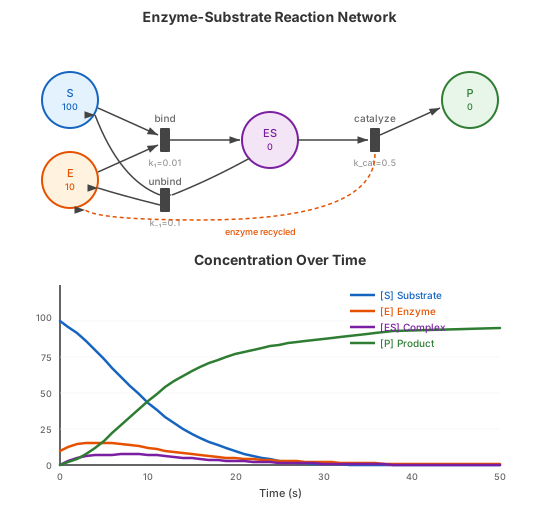
The arc structure encodes the chemistry directly:
substrate --> bind --> complex --> catalyze --> product
enzyme -->          /              enzyme <--+
             unbind
complex --> unbind --> substrate
                  --> enzyme
The enzyme appears as both input and output of catalyze — it’s consumed when the complex forms and returned when the product is released. This cyclic flow is the structural signature of catalysis.
In Code
net, rates := petri.Build().
    Place("substrate", 100).
    Place("enzyme", 10).
    Place("complex", 0).
    Place("product", 0).
    Transition("bind").
    Transition("unbind").
    Transition("catalyze").
    Arc("substrate", "bind", 1).
    Arc("enzyme", "bind", 1).
    Arc("bind", "complex", 1).
    Arc("complex", "unbind", 1).
    Arc("unbind", "substrate", 1).
    Arc("unbind", "enzyme", 1).
    Arc("complex", "catalyze", 1).
    Arc("catalyze", "product", 1).
    Arc("catalyze", "enzyme", 1).
    WithRates(map[string]float64{
        "bind":     0.01,
        "unbind":   0.1,
        "catalyze": 0.5,
    })
The net is complete. Four places, three transitions, nine arcs. Every biochemistry textbook’s enzyme kinetics chapter is encoded in this structure.
Mass-Action Kinetics as Native Semantics
With mass-action kinetics, each transition fires at a rate proportional to the product of its input concentrations:
The ODE system follows directly from the Petri net topology. Using the incidence matrix and rate vector :
We didn’t write these equations. They emerged from the net structure and mass-action kinetics — exactly the process described in Chapter 3. The incidence matrix encodes all the stoichiometry. The mass-action rate law provides the dynamics. The ODE solver does the rest.
Emergent Michaelis-Menten Behavior
At steady state (), the complex concentration stabilizes:
Solving for the reaction rate and using :
where and .
This is the Michaelis-Menten equation. The algebra above is only confirmation — the ODE solver produces the saturation curve directly from the Petri net without it. Running the simulation with increasing initial substrate concentrations traces out the classic hyperbolic curve: rate increases linearly at low [S], then levels off as enzyme becomes saturated.
The Saturation Effect
Why does the rate saturate? The Petri net makes it visible through token flow.
At low substrate, most enzyme tokens are in the enzyme place (free). Increasing [S] means more bind events, so the rate climbs linearly. But at high substrate, almost all enzyme tokens are tied up in complex. Adding more substrate can’t speed things up — there’s no free enzyme to bind with.
is the substrate concentration at half-maximum rate. It measures binding affinity. With the default parameters: . You need 60 substrate molecules to reach half the maximum rate.
is the theoretical maximum rate when all enzyme is saturated. With 10 enzyme molecules and : .
Both constants emerge from the simulation without being computed algebraically.
Simulation Predictions
The ODE solver computes several predictions from the initial conditions and rate constants:
| Prediction | Default Value | What It Means |
|---|---|---|
| Time to 50% conversion | ~17s | When half the substrate is consumed |
| Peak reaction rate | ~2.95 | Maximum d[P]/dt, approaches Vmax |
| Final yield | ~70% | Percentage of substrate converted |
| / | 60 / 5.0 | The Michaelis-Menten constants |
The concentration curves show the classic pattern: substrate depletes as product accumulates, with the enzyme-substrate complex rising quickly then falling as substrate runs out.
Conservation Laws from P-Invariants
The Petri net enforces conservation laws automatically through its structure:
Enzyme conservation:
Free enzyme plus bound enzyme always equals the initial enzyme count. This isn’t coded as a constraint — it’s a structural property of the net. The enzyme token circulates through enzyme → complex → enzyme but never leaves the system.
Check via P-invariant: the weight vector (for places [substrate, enzyme, complex, product]) satisfies :
bindcolumn:unbindcolumn:catalyzecolumn:
Mass conservation:
Substrate is either free, bound in complex, or converted to product. Mass is conserved because every arc that removes a token from one place adds it to another.
These invariants are verified at every timestep of the ODE simulation. If they ever fail, something is wrong with the model — a missing arc, an incorrect weight, a bug in the solver. Conservation laws are free structural correctness checks.
Parameter Exploration and Sensitivity
The model invites exploration by changing rate constants:
High enzyme, low substrate (): The reaction completes almost instantly. All substrate is converted because there’s plenty of enzyme. The rate curve is a sharp spike.
Low (): Binding becomes the bottleneck. shoots up to 600, meaning enormous substrate concentrations are needed for half-max rate. The enzyme is effectively less efficient.
High (): The enzyme turns over faster. increases to 20, but also increases to 210. Faster catalysis means the complex is consumed faster, so more substrate is needed to keep it populated.
Equal and (): Half the binding events are “wasted” on unbinding. — higher than default. The enzyme is less efficient.
Each parameter change is a different set of rate constants on the same net. The structure stays the same. The dynamics change. This is the pattern throughout the book: one model, many scenarios.
From Chemistry to Everything
The Michaelis-Menten pattern appears far beyond biochemistry. Anywhere a limited resource cycles between free and occupied states, the same saturation dynamics emerge:
- CPU scheduling: processes (substrate) compete for cores (enzyme), creating context-switch overhead (complex formation)
- Customer service: customers (substrate) wait for agents (enzyme), with a queue (complex) that saturates
- Manufacturing: raw materials (substrate) need machines (enzyme), with work-in-progress (complex) limited by machine count
In each case, the Petri net structure is identical — only the labels change. Four places, three transitions, nine arcs. The same and characterize the system’s capacity and responsiveness.
This is the ComputationNet pattern from Chapter 4 in its purest form: continuous quantities, rate-based firing, conservation laws, and emergent behavior from structure. The enzyme kinetics model is the smallest non-trivial example — small enough to understand completely, yet producing one of the most important results in biochemistry.
Complex State Machines — Texas Hold’em
Learning objective: Model multi-player, multi-phase systems with roles and guards.
The previous chapters built progressively: resources (coffee shop), two-player games (tic-tac-toe), constraint puzzles (Sudoku), optimization (knapsack), and chemistry (enzyme kinetics). Each used a focused subset of Petri net features. Texas Hold’em poker demands all of them simultaneously: sequential phases, multi-player turn control, role-based permissions, conditional betting, and event sourcing for audit trails.
This chapter shows that the formalism scales. The same four-term primitive — cell, func, arrow, guard — handles a system with dozens of states, multiple interacting players, and complex conditional logic. No new machinery is needed. The complexity is in the model, not the formalism.
The Challenge
Poker has intricate state:
- Phases: preflop → flop → turn → river → showdown — a sequential state machine
- Turn order: Players act in sequence, skipping folded players
- Actions: fold, check, call, raise — each with preconditions on chips, bets, and game state
- Roles: Only the dealer can deal cards, only active players can bet, only the admin can determine winners
- Audit: Every action must be logged for replay and verification
Traditional implementations scatter this logic across conditionals, state variables, and validation functions. A Petri net makes it explicit: the structure is the specification. Illegal states are structurally unreachable rather than checked-for at runtime.
Phase Places
The core flow is a WorkflowNet — a sequential state machine where a single token traces a path through phases:
waiting -> preflop -> flop -> turn_round -> river -> showdown -> complete
Each phase is a place. Phase transitions move the game forward:
preflop --> deal_flop --> flop
             ^
betting_done +
The deal_flop transition requires two things: a token in preflop (we’re in that phase) and a token in betting_done (all players have acted). Both must be present for the transition to fire. This ensures cards aren’t dealt mid-betting.
The phase token is a cursor — exactly one phase place holds a token at any time. The P-invariant:
This is the WorkflowNet guarantee: mutual exclusion. The game is always in exactly one phase.
Turn Tokens and Role-Based Access
Each player has a turn place: p0_turn, p1_turn, …, p4_turn. When it’s Player 0’s turn, only p0_turn holds a token. Player actions consume their turn token and produce the next player’s:
p0_check:
  inputs:  [p0_turn, p0_active]
  outputs: [p1_turn]
Player 0 can only check when two conditions hold: it’s their turn (p0_turn has a token) AND they’re still in the hand (p0_active has a token). After checking, the turn token moves to Player 1.
This is the same turn control mechanism from tic-tac-toe (Chapter 6), generalized to N players. The token passes in sequence, enforcing strict turn order without explicit checks.
Folding and Skipping
When a player folds, their p_active token is consumed:
p2_fold:
  inputs:  [p2_turn, p2_active]
  outputs: [p3_turn]
  // Note: p2_active is NOT returned
Subsequent rounds must skip folded players. A skip transition handles this:
p2_skip:
  inputs:  [p2_turn]  // No p2_active required
  outputs: [p3_turn]
  guard:   {!p2_active}  // Only fire when player is folded
The guard ensures the skip only fires for folded players. Active players can’t be skipped — they must act. This combination of structural enabling (turn tokens) and guards (active status) handles the full complexity of variable-player turn order.
Betting Conditions as Guard Expressions
Some actions require conditions beyond token availability. Guards from Chapter 4 handle this:
(action p0_raise
  :guard {bets[0] >= current_bet && chips[0] >= raise_amount})
This ensures:
- Player has matched the current bet (can’t raise without calling first)
- Player has enough chips to raise
Guards add business logic without changing the Petri net structure. The net handles what can happen (which transitions exist). Guards handle when it can happen (what conditions must hold). This separation is essential for complex systems — the structural properties (deadlock freedom, mutual exclusion) can be verified from the net alone, independent of the guard expressions.
The Full Action Set
For each player, four actions with their preconditions:
| Action | Preconditions | Effect |
|---|---|---|
fold | Turn token + active | Remove from hand |
check | Turn token + active + no outstanding bet | Pass action |
call | Turn token + active + sufficient chips | Match current bet |
raise | Turn token + active + sufficient chips | Increase bet |
Five players × four actions = 20 player transitions, plus 5 skip transitions for folded players, plus 7 phase transitions (start, deal flop/turn/river, showdown, determine winner, end hand). Total: 32 transitions.
The Model Structure
The full model:
Places (18+):
  waiting, preflop, flop, turn_round,     -- Phase places
  river, showdown, complete
  p0_turn, p1_turn, p2_turn,              -- Turn tokens
  p3_turn, p4_turn
  p0_active, p1_active, p2_active,        -- Active markers
  p3_active, p4_active
  betting_done                            -- Sync signal

Transitions (32):
  start_hand, deal_flop, deal_turn,        -- Phase transitions
  deal_river, go_showdown,
  determine_winner, end_hand
  p0_fold, p0_check, p0_call, p0_raise,   -- Player 0 actions
  p1_fold, p1_check, p1_call, p1_raise,   -- Player 1 actions
  ...                                      -- (5 players x 4 actions)
  p0_skip, p1_skip, ...                    -- Skip folded players
Role-Based Access Control
Not all transitions are available to all players. The model uses roles to restrict who can fire which transitions:
| Role | Transitions | Purpose |
|---|---|---|
dealer | deal_flop, deal_turn, deal_river | Only dealer advances phases |
player0 | p0_fold, p0_check, p0_call, p0_raise | Player-specific actions |
admin | end_hand, determine_winner | Game control |
When deployed as a service, the API enforces these roles — a player can’t fire another player’s transitions. The Petri net defines what each role can do; the runtime enforces who has which role.
Event Sourcing for Audit Trails
Every transition firing creates an immutable event:
[
  {"action": "start_hand", "time": "10:00:00"},
  {"action": "p0_raise", "amount": 50, "time": "10:00:15"},
  {"action": "p1_call", "time": "10:00:23"},
  {"action": "p2_fold", "time": "10:00:31"},
  {"action": "deal_flop", "cards": ["Ah", "Ks", "7d"], "time": "10:00:35"}
]
The Petri net’s discrete transitions map perfectly to event sourcing:
- Replay: Given the initial marking and the event sequence, reconstruct any game state by replaying transitions
- Audit: Verify that every transition was enabled when it fired — illegal moves are provably impossible
- Undo: Roll back to any previous state by replaying up to that point
This is the event sourcing pattern, revisited in Chapter 20: . Each event is a transition firing. Each state is a marking. The fold is the firing rule applied sequentially.
ODE Analysis of Game Flow
While the game runs discretely, ODE simulation provides strategic analysis. Converting the Petri net to continuous dynamics lets us evaluate position strength:
// For each possible action, create hypothetical state
// and simulate forward
for _, action := range availableActions {
    hypState := stateutil.Apply(currentState, action.Delta)

    prob := solver.NewProblem(net, hypState,
        [2]float64{0, 5.0}, rates)
    sol := solver.Solve(prob, solver.Tsit5(), solver.FastOptions())
    final := sol.GetFinalState()

    score := final["win_p0"] - final["win_p1"]
}
The ODE simulation explores possible game continuations:
- Higher flow to
win_p0indicates stronger positions - Raising in a strong position increases flow to win places
- Folding prevents further loss when position is weak
This is the same pattern as tic-tac-toe (Chapter 6), but with a much larger state space. The strategic insights are less precise — poker has hidden information (hole cards) that the ODE can’t fully model — but they provide useful guidance for position evaluation.
Hand Strength from Structure
The poker model can include draw potential places that track partial hands:
flush_draw: 4 cards of the same suitstraight_draw: 4 cards in sequenceovercards: hole cards above board cards
These places feed into scoring transitions that evaluate hand strength. The ODE simulation integrates over possible completions, producing an aggregate strength score. Combined with opponent range estimation (which hands the opponent likely holds given their actions), this creates a complete decision framework.
Compositional Design
The Texas Hold’em model is a composition of simpler patterns:
- WorkflowNet — Phase sequence (waiting → preflop → … → complete)
- ResourceNet — Chip tracking (bet placement, pot management)
- GameNet — Turn control and player actions
- Guards — Conditional betting logic
Each pattern is independently verifiable:
- The phase sequence guarantees mutual exclusion (one phase at a time)
- Chip tracking preserves conservation (total chips constant)
- Turn control ensures exactly one player acts at a time
- Guards prevent illegal bets
Composition adds links between patterns — the betting_done signal connects turn control to phase advancement — without breaking any individual guarantee. This is the assume-guarantee reasoning from Chapter 4: verify components in isolation, check only the boundaries.
Why Petri Nets for Complex Systems
Traditional game code mixes state, rules, and UI into monolithic logic. A Petri net separates concerns:
- Structure = What’s possible (places, transitions, arcs)
- State = What’s current (token marking)
- Rules = What’s allowed (guards, roles)
- History = What happened (events)
This separation makes complex systems:
- Verifiable: Prove invariants (one player acts at a time, chips conserved)
- Replayable: Deterministic event sequence from any initial state
- Analyzable: ODE simulation for strategy, reachability for deadlock detection
- Evolvable: Add rules (side pots, all-in) without rewriting existing logic
Texas Hold’em is at the complex end of the spectrum covered in Part II. It combines every pattern from the previous chapters into a single model. The formalism doesn’t struggle with this complexity — it absorbs it. The four-term primitive handles a coffee shop, a tic-tac-toe board, a Sudoku grid, a knapsack, an enzyme reaction, and a poker table with the same vocabulary.
Part III of this book shifts focus from building models to analyzing them — process mining, zero-knowledge proofs, and the tooling that makes Petri net development practical.
Process Mining
Learning objective: Discover Petri net models from event logs and use them for prediction.
The previous chapters built Petri net models by hand — designing places, transitions, and arcs to capture known rules. But what about systems where the rules aren’t written down? Where the actual process diverges from the official procedure? Process mining reverses the direction: instead of building a model and running it, you collect data from a running system and discover the model automatically.
This chapter covers the complete pipeline: event logs as raw material, discovery algorithms that extract Petri net structure, timing analysis that learns transition rates, and predictive monitoring that uses the learned model to forecast outcomes before they happen.
Event Logs: The Raw Material
Every information system generates event logs. Hospital admissions systems record when patients register, get triaged, see a doctor, and are discharged. ERP systems record when orders are placed, approved, shipped, and invoiced. The events are already there — process mining extracts structure from them.
An event log has three required fields:
| Field | Example | Purpose |
|---|---|---|
| Case ID | P101 | Which process instance |
| Activity | Registration | What happened |
| Timestamp | 2024-11-21 08:15:00 | When it happened |
Optional fields — resource (who did it), lifecycle (start/complete), cost, outcome — enrich the analysis but aren’t required for discovery.
A trace is the sequence of activities for a single case. Patient P101’s trace might be:
Registration -> Triage -> Doctor_Consultation -> Discharge
Patient P102, who needed lab work:
Registration -> Triage -> Doctor_Consultation -> Lab_Test -> Results_Review -> Discharge
These are process variants — different paths through the same system. In a typical hospital ER, the simple path (no lab, no imaging) accounts for about 60% of cases. Adding lab tests covers another 30%. X-rays, surgery, and other branches handle the remaining 10%. Process mining discovers these variants automatically from the log data.
Loading Event Logs
config := eventlog.DefaultCSVConfig()
log, _ := eventlog.ParseCSV("hospital_er.csv", config)

summary := log.Summarize()
// Parsed 1000 cases with 5200 events
// Found 6 unique activities
// Discovered 4 process variants
The eventlog package handles CSV and JSONL formats with configurable column mappings. The summary immediately reveals the process’s complexity: how many variants exist, how many activities are involved, and how many cases the log contains.
Process Discovery
Given an event log, a discovery algorithm produces a Petri net that explains the observed behavior. Three algorithms illustrate the design space.
Common-Path Discovery
The simplest approach: find the most frequent trace variant and build a linear Petri net for it.
Variant 1 (60% of cases): Reg -> Triage -> Doctor -> Discharge

Discovered model:
[start] -> Reg -> [p1] -> Triage -> [p2] -> Doctor -> [p3] -> Discharge -> [end]
Each activity becomes a transition. Places are inserted between transitions to carry the control flow token. A token in start means the case has arrived; a token in end means it’s complete; a token in p2 means the patient has been triaged and is waiting for the doctor.
Common-path discovery is fast and always produces a valid model, but it ignores all variant behavior. It’s useful as a starting point or when the process is genuinely linear.
discovery, _ := mining.Discover(log, "common-path")
net := discovery.Net
// Model covers 60% of cases
The Alpha Algorithm
The Alpha algorithm, introduced by van der Aalst in 2004, discovers concurrent structure — not just sequences. It works by analyzing ordering relations between activities.
The algorithm builds a footprint matrix from the event log. For every pair of activities (A, B), it classifies their relationship:
| Relation | Symbol | Meaning |
|---|---|---|
| Causality | A → B | A directly precedes B, never vice versa |
| Parallel | A ‖ B | Both orderings observed (A before B and B before A) |
| Choice | A # B | Neither ordering observed (exclusive alternatives) |
Given traces:
Case 1: A -> B -> D -> E
Case 2: A -> C -> D -> E
The footprint matrix reveals: A → B (causal), A → C (causal), B # C (choice — they never co-occur), B → D and C → D (both causal), D → E (causal).
From these relations, the Alpha algorithm constructs a Petri net:
       -> [B] ->
[A] ->          [D] -> [E]
       -> [C] ->
B and C are alternative paths after A, both converging at D. The algorithm discovers this branching structure automatically — no human specified that B and C are alternatives.
The implementation builds place candidates from maximal pairs of causally connected activity sets, then filters to keep only maximal candidates:
miner := mining.NewAlphaMiner(log)
net := miner.Mine()
The Alpha algorithm has known limitations: it can’t handle loops of length 1 or 2, and it’s sensitive to noise in the log. For real-world data, the heuristic miner is more robust.
Heuristic Miner
The heuristic miner adds noise tolerance by counting how often each activity pair occurs and applying thresholds:
Observations:
A -> B: 100 times
A -> C: 95 times
B -> D: 85 times
C -> X: 2 times   <-- noise (only 2% of cases)
With a 5% threshold, the C → X edge is filtered out. The resulting model is cleaner and more representative of the actual process, at the cost of ignoring rare behavior.
Timing Analysis and Rate Learning
Discovery tells us the process structure — which activities exist and how they connect. Timing analysis tells us the dynamics — how long each activity takes and how fast cases flow through the system.
Extracting Timing Statistics
stats := mining.ExtractTiming(log)

// Per-activity statistics
meanTriage := stats.GetMeanDuration("Triage")       // 615 seconds (10.3 min)
stdTriage := stats.GetStdDuration("Triage")          // 192 seconds
rateTriage := stats.EstimateRate("Triage")           // 0.001626 /sec
The ExtractTiming function computes, for each activity: mean duration, standard deviation, occurrence count, and estimated rate. It also computes inter-arrival times (how frequently new cases appear) and total case durations (end-to-end cycle time).
From Durations to Rates
The key conversion: . If triage takes an average of 10 minutes, the triage rate is per second. This assumes exponentially distributed service times — the same memoryless property that mass-action kinetics uses.
For a hospital ER with six activities:
| Activity | Mean Duration | Estimated Rate |
|---|---|---|
| Registration | 12.5 min | 0.00133 /sec |
| Triage | 27.5 min | 0.000606 /sec |
| Doctor_Consultation | 31.2 min | 0.000533 /sec |
| Lab_Test | 97.5 min | 0.000171 /sec |
| Results_Review | 50.0 min | 0.000333 /sec |
| Discharge | 15.0 min | 0.00111 /sec |
The bottleneck is immediately visible: Lab_Test has the lowest rate, meaning it takes the longest. Any effort to reduce end-to-end time should target the lab.
Learning Rates for Simulation
The learned rates plug directly into the ODE solver:
rates := mining.LearnRatesFromLog(log, net)

initialState := net.SetState(nil)
prob := solver.NewProblem(net, initialState, [2]float64{0, 10000}, rates)
sol := solver.Solve(prob, solver.Tsit5(), solver.DefaultOptions())
The simulation now uses rates derived from actual data rather than guesses. The ODE dynamics reproduce the observed flow patterns: tokens accumulate before the lab (the bottleneck), flow smoothly through registration and triage (fast steps), and drain out through discharge.
This closes the loop: event log → discovered model → learned rates → simulation → prediction. The same Petri net formalism works for hand-crafted models (Parts I and II) and data-driven models (this chapter). The mathematics doesn’t care where the model came from.
Predictive Monitoring
With a learned model, we can predict the future. A patient who has completed registration and triage but not yet seen a doctor — what’s their expected remaining time? Will they violate the 4-hour SLA?
State Estimation
The first step is mapping the patient’s event history to a Petri net marking. Each observed activity corresponds to firing a transition:
currentState := monitoring.EstimateCurrentState(activeCase, net)
The function replays the event history through the net: start with a token in the start place, fire each observed transition in sequence, and the resulting marking represents the patient’s current position in the process. If the patient has completed Registration and Triage, the token sits in the place between Triage and Doctor_Consultation.
Simulation-Based Prediction
From the current state, the ODE solver simulates forward to predict completion:
predictor := monitoring.NewPredictor(net, rates)
pred := predictor.PredictFromState(currentState, currentTime)

remainingTime := pred.PredictedEndTime - pred.CurrentTime
confidence := pred.Confidence
The predictor watches for a token to arrive in the end place. The time at which the token crosses a threshold (0.5) is the predicted completion time. The confidence score reflects how much token mass reaches the end — higher confidence means the simulation is more certain about the outcome.
SLA Violation Detection
The real value is early warning. At 9:30 AM, a patient who arrived at 8:00 AM has been in the system for 90 minutes. The model predicts 180 more minutes of processing (lab test is the bottleneck). Total predicted time: 270 minutes. The 4-hour SLA (240 minutes) will be violated.
The alert fires 2.5 hours before the violation — enough time for intervention. Expedite the lab order, assign additional staff, or notify the patient about the expected wait.
Next Activity Prediction
Beyond completion time, the model predicts which activity happens next and how likely each option is:
predictions := monitoring.PredictNextActivity(activeCase, predictor)
// [{Activity: "Doctor_Consultation", Probability: 0.85, ExpectedTime: 15min},
//  {Activity: "Lab_Test", Probability: 0.15, ExpectedTime: 45min}]
The prediction uses mass-action kinetics: each enabled transition fires at a rate proportional to its rate constant times the product of its input place tokens. The transition with the highest effective rate is most likely to fire first. The probability is the ratio of each transition’s effective rate to the total.
The Hospital ER Case Study
Putting it all together with the mining demo:
// 1. Parse event log
log, _ := eventlog.ParseCSV("hospital.csv", config)
// 1000 cases, 5200 events, 6 activities, 4 variants

// 2. Extract timing
stats := mining.ExtractTiming(log)
// Registration: 12.5 min, Triage: 27.5 min, Doctor: 31.2 min
// Lab_Test: 97.5 min (bottleneck), Results_Review: 50.0 min

// 3. Discover model
discovery, _ := mining.Discover(log, "common-path")
net := discovery.Net
// 7 places, 6 transitions, covers 60% of cases

// 4. Learn rates
rates := mining.LearnRatesFromLog(log, net)

// 5. Simulate
prob := solver.NewProblem(net, net.SetState(nil), [2]float64{0, 10000}, rates)
sol := solver.Solve(prob, solver.Tsit5(), solver.DefaultOptions())

// 6. Use for prediction
predictor := monitoring.NewPredictor(net, rates)
The discovered model matches the observed behavior: tokens flow from registration through discharge, accumulating before the lab (the bottleneck). The simulation predicts an average case duration of ~166 minutes, consistent with the timing statistics extracted from the log.
What-If Analysis
The learned model enables scenario planning. “What if we add another lab technician?” — double the Lab_Test rate and re-simulate. “What if we add a fast-track for simple cases?” — add a bypass transition from Doctor to Discharge with a guard on case complexity.
Each scenario is a parameter change or structural modification to the same Petri net. The ODE solver produces updated predictions in milliseconds. No new data collection needed — just adjust the model and simulate.
Conformance Checking
Discovery produces a model. Conformance checking asks: how well does the model match reality?
Fitness measures how many traces in the log can be replayed on the model. If the model says A must precede B, but a trace shows B before A, that trace doesn’t fit. Fitness = (fitting traces) / (total traces). A fitness of 1.0 means every trace is consistent with the model.
Precision measures how much of the model’s allowed behavior actually occurs. A model that allows everything has perfect fitness but zero precision — it’s too general to be useful. A model that captures only the observed paths has high precision.
Good models balance both: high fitness (captures real behavior) with high precision (doesn’t over-generalize). The trade-off is complexity — more complex models fit more traces but allow more unobserved paths.
conf := mining.CheckConformance(log, net)
// Fitness: 0.87, FittingTraces: 870/1000
The 13% non-fitting traces represent process variants not captured by the common-path model. Switching to the Alpha algorithm or heuristic miner would increase fitness at the cost of model complexity.
Generator and Recognizer: Closing the Loop
Process mining infers structure from observations. There is a complementary move worth naming: executing a declared structure to produce observations. Both end at the same artifact — a Petri net — but they travel in opposite directions.
Take a streaming pipeline of the kind Apache Beam popularised: a chain of
windowed aggregations over a keyed event stream. The tokenmodel/dataflow
package lowers such a pipeline to a bundle of Petri net subnets — one per
key, one per (key, window) accumulator, one for the watermark. Feed the
pipeline an event stream and every order, every ingredient unit, every
window pane becomes a token in the net. The pipeline is the generator.
Mining is the recognizer. Give it the execution trace and ask it to recover the structure that produced it:
log := pipeline.ToEventLog()
res, _ := mining.DiscoverPipeline(log, mining.PipelineDiscoveryOptions{
    IdealEventsPerWindow: 7,
})
// Recovered: window kind=fixed, size≈60min, 6 keys — matches the spec.
Run a coffee shop’s worth of orders through the lowered pipeline, export
the input history, and DiscoverPipeline recovers the original window
strategy, key set, and trigger family from the inter-arrival statistics
alone. The window size it recovers is heuristic — the stream’s timing
cannot reveal that “60 minutes” was chosen because that’s an hour — but
the qualitative structure is exact.
This is the same duality that runs through the whole book, made explicit:
- Generator is total and deterministic — a spec fully determines the net.
- Recognizer is partial and statistical — a log under-determines the net, which is why we have algorithms like Alpha and the heuristic miner to choose between candidates.
The two directions meet in the middle, at the Petri net. Whether you arrive by declaration or by induction, the resulting object obeys the same incidence matrix, the same conservation laws, the same simulation dynamics. That is the practical reason the formalism is worth the investment: it gives you one mathematical surface on which generator and recognizer can compose.
From Data to Model to Prediction
Process mining completes the Petri net toolkit. Parts I and II showed how to build models from domain knowledge — encoding rules as structure. This chapter shows how to extract models from data — discovering rules from behavior.
The pipeline:
- Collect event logs from existing systems
- Discover process structure using mining algorithms
- Learn transition rates from timestamps
- Validate via conformance checking and simulation
- Predict using ODE simulation with learned parameters
- Intervene based on early warnings
The same Petri net formalism handles both directions. A coffee shop model built by hand (Chapter 5) and a hospital process discovered from logs produce the same mathematical object: places, transitions, arcs, rates. The ODE solver doesn’t know or care which one was hand-crafted and which was mined. The incidence matrix, conservation laws, and simulation dynamics work identically.
This is the practical payoff of a universal formalism. Process mining connects Petri nets to the real world — any system that generates event logs can be modeled, analyzed, and predicted.
Zero-Knowledge Proofs
Learning objective: Prove a state transition is valid without revealing the state.
Every Petri net model in this book has been transparent — all token counts visible to all participants. The coffee shop owner sees inventory levels. Both tic-tac-toe players see the board. The hospital monitor sees patient states. But some applications require privacy. A voter should prove they cast a valid ballot without revealing their choice. A financial institution should verify a transfer is valid without exposing account balances. A player should prove their move is legal without revealing their strategy.
Zero-knowledge proofs make this possible. The key insight: a Petri net is already a formal specification of valid state transitions. A ZK circuit turns that specification into a cryptographic proof system. The prover demonstrates they followed the rules; the verifier confirms it without seeing the state.
The Statement Being Proven
Every ZK proof in this system proves one statement:
“I know a valid marking that, when transition T fires, produces the claimed next state.”
More precisely:
- The pre-state root (a hash) matches a specific private marking
- The post-state root matches a specific private marking
- The chosen transition was enabled — all input places had sufficient tokens
- The marking change is correct — post = pre + delta, where delta comes from the net topology
The verifier sees only the two state roots and the transition ID. The actual token counts remain hidden.
Public vs. Private
| What | Who Sees It | |
|---|---|---|
| Public | Pre-state root (hash) | Everyone |
| Public | Post-state root (hash) | Everyone |
| Public | Transition ID | Everyone |
| Private | Pre-marking (all token counts) | Prover only |
| Private | Post-marking (all token counts) | Prover only |
The state roots are commitments. They bind the prover to a specific marking without revealing it.
State Commitment via MiMC Hashing
The hash function matters. Inside a ZK circuit, every operation becomes arithmetic constraints on a finite field. SHA-256 needs thousands of boolean operations — roughly 25,000 constraints per hash. MiMC (Minimum Multiplicative Complexity) is designed for arithmetic circuits — it operates over the same finite field the circuit uses, costing roughly 300 constraints per hash.
func petriMimcHash(api frontend.API, values []frontend.Variable) frontend.Variable {
    h, _ := mimc.NewMiMC(api)
    for _, v := range values {
        h.Write(v)
    }
    return h.Sum()
}
The state root is:
To recover the actual token counts from a state root, an attacker would need to invert MiMC — computationally infeasible. The hash commits the prover to a specific marking without revealing it.
The Circuit in Five Steps
The gnark circuit for a Petri net transition proof has five steps. Each adds constraints that the prover must satisfy.
Step 1: Hash the Pre-Marking
Compute the MiMC hash of every place’s token count and assert it equals the public pre-state root:
preRoot := petriMimcHash(api, c.PreMarking[:])
api.AssertIsEqual(preRoot, c.PreStateRoot)
This binds the private marking to the public commitment. The prover can’t lie about what state they started from.
Step 2: Hash the Post-Marking
Same check for the post-state:
postRoot := petriMimcHash(api, c.PostMarking[:])
api.AssertIsEqual(postRoot, c.PostStateRoot)
Now both states are committed.
Step 3: Compute the Delta from Topology
From the transition ID, look up the Petri net topology to build a delta vector. The topology is baked into the circuit as constants — the incidence matrix encoded as input/output lists:
for t := 0; t < NumTransitions; t++ {
    isThis := api.IsZero(api.Sub(c.Transition, t))

    for _, p := range Topology[t].Inputs {
        deltas[p] = api.Sub(deltas[p], isThis)
    }
    for _, p := range Topology[t].Outputs {
        deltas[p] = api.Add(deltas[p], isThis)
    }
}
The isThis variable is 1 for the selected transition and 0 for all others. This multiplexes over all transitions without branching — arithmetic circuits can’t branch, so we compute all possibilities and select. Only the chosen transition’s delta contributes to the result.
Step 4: Assert Marking Change
For every place, check that the post-marking equals the pre-marking plus the delta:
for p := 0; p < NumPlaces; p++ {
    expected := api.Add(c.PreMarking[p], deltas[p])
    api.AssertIsEqual(c.PostMarking[p], expected)
}
This ensures the marking changed exactly as the topology dictates. No extra tokens appeared. No tokens vanished. The transition fired correctly.
Step 5: Assert Enabledness
For every input place of the selected transition, the pre-marking must have at least one token:
diff := api.Sub(c.PreMarking[p], isInput)
api.ToBinary(diff, 8)
The trick: ToBinary decomposes a value into bits. If the value were negative (insufficient tokens), it would wrap to a huge field element and the bit decomposition would fail — the proof can’t be generated. This is a standard gnark pattern for range checks: decompose into bits to prove non-negativity.
Topology as Circuit Constants
The most important property of this approach: the Petri net topology is baked into the circuit as constants.
var Topology = [NumTransitions]struct {
    Inputs  []int
    Outputs []int
}{
    {Inputs: []int{0, 1}, Outputs: []int{2}},    // bind
    {Inputs: []int{2}, Outputs: []int{0, 1}},     // unbind
    {Inputs: []int{2}, Outputs: []int{3, 1}},     // catalyze
}
This means:
- No application-specific logic in the circuit. The same
Define()method works for any Petri net. - Topology changes require recompilation. Adding a place or transition means a new trusted setup.
- The circuit is auditable. Anyone can inspect the topology to verify it matches the claimed rules.
The Petri net is the specification. The circuit is the verifier. The proof is the attestation that the specification was followed.
Groth16 Proofs
The proving system is Groth16, implemented by gnark. It requires a one-time trusted setup per circuit but produces:
- Smallest proofs: ~128 bytes (2 G1 points + 1 G2 point)
- Fastest verification: ~2ms, constant regardless of circuit size
- Solidity export: gnark generates a ready-to-deploy verifier contract
| Property | Groth16 | PLONK | STARKs |
|---|---|---|---|
| Proof size | ~128 B | ~400 B | ~50 KB |
| Verification | ~2ms | ~5ms | ~50ms |
| Trusted setup | Per-circuit | Universal | None |
| Quantum-safe | No | No | Yes |
For applications with small circuits and many proofs — like games or token transfers — Groth16’s compact proofs and fast verification dominate.
ZK Tic-Tac-Toe: A Complete Example
The ZK build of tic-tac-toe uses a variant of the Chapter 6 model with 33 places and 35 transitions (Chapter 6’s model has 30 and 34; the ZK variant uses separate x_turn/o_turn places and a game_active flag). It uses two circuits, both encoding the full Petri net:
PetriTransitionCircuit proves a move is legal. It’s the general circuit described above — works for any transition in the net. Used for every move.
PetriWinCircuit proves a player has won. The win condition is already in the Petri net topology (win-detection transitions from Chapter 6 fire when three cells align). The circuit checks that the win_x or win_o place has a token:
func (c *PetriWinCircuit) Define(api frontend.API) error {
    root := petriMimcHash(api, c.Marking[:])
    api.AssertIsEqual(root, c.StateRoot)

    winTokens := frontend.Variable(0)
    for p := 0; p < NumPlaces; p++ {
        isWinnerPlace := api.IsZero(api.Sub(c.Winner, p))
        winTokens = api.Add(winTokens, api.Mul(c.Marking[p], isWinnerPlace))
    }
    api.ToBinary(api.Sub(winTokens, 1), 8) // >= 1 token
    return nil
}
Because the game logic lives in the net topology, the circuit doesn’t know anything about tic-tac-toe. Change the topology constants and you get ZK proofs for a different game.
Constraint Counts
For the 33-place, 35-transition tic-tac-toe net:
| Component | Constraints | Purpose |
|---|---|---|
| MiMC hash (pre) | ~300 | State root verification |
| MiMC hash (post) | ~300 | State root verification |
| Transition delta | ~2,300 | Topology multiplexing |
| Marking assertion | ~33 | post = pre + delta |
| Enabledness | ~264 | Bit decomposition per place |
| Total | ~3,200 | Full transition proof |
Proof generation takes ~100ms on commodity hardware. Verification takes ~2ms. The circuit compiles once; proofs are generated per-move.
The Game Protocol
A complete ZK tic-tac-toe game works as:
Initial: state_hash = hash(empty_board)

Round n:
  1. Current player fires transition locally (computes new marking)
  2. Computes new_state_hash = MiMC(new_marking)
  3. Generates Groth16 proof: (old_hash, new_hash, transition_id, proof)
  4. Opponent verifies proof (~2ms)
  5. If valid: state_hash = new_hash, continue
  6. If invalid: cheating detected, game forfeited
The opponent knows which transition fired (the move is public) but doesn’t see the full board state. Win detection is a separate proof demonstrating that a win place has a token.
Beyond Games: Token Transfers
The same circuit structure handles blockchain token transfers. An ERC-20 transfer is a Petri net transition:
balances[from]is an input place (tokens consumed)balances[to]is an output place (tokens produced)- The guard
balances[from] >= amountis the enabledness check
A note on what that guard is. In the net it is a read of balances[from] — a contextual arc, not a column of the incidence matrix — and contextual arcs are exactly the thing that stops a net from generating the free symmetric monoidal category of Appendix E. Inside the circuit that distinction disappears: a proof certifies one firing, one firing has only interleaving semantics, and under interleaving semantics a read arc and a consume-then-restore self-loop are the same thing. So encoding the guard as a range check on a witnessed balance is an exact encoding, not an approximation. The boundary the circuit cannot erase is the other one — a transition with more inputs than outputs still costs a non-uniform constraint block, because that is a fact about and the circuit is compiled from .
The arcnet project extends this with Merkle trees for account balances, enabling L1-to-L2 bridge verification:
func (c *TransferCircuit) Define(api frontend.API) error {
    // Guard: balance >= amount
    diff := api.Sub(c.BalanceFrom, c.Amount)
    api.ToBinary(diff, 64)

    // Verify Merkle inclusion
    leaf := mimcHash(api, c.From, c.BalanceFrom)
    current := leaf
    for i := 0; i < 20; i++ {
        left := api.Select(c.PathIndices[i], c.PathElements[i], current)
        right := api.Select(c.PathIndices[i], current, c.PathElements[i])
        current = mimcHash(api, left, right)
    }
    api.AssertIsEqual(current, c.PreStateRoot)
    return nil
}
The 20-level Merkle proof means the full state doesn’t need to live on-chain. Only state roots are published. The bridge contract verifies the proof and updates the root.
| Application | Places | Transition | Enabledness |
|---|---|---|---|
| Tic-Tac-Toe | 33 board+game states | Player move | Cell empty, correct turn |
| ERC-20 Transfer | Account balances | Transfer | Sufficient balance |
| Workflow | Process stages | State change | Required approvals |
| Voting | Ballot states | Cast vote | Eligible, hasn’t voted |
Same circuit structure. Different topology.
What ZK Doesn’t Hide
A common misconception is that ZK hides the transition ID. It doesn’t: the verifier sees which transition fired. What’s hidden is the state — the full marking of every place.
In tic-tac-toe, the opponent knows a move was made (say, X plays center) but doesn’t see the accumulated pattern of tokens across all 33 places. In a token transfer, the network knows a transfer happened but doesn’t see individual balances.
For applications where even the transition must be hidden, an additional layer of indirection is needed — proving that some valid transition fired without revealing which one. This is possible but increases circuit complexity significantly.
The Proof Pipeline
A complete proof cycle for any Petri net application:
- Client fires transition locally (computes new marking)
- Client computes MiMC state roots for pre and post markings
- Prover receives witness (pre/post markings + transition ID) and generates Groth16 proof
- Proof returned as ~128 bytes with public inputs
- Anyone can verify the proof in constant time (~2ms)
- On-chain verification possible via auto-generated Solidity verifier contract
The circuit doesn’t encode tic-tac-toe, or token transfers, or workflow rules. It encodes Petri net semantics: hash the marking, compute the delta from topology, assert the change, check enabledness. The application logic is in the net. The privacy is in the proof.
Topology-Driven Verification
Learning objective: Generate ZK proof circuits automatically from Petri net topology, and verify execution on-chain.
Chapter 12 built ZK circuits by hand — defining the PetriTransitionCircuit step by step, wiring up MiMC hashes and delta computations manually. That was instructive, but nobody should write ZK circuits by hand for every new model. This chapter closes the loop: given a Petri net JSON model, the petrigen compiler produces working gnark circuits, witness generators, and Solidity verifiers automatically. The topology is the circuit. Change the model, recompile, and you have a new proof system.
Along the way, we discover that graph connectivity determines more than circuit structure — it determines strategic value. Rate constants for ODE simulation can be derived directly from the bipartite graph, with no training data and no manual tuning. The classic tic-tac-toe heuristic (center > corner > edge) emerges from counting win-line connections. This is graph theory applied to Petri nets, and it feeds directly into the ZK pipeline.
The Compilation Pipeline
The full path from model to verifiable computation:
┌─────────────────┐     ┌─────────────────┐     ┌─────────────────┐
│   JSON Model    │────▶│    petrigen     │────▶│  gnark Circuit  │
│  (Petri net)    │     │   (generator)   │     │   (Go code)     │
└─────────────────┘     └─────────────────┘     └─────────────────┘
                                                        │
                                                        ▼
                                               ┌─────────────────┐
                                               │ Groth16/PLONK   │
                                               │    Prover       │
                                               └─────────────────┘
                                                        │
                                                        ▼
                                               ┌─────────────────┐
                                               │ Solidity        │
                                               │ Verifier        │
                                               └─────────────────┘
The petrigen package in go-pflow reads a Petri net model and generates four files:
| File | Purpose |
|---|---|
petri_state.go | Place/transition constants, topology arrays, marking operations |
petri_circuits.go | PetriTransitionCircuit and PetriReadCircuit definitions |
petri_game.go | Game state tracking and witness generation |
petri_circuits_test.go | Compilation and proof verification tests |
No manual circuit writing. The topology encoding — which places connect to which transitions, with what weights — becomes compile-time constant arrays in the generated code. The selector trick from Chapter 12 (evaluating all transitions and using IsZero to select one) is wired up automatically.
A Complete Example: Order Workflow
Consider a simple order processing workflow:
[pending] --approve--> [approved] --ship--> [shipped]
     |
     +----cancel----> [cancelled]
Define it as JSON:
{
  "name": "order-workflow",
  "places": [
    {"id": "pending", "initial": 1},
    {"id": "approved"},
    {"id": "shipped"},
    {"id": "cancelled"}
  ],
  "transitions": [
    {"id": "approve"},
    {"id": "ship"},
    {"id": "cancel"}
  ],
  "arcs": [
    {"from": "pending", "to": "approve"},
    {"from": "approve", "to": "approved"},
    {"from": "approved", "to": "ship"},
    {"from": "ship", "to": "shipped"},
    {"from": "pending", "to": "cancel"},
    {"from": "cancel", "to": "cancelled"}
  ]
}
Generate the circuits:
gen, _ := petrigen.New(petrigen.Options{
    PackageName:  "main",
    OutputDir:    ".",
    IncludeTests: true,
})

files, _ := gen.Generate(&model)
for _, f := range files {
    fmt.Println("Generated:", f.Name)
}
Output:
Generated: petri_state.go
Generated: petri_circuits.go
Generated: petri_game.go
Generated: petri_circuits_test.go
The generated petri_state.go encodes the topology as constants:
const NumPlaces = 4
const NumTransitions = 3

const (
    Pending   = 0
    Approved  = 1
    Shipped   = 2
    Cancelled = 3
)

const (
    Approve = 0
    Ship    = 1
    Cancel  = 2
)

var Topology = [NumTransitions]ArcDef{
    Approve: {Inputs: []int{0}, Outputs: []int{1}},  // pending → approved
    Ship:    {Inputs: []int{1}, Outputs: []int{2}},   // approved → shipped
    Cancel:  {Inputs: []int{0}, Outputs: []int{3}},   // pending → cancelled
}
This is the same pattern from Chapter 12, but generated automatically. The circuit’s Define() method iterates over Topology, computing deltas and enforcing the firing rule. The developer never touches circuit code.
Proving a Transition
With the generated code, proving a valid state transition takes five steps:
// 1. Compile the circuit
ccs, _ := frontend.Compile(ecc.BN254.ScalarField(),
    r1cs.NewBuilder, &PetriTransitionCircuit{})
fmt.Printf("Circuit has %d constraints\n", ccs.GetNbConstraints())

// 2. Trusted setup (one-time per circuit)
pk, vk, _ := groth16.Setup(ccs)

// 3. Fire a transition locally
game := NewPetriGame()
witness, _ := game.FireTransition(Approve)

// 4. Generate proof
assignment := witness.ToPetriTransitionAssignment()
w, _ := frontend.NewWitness(assignment, ecc.BN254.ScalarField())
proof, _ := groth16.Prove(ccs, pk, w)

// 5. Verify
publicWitness, _ := w.Public()
err := groth16.Verify(proof, vk, publicWitness)
// err == nil: proof valid
The verifier sees three public inputs — PreStateRoot, PostStateRoot, and Transition — and confirms the state changed correctly. The actual marking (which places have tokens) stays private.
For the order workflow, this circuit has roughly 1,800 R1CS constraints. Proof generation takes ~100ms. Verification takes ~2ms. The proof is ~128 bytes.
Invalid Transitions Are Unprovable
What happens if someone tries to ship an order that hasn’t been approved?
game := NewPetriGame()  // Initial: pending=1
_, err := game.FireTransition(Ship)
// err: "transition ship is not enabled"
The FireTransition function checks enabledness before generating a witness. But even if someone bypasses this check and constructs a malicious witness, the circuit’s bit decomposition will fail — PreMarking[Approved] is 0, and 0 - 1 wraps to a huge field element that can’t be decomposed into 8 bits. The proof literally cannot be generated. Soundness comes from the circuit, not from the application code.
From Graph Connectivity to Rate Constants
Chapter 3 introduced mass-action kinetics with hand-tuned rate constants. Chapter 6 used them for tic-tac-toe heatmaps. But where do rate constants come from?
For chemical reactions, rates encode physical properties — activation energies, temperature dependence, catalytic effects. You measure them in a lab. For games and workflows, there’s no lab. The rate constants encode strategic value, and that value can be derived from the graph itself.
The Algorithm
The rate auto-derivation algorithm operates on the bipartite directed graph of the Petri net:
- Identify candidate transitions (the moves a player can make) and target transitions (the goals — win conditions, completion states)
- For each candidate, find its unique output places — places it produces that no other candidate produces
- Count how many target transitions take those unique places as inputs
- That count is the rate constant
Tic-Tac-Toe: Strategy from Topology
The ZK variant of the TTT Petri net from Chapter 6 (the one Chapter 12 compiles; 33 places and 35 transitions, against Chapter 6’s 30 and 34) is the model used here. Each play transition (like x_play_11) produces a piece at a position (like x11). Each win transition (like x_win_diag) requires three specific pieces as inputs.
Apply the algorithm to the center position:
x_play_11 outputs → {x11, o_turn, move_tokens}

Unique outputs (only x_play_11 produces x11):
  x11

Win transitions with x11 as input:
  x_win_row1  (middle row)    ✓
  x_win_col1  (center column) ✓
  x_win_diag  (main diagonal) ✓
  x_win_anti  (anti-diagonal) ✓

Rate for x_play_11 = 4  (center: 4 win lines)
Compare with a corner:
x_play_00 outputs → {x00, o_turn, move_tokens}

Unique outputs: x00

Win transitions with x00 as input:
  x_win_row0  ✓
  x_win_col0  ✓
  x_win_diag  ✓

Rate for x_play_00 = 3  (corner: 3 win lines)
And an edge:
x_play_01 outputs → {x01, o_turn, move_tokens}

Unique outputs: x01

Win transitions with x01 as input:
  x_win_row0  ✓
  x_win_col1  ✓

Rate for x_play_01 = 2  (edge: 2 win lines)
Center > corner > edge. The classic tic-tac-toe strategy emerges from counting graph connections. No game theory, no training data, no heuristics — just topology.
Filtering Shared Places
The algorithm has one non-obvious step: filtering shared output places. Without it, the results are useless.
Every x_play_* transition produces three output places: the piece (e.g., x00), the opponent’s turn token (o_turn), and a move counter (move_tokens). The piece place is unique to that candidate — only x_play_00 produces x00. But o_turn and move_tokens are produced by all 9 x-play transitions identically.
The problem: o_turn is an input to every x_win_* transition (win detection happens on the opponent’s turn). If you include o_turn in the connectivity count, every candidate connects to all 8 win targets through it, giving every position rate=8. The heatmap collapses to a flat field — center, corner, and edge become indistinguishable.
The fix: exclude any output place produced by more than one candidate. A shared place carries no discriminative signal — it’s the DC component that shifts every candidate equally. Only places unique to a single candidate can distinguish one candidate from another. This is analogous to mean-centering features before computing distances: the shared component must be subtracted before differences become meaningful.
Graph Theory First
The rate auto-derivation is pure graph theory. It operates on a bipartite directed graph — nodes are candidates and targets, edges pass through output places — and computes degree centrality of candidates with respect to targets through unique edges. Nothing about the algorithm requires Petri net firing semantics, token counts, or conservation laws.
The algorithm is structurally similar to a single message-passing step in a graph neural network:
- GNN:
node_embedding = aggregate(neighbor_features) - Petri net:
rate[candidate] = count(reachable_targets through unique_outputs)
The difference: GNNs learn the aggregation function from data. The Petri net version uses a fixed, interpretable aggregation (count of target connections). No training needed.
What the Petri net formalism adds comes in layers above the rate derivation:
- Firing semantics. Transitions consume and produce tokens atomically. This gives you state machines that pure graph connectivity cannot express.
- Mass-action convention. The rate formula couples topology-derived weights to the current state.
- Conservation laws. P-invariants constrain the state space with guarantees that graph centrality alone cannot provide.
- ZK circuit structure. The stoichiometry matrix defines the gnark circuit constraints directly.
The rate derivation discovers how much each candidate matters. The Petri net machinery determines what happens when you act on that knowledge.
Poker Hand Ranking: Integer Reduction
The tic-tac-toe example derives strategic value from outgoing connectivity — more connections to win transitions means higher value. But the same mechanism works in reverse. In poker, we want to rank hand categories by rarity. Rare hands should have high value; common hands, low.
The insight: encode combinatorial frequency as structural outflow. Build an analysis net where each hand category gets:
- A source place
src_H(1 token) — constant inflow via catalytic arc - A value place
val_H(0 tokens) — accumulation target - A play transition
play_H— moves tokens from source to value, returning the source token - N drain transitions — consume tokens from
val_Hat a rate proportional to hand frequency
The drain counts are log-scaled from actual 5-card combination counts:
| Hand | 5-Card Combos | Drains |
|---|---|---|
| Straight Flush | 40 | 1 |
| Four of a Kind | 624 | 2 |
| Full House | 3,744 | 4 |
| Flush | 5,108 | 5 |
| Straight | 10,200 | 8 |
| Three of a Kind | 54,912 | 12 |
| Two Pair | 123,552 | 16 |
| One Pair | 1,098,240 | 24 |
| High Card | 1,302,540 | 32 |
The full net has 18 places and 113 transitions (9 play + 104 drain).
At equilibrium under mass-action kinetics, inflow equals outflow for each value place:
Since src_H is catalytic (always 1) and rates are uniform:
Rare hands have fewer drains, accumulate more tokens, and produce higher equilibrium values. Common hands drain fast, accumulate little, and score low. Running the ODE with uniform rates to equilibrium, and scaling so that High Card = 1 (i.e. ), yields:
Straight Flush:  32.0  (1 drain)
Four of a Kind:  16.0  (2 drains)
Full House:       8.0  (4 drains)
Flush:            6.4  (5 drains)
Straight:         4.0  (8 drains)
Three of a Kind:  2.7  (12 drains)
Two Pair:         2.0  (16 drains)
One Pair:         1.3  (24 drains)
High Card:        1.0  (32 drains)
The entire poker hand hierarchy emerges from topology. No poker knowledge is injected beyond the frequency encoding in drain counts.
TTT vs. Poker: Same Mechanism, Inverted Reading
In tic-tac-toe, more connections to win transitions means higher strategic value. The raw ODE concentration increases with connectivity — center accumulates tokens fastest because it connects to the most win lines.
In poker, fewer drain connections means higher hand value. The raw ODE concentration increases with fewer drains — straight flush accumulates tokens fastest because it has the fewest sinks.
Both cases recover integers (or integer-like ratios) from topology via ODE equilibrium. The structural principle is identical: differential outflow creates differential accumulation, and the equilibrium concentrations encode the ranking.
This also addresses the boundary question from Chapter 15. The exponential weights approach bolted scoring onto the net as bookkeeping — 52 extra transitions producing a number that nothing in the net reads. Integer reduction derives the scoring from the net. The drain transitions aren’t bookkeeping; they’re the mechanism that produces the ranking. The topology speaks.
The next chapter completes the pipeline: compiling guards and state invariants into ZK circuits, committing state with Merkle trees, and verifying proofs on-chain via smart contracts.
On-Chain ZK Verification
Learning objective: Compile guards and state invariants into ZK circuits, commit state with Merkle trees, and verify Petri net execution on-chain.
Chapter 13 showed how petrigen compiles Petri net topology into gnark circuits and how graph connectivity determines strategic value. This chapter completes the pipeline: guards become arithmetic constraints, state is committed via Merkle trees, invariants are enforced cryptographically, and proofs are verified on-chain by smart contracts.
Guard Compilation
Chapter 4 introduced guards — boolean expressions that add conditions beyond simple token availability. A guard like balances[from] >= amount on a transfer transition means: even if the input places have tokens, the transition only fires when the guard is satisfied.
In a ZK circuit, guards become arithmetic constraints. The GuardCompiler in go-pflow transforms guard expressions into the constraint IR that the gnark code generator consumes.
Boolean Logic as Field Arithmetic
ZK circuits operate over a finite field. There are no if statements, no booleans, no branches. Everything is multiplication and addition over integers mod a prime. The compiler transforms each logical operation:
AND: A && B becomes A * B. Both must be 1 for the product to be 1.
OR: A || B becomes A + B - A * B. At least one must be 1.
NOT: !A becomes 1 - A. The operand must be boolean (0 or 1).
Comparisons as Range Checks
The more subtle transformations handle comparisons:
Greater-or-equal: left >= right becomes:
- Compute
diff = left - right - Assert
diffis non-negative via bit decomposition
Non-negativity in a finite field is tricky — every field element is technically positive. The trick from Chapter 12 applies: decompose diff into bits. If the original value was negative, it wraps to a huge field element that won’t fit in the expected bit width, and the decomposition fails.
Strict greater-than: left > right reduces to left - right - 1 >= 0.
Equality: left == right is a direct AssertIsEqual constraint.
Inequality: left != right requires proving the inverse exists. The compiler introduces a witness inv and constrains (left - right) * inv = 1. This is satisfiable only when left - right is non-zero — zero has no multiplicative inverse in a field.
State Access and Merkle Proofs
Guards often reference state: balances[alice] >= amount. The compileIndexExpr function handles map lookups by registering a state read. Each state read becomes a Merkle proof obligation — the prover must demonstrate that the claimed value actually exists in the committed state tree.
For nested maps like allowances[owner][spender], the compiler generates composite key hashing: key = Poseidon(owner, spender). The resulting key looks up a single leaf in the Merkle tree.
func (c *GuardCompiler) compileIndexExpr(idx *guard.IndexExpr) *Expr {
    // Check for nested index (e.g., allowances[owner][spender])
    if innerIdx, ok := idx.Object.(*guard.IndexExpr); ok {
        return c.compileNestedIndex(innerIdx, idx.Index)
    }

    // Simple index: place[key]
    placeIdent, _ := idx.Object.(*guard.Identifier)
    keyIdent, _ := idx.Index.(*guard.Identifier)

    // Register state read — triggers Merkle proof generation
    witness := c.witnesses.AddStateRead(placeIdent.Name, []string{keyIdent.Name})
    return VarExpr(witness.Name)
}
The guard compiler doesn’t verify Merkle proofs itself. It registers what state needs to be proven, and the pipeline’s Merkle proof compiler generates the verification constraints separately.
Merkle State Commitment
Chapter 12 committed state with a flat MiMC hash: feed all place values into a single hash and publish the result. This works for small nets — the ZK tic-tac-toe model has 33 places, and hashing 33 values costs ~300 constraints.
But real applications have thousands or millions of state entries. An ERC-20 token has one balance per address. A workflow system has one case state per process instance. Flat hashing doesn’t scale.
From Flat Hash to Merkle Tree
A Merkle tree organizes state as leaves and hashes pairs up to a single root:
            root
           /    \
        h01      h23
       /   \    /   \
     h0    h1  h2    h3
     |     |   |     |
   leaf0 leaf1 leaf2 leaf3
To prove a single value, the prover provides the leaf and the sibling hashes along the path to the root — hashes instead of . A depth-20 tree supports (~1 million) leaves with only 20 hash operations per proof.
Poseidon vs. MiMC
Chapter 12 used MiMC for state commitment — ~300 constraints per hash. The Merkle tree compiler uses Poseidon, another ZK-friendly hash function, at ~182 constraints per hash. Over 20 levels of tree traversal, this saves roughly 2,400 constraints per Merkle proof.
Verification in the Circuit
The Merkle proof verification algorithm in the circuit:
- Compute the leaf hash:
leaf = Poseidon(key, value) - Walk up the tree: at each level, select left/right based on the path index, then hash the pair
- Assert the computed root equals the committed state root
The path selection uses the same no-branching pattern as transition selection — arithmetic multiplexing:
left  = pathIndex * sibling + (1 - pathIndex) * current
right = pathIndex * current + (1 - pathIndex) * sibling
hash  = Poseidon(left, right)
Each Merkle proof adds approximately constraints (20 levels, 2 operations per level, 182 constraints per Poseidon hash). A transition with two state accesses (sender balance, receiver balance) adds ~14,560 constraints for Merkle proofs alone. This is the cost of scalable state — more constraints per proof, but the state tree can hold millions of entries without growing the circuit further.
Nested Maps
For data structures like allowances[owner][spender], the compiler hashes the key pair into a single composite key:
compositeKey = Poseidon(owner, spender)
leaf = Poseidon(compositeKey, value)
This flattens nested maps into a single Merkle tree. The prover includes the raw keys and the composite key hash in the witness, and the circuit verifies the key composition.
State Invariants in Circuits
Chapter 2 introduced P-invariants — weighted sums of places that remain constant across all firings. For the enzyme kinetics model, the total of substrate plus complex plus product is conserved: tokens are neither created nor destroyed, only rearranged.
P-invariants are powerful for offline analysis. But in a ZK context, they become something stronger: constraints compiled directly into the proof circuit. A violation isn’t just detectable — it’s unprovable. No valid proof can exist for a state transition that breaks an invariant.
Conservation Laws
The InvariantCompiler generates constraints for conservation laws. Consider an ERC-20 token with the invariant sum(balances) == totalSupply. In a ZK circuit, we can’t iterate over all balances — the circuit doesn’t know how many accounts exist. Instead, we verify the invariant differentially:
Untouched balances don’t change, so their deltas are zero. The circuit only needs to verify that the changes to touched balances sum to the change in total supply:
func (c *InvariantCompiler) CompileConservation(
    sumPlace string,
    totalPlace string,
    transitions []StateTransition,
) []*Constraint {
    // Sum deltas for the summed place (e.g., balances)
    var sumDeltaExpr *Expr
    for _, t := range transitions {
        if t.Place == sumPlace {
            delta := SubExpr(VarExpr(t.PostVar), VarExpr(t.PreVar))
            if sumDeltaExpr == nil {
                sumDeltaExpr = delta
            } else {
                sumDeltaExpr = AddExpr(sumDeltaExpr, delta)
            }
        }
    }

    // Conservation: delta(total) == sum(deltas)
    return []*Constraint{{
        Type:  Equal,
        Left:  totalDeltaExpr,
        Right: sumDeltaExpr,
        Tag:   "conservation: delta(totalSupply) == sum(delta(balances))",
    }}
}
This is the state equation from Chapter 2 () enforced cryptographically. The incidence matrix determines the deltas; the invariant compiler verifies they satisfy the conservation law.
Non-Negativity
Token counts can’t go negative. The CompileNonNegative function adds range checks on every touched place’s post-transition value:
func (c *InvariantCompiler) CompileNonNegative(
    place string,
    transitions []StateTransition,
) []*Constraint {
    var constraints []*Constraint
    for _, t := range transitions {
        if t.Place == place {
            constraints = append(constraints,
                RangeConstraint(VarExpr(t.PostVar),
                    fmt.Sprintf("%s >= 0", place)))
        }
    }
    return constraints
}
In the circuit, this becomes a bit decomposition — the same trick Chapter 12 used for enabledness checks. If a balance would go negative, the field element wraps to a huge value that fails the range check.
Boundedness
Some places have capacity limits. A voting system might limit each voter to one ballot. The CompileBounded function constrains post-values to not exceed a maximum:
// max - post >= 0
diff := SubExpr(ConstExpr(maxValue), VarExpr(t.PostVar))
constraints = append(constraints,
    EqualConstraint(VarExpr(diffWitness), diff, "bounded"),
    RangeConstraint(VarExpr(diffWitness), "bounded check"),
)
From Schema to Constraints
The invariant compiler reads constraints directly from the model schema:
sum(balances) == totalSupply    → Conservation constraint
balances >= 0                   → Non-negative constraint
votes <= maxVotes               → Bounded constraint
Each constraint adds a small number of R1CS constraints to the circuit. The cost is minimal — typically 1-3 constraints per invariant — but the guarantee is absolute. A prover who violates any invariant simply cannot generate a valid proof.
On-Chain Verification
Generating proofs locally is useful for peer-to-peer verification — one player proves to another that a move is valid. But for applications with shared state — token transfers, governance, auctions — the proof needs to be verified where the state lives: on a blockchain.
State Root Chaining
The ZkOde smart contract maintains a chain of state roots. Each proof’s post-state root must equal the next proof’s pre-state root, creating an unbroken chain from genesis to the current state:
Genesis: stateRoot₀ = MiMC(initial_marking)

Step 1: proof₁ proves stateRoot₀ → stateRoot₁
Step 2: proof₂ proves stateRoot₁ → stateRoot₂
  ...
Step n: proofₙ proves stateRootₙ₋₁ → stateRootₙ
The contract stores the current state root and rejects any proof whose pre-state root doesn’t match:
if (preRoot != currentStateRoot) {
    revert InvalidStateChain(currentStateRoot, preRoot);
}
This ensures no steps are skipped, replayed, or reordered. The on-chain state root is the single source of truth.
The ZkOde Contract
The core contract is straightforward:
contract ZkOde {
    IVerifier public verifier;
    uint256 public currentStateRoot;
    uint256 public stepCount;
    uint256 public immutable numTransitions;
    bool public enforceOptimal;

    struct Step {
        uint256 preRoot;
        uint256 postRoot;
        uint256 nextRoot;
        uint256 stepSize;
        uint256 chosenTransition;
        uint256 timestamp;
    }

    mapping(uint256 => Step) public steps;
}
The verifier is a gnark-generated Groth16 verifier contract — exported directly from the proving system. The submitStep function accepts a proof, verifies it, and advances the state root:
function submitStep(
    uint256[8] calldata proof,
    uint256[] calldata publicInputs,
    uint256 chosenTransition,
    uint256 nextStateRoot
) external onlyProver {
    // Validate state chain continuity
    require(publicInputs[0] == currentStateRoot);

    // Verify Groth16 proof
    uint256[2] memory a = [proof[0], proof[1]];
    uint256[2][2] memory b = [[proof[2], proof[3]],
                               [proof[4], proof[5]]];
    uint256[2] memory c = [proof[6], proof[7]];
    require(verifier.verifyProof(a, b, c, publicInputs));

    // Record step and advance state
    currentStateRoot = nextStateRoot;
    stepCount++;
}
Optimal Play Enforcement
For game applications, the contract can enforce that the chosen transition has the highest rate among all available transitions. The public inputs include rate values for every transition (derived from the ODE integration), and the contract checks that no other transition has a higher rate:
if (enforceOptimal) {
    uint256 chosenRate = publicInputs[3 + chosenTransition];
    for (uint256 t = 0; t < numTransitions; t++) {
        uint256 rate = publicInputs[3 + t];
        if (rate > chosenRate) {
            revert NotOptimalPlay(
                chosenTransition, chosenRate, t, rate);
        }
    }
}
This is a remarkable property: the contract doesn’t know the game rules, doesn’t know what tic-tac-toe is, doesn’t store the board state. It only knows the topology-derived rates. And yet it enforces optimal play — because the rates encode strategic value, and strategic value comes from the topology, and the topology is the game rules.
Batch Submission
For applications with many steps per session (a full game, a sequence of workflow transitions), submitting proofs one at a time wastes gas on per-transaction overhead. The submitBatchSteps function accepts arrays of proofs and processes them sequentially:
function submitBatchSteps(
    uint256[8][] calldata proofs,
    uint256[][] calldata publicInputsBatch,
    uint256[] calldata chosenTransitions,
    uint256[] calldata nextStateRoots
) external onlyProver {
    for (uint256 i = 0; i < proofs.length; i++) {
        _verifyAndRecord(
            proofs[i], publicInputsBatch[i],
            chosenTransitions[i], nextStateRoots[i]);
    }
}
Gas Costs
| Operation | Gas Cost |
|---|---|
| Groth16 verification | ~200,000 |
| State root storage | ~20,000 |
| Total per transition | ~220,000 |
At current L2 gas prices, this is roughly $0.01–$2 per verified transition, depending on the chain. A full 9-move tic-tac-toe game costs under $1 on Base.
Deployed Contracts
The system is deployed on Base Sepolia (testnet) with two configurations:
| Deployment | Verifier | ZkOde | Transitions | Optimal |
|---|---|---|---|---|
| Cascade (3-place) | 0xA675... | 0x2084... | 2 | No |
| TTT Heatmap (33-place) | 0x97a6... | 0xF5d9... | 9 | Yes |
The TTT deployment enforces optimal play — the contract rejects any move that doesn’t have the highest topology-derived rate. Combined with the ZK proof of correct state transition, this creates a fully trustless game: no server, no referee, no possibility of cheating.
ZK Hold’em: Topology-Derived Payouts
The poker hand analysis net from Chapter 13 produces hand strength values purely from topology. These values transfer directly to a game contract as payout multipliers.
The ZKHoldem contract uses the same Groth16 verifier pattern as ZkOde, but adds three poker-specific mechanisms:
Commit-reveal shuffle. Before the game starts, the house publishes Poseidon(seed) as a binding commitment. The deck is shuffled via Fisher-Yates with the seed as a deterministic PRNG. At showdown, the house reveals the seed. Anyone can verify Poseidon(seed) == commitment and derive the cards independently. If the house doesn’t reveal within a timeout window, the player claims the pot.
State root chaining per action. Each game action — deal, check, bet, call, fold — fires a transition on a reduced heads-up game net (18 places, 16 transitions — not the Chapter 10 model) and produces a Groth16 proof. The post-state Poseidon hash of one action becomes the pre-state hash of the next, forming an unbroken proof chain.
Topology-derived bonus payouts. The winner takes the pot plus a bonus proportional to the integer reduction value of their hand:
uint256[9] private HAND_STRENGTH = [
    uint256(1), 1, 2, 3, 4, 6, 8, 16, 32
];
// Index: 0=HC, 1=Pair, 2=2P, 3=3K, 4=Str, 5=Flush, 6=FH, 7=4K, 8=SF

bonus = HAND_STRENGTH[rank] * ante;
A straight flush win pays 32x the ante as bonus. A pair win pays 1x. These multipliers aren’t tuned by a game designer — they’re the equilibrium concentrations from the analysis net, normalized and rounded. The house edge is transparent because the payout structure is derived from the same topology that defines the game.
The house AI is deterministic: it evaluates its hand against the topology-derived strength values and applies a fixed strategy based on hand strength and pot odds. This determinism is enforceable on-chain — the contract can verify that the house played according to the strategy given its cards, just as the TTT contract enforces optimal play.
Combinatorial vs. Continuous
The compilation pipeline supports two fundamentally different modes, and choosing the right one matters for both the circuit design and the interpretation of results.
Combinatorial Mode
Games, workflows, governance, token standards.
The state space is finite and discrete. Tic-tac-toe has at most 5,478 reachable board states. A workflow has a bounded number of case states. An ERC-20 has integer balances.
In these systems, the topology and discrete scoring are sufficient. The ODE provides a continuous visualization of token flow — useful for intuition, beautiful as a heatmap — but when it comes time to decide, you discretize. The heatmap scoring that drives move selection in tic-tac-toe is discrete: count win lines, evaluate threats, pick the best move. There is no continuous quantity being modeled.
The “mass-action kinetics” framing is a useful metaphor that lets you apply ODE machinery, but the strategic information is graph-theoretic.
What the ZK circuit proves: the discrete state transition was valid — correct inputs consumed, correct outputs produced, guard conditions met. The ODE step is optional — it enriches the public output with heatmap scores but isn’t necessary for correctness.
Rate derivation: auto-derive from topology. Degree centrality captures the essential structure.
Continuous Mode
Chemical kinetics, population ecology, epidemiology, economic models.
The state genuinely evolves in continuous time. Concentrations rise and fall. Populations oscillate. Epidemics peak and decay. The trajectory carries information — you care about when concentrations peak, in what order, and how fast.
In these systems, the topology tells you what can happen, but the ODE tells you what happens first. A chemical cascade where reaction A peaks before reaction B produces a different product mix than one where B peaks first, even if the topology is identical.
What the ZK circuit proves: the ODE integration was computed correctly. The 7-stage Tsit5 step, the mass-action rates, the stoichiometry-weighted derivatives — all verified. This is where the ZK ODE machinery earns its keep.
Rate derivation: bring domain-specific rates. They encode physical properties (activation energies, birth/death rates, transmission coefficients) that topology cannot capture.
Fixed-Point Arithmetic for Continuous Mode
ZK circuits operate over finite fields — integers mod a prime. There are no floating-point numbers. The system uses fixed-point arithmetic with a scale factor over the BN254 scalar field:
This gives 18 decimal digits of precision — more than enough for ODE integration — using only integer operations that ZK circuits handle natively.
The Pipeline Supports Both
| Combinatorial | Continuous | |
|---|---|---|
| Rates | Auto-derived from topology | Specified in model |
| ODE step | Optional (enriches output) | Essential (proves trajectory) |
| Scoring | Discrete win/block detection | Rate-weighted heatmap |
| Circuit focus | State transition validity | Integration correctness |
| Examples | TTT, Hold’em, workflows, ERC-20 | Cascade reactions, SIR epidemics |
The zkgen compiler selects the appropriate circuit template based on the model configuration.
Putting It Together
The compilation pipeline from this chapter and Chapter 13, combined with the circuit fundamentals from Chapter 12, creates a complete system for verifiable Petri net execution:
- Define the model in JSON — places, transitions, arcs, guards, invariants
- Generate circuits with
petrigen— topology becomes constants, guards become constraints, invariants become range checks - Derive rates from graph connectivity — or specify domain-specific rates
- Prove transitions locally — the prover generates a Groth16 proof that the state changed correctly
- Verify anywhere — peers verify in 2ms, smart contracts verify on-chain for ~220,000 gas
The model is the specification. The compiler generates the verifier. The proof is the attestation that the specification was followed.
The technique generalizes. Two games now demonstrate topology-derived strategic values:
| Game | What Reduction Recovers | Net Size |
|---|---|---|
| Tic-Tac-Toe | Position value: center=4, corner=3, edge=2 | 18p x 33t |
| Hold’em | Hand ranking: SF=32, 4K=16, …, HC=1 | 18p x 113t |
In both cases, ODE simulation with uniform rates extracts integers (or integer-like ratios) that encode strategic value. No game-specific heuristics. No training data. Just topology. The same proof system — Groth16 over BN254, Poseidon state hashing, stoichiometry-based constraints — covers both. The circuit doesn’t know what game it’s proving. It only knows the topology.
Exponential Weights and Scoring Systems
Learning objective: Design scoring systems using power-of-2 encoding in net structure.
Chapters 5 through 10 modeled diverse systems with Petri nets, and Chapters 11 through 14 extracted models from data, derived strategy from topology, and compiled nets into proofs. This chapter examines a technique that sits at the edge of what a Petri net should model internally and what should be delegated to external systems: encoding priority rankings as exponential arc weights.
Power-of-2 weights encode a lexicographic order as a single integer. Applying that encoding to poker hand scoring inside the net, and then removing it, is the case study here; the removal suggests a rule for deciding what belongs in a net at all.
Binary Dominance
The core idea: assign power-of-2 weights so that any single higher-priority item outweighs all lower-priority items combined. This is the same principle behind bitmasks, Unix file permissions (read=4, write=2, execute=1), and binary-encoded feature flags.
For poker card ranking, each rank gets a power of 2:
| Rank | Rank Power |
|---|---|
| A | 4096 () |
| K | 2048 () |
| Q | 1024 () |
| J | 512 () |
| T | 256 () |
| 9 | 128 () |
| … | … |
| 2 | 1 () |
The key property is binary dominance, and on rank powers alone it is exact: , so one King (2048) outweighs Queen through Two together (2047). For two hands with no repeated rank, comparing the sums of their rank powers gives the same answer as comparing their ranks highest first. No sorting is needed.
The poker experiment described below also broke ties by suit (spade=3, heart=2, diamond=1, club=0), with the per-card formula:
Every card maps to a unique integer: A-spade = 16387, A-heart = 16386, down to 2-club = 4. But the factor of 4 leaves room for one card’s suit value, not for the suit values of a whole hand, so summed card weights can misorder two hands that differ only in a low card:
| Hand | Card weights | Sum |
|---|---|---|
| A♣ K♣ Q♣ 4♦ 2♣ | 16384 + 8192 + 4096 + 17 + 4 | 28693 |
| A♠ K♠ Q♥ 3♠ 2♠ | 16387 + 8195 + 4098 + 11 + 7 | 28698 |
Neither hand is a flush or a straight, so both are compared card by card, and the first wins on its fourth card (4 over 3). The sums say the second. The fix is a larger factor: when the factor exceeds three times the number of cards, the summed suit values can never outweigh a one-step difference in the rank sum, so rank_power × 32 + suit_value orders any hands of up to ten distinct-rank cards by rank first and by total suit value only on a tie. This bound and the table are derived by hand from the formula, not taken from a test.
Why Linear Weights Fail
Naive linear weights (A=13, K=12, Q=11, …) break dominance. A hand with {A, K, 5, 4, 3} scores . A hand with {A, Q, J, T, 9} scores . Linear scoring says the second hand wins; poker says the King beats the Queen, so the first hand wins.
With rank powers the King’s 2048 exceeds the 2047 that every lower rank together can contribute, so the first hand outscores any hand whose second-highest card is a Queen.
The Score Is the State
When each item gets weight , the sum of any subset is unique: that is binary representation. Consider what this means for Petri nets.
A hand with {K, T, 5, 2}, using rank powers:
K = 2^11 = 2048
T = 2^8  = 256
5 = 2^3  = 8
2 = 2^0  = 1
---------------
Sum = 2313
Now write 2313 in binary: 100100001001. Each bit position maps to a rank: the bits are the places of a thirteen-place rank vector and the 1s are its tokens. The binary representation of the score is that marking.
A Petri net marking is a vector of token counts across places. When every place holds 0 or 1 tokens, that vector is a bit string, and a bit string is a binary number, so the accumulated score, the bit string and the marking carry exactly the same information.
The constraint: this works for set membership, where each place holds at most one token. If a place could hold 2 or more tokens, a single bit cannot represent it. It also needs one power of two per place. The suited card weights above are not one bit per card, and their sums collide: {A♠, K♣} and {A♣, K♠} both total 24579. Recovering the exact cards would take a distinct power of two for each of the 52 card places, a 52-bit integer. With that encoding, the number does not just rank the hand; it identifies it.
What We Built (And Removed)
We encoded this in the poker hand Petri net:
- A
kicker_scoreplace that accumulated the total weight (initial = 0) - 52 detection transitions (
hc_A-heart,hc_K-spade, …), one per card - Consuming input arcs from each card place to its detection transition
- Weighted output arcs from each detection transition to
kicker_score
When a card was in the hand, its place had a token, enabling the corresponding transition. It fired once — consuming the card token — and deposited the card’s universal weight into kicker_score. Cards not in the hand never fired. The consuming arcs made each transition self-limiting.
Mechanically, it worked: the transitions fired and tokens accumulated, and two hands’ kicker scores could be compared to pick a winner. That comparison was only as good as the formula, and the pair of high-card hands in the table above is one it orders wrongly.
Then we removed it. The revert, petri-pilot PR #1, takes out the 52 hc_* transitions, the kicker_score place and a card_counter guard from the model builder.
Why It Was Wrong
The poker hand model that remains, buildPokerHandModel in petri-pilot’s pkg/serve/serve.go and served at pilot.pflow.xyz/poker-hand, encodes hand patterns as structure. Each of its 78 pair transitions (6 suit pairs × 13 ranks) has input arcs from two cards of one rank, so it is enabled exactly when both cards hold tokens; three-of-a-kind and straight-flush transitions work the same way with three and five cards. Flushes and straights are covered only for a representative subset of patterns, ten five-card flush patterns per suit and one suit combination per straight, as the builder’s own comments note. Where a pattern has a transition, the net’s structure is the classifier.
What has not been demonstrated is the net doing that classification end to end. The builder also computes the hand’s name directly in Go for the model’s description, and its tests (pkg/serve/poker_hand_test.go) check that name against a standard evaluator and check the net’s structure (52 deal transitions, 78 pair transitions). The web page’s hand comparison runs a conventional JavaScript evaluator. No test fires the detection transitions and reads the result.
Kicker scoring has no such structure. The kicker_score place just accumulates a number. Nothing in the net reads that number. No transition is enabled or disabled by it. No arc weight depends on it. The model needs a separate interpreter to extract meaning from the token count: you have to decompose the sum back into powers of 2 to recover which cards contributed, and with the suited weights even that decomposition is ambiguous.
That is bookkeeping bolted onto the side of the model, not modeling.
A Petri net model should be self-describing: the structure of places, transitions, and arcs encodes the rules. If you need a decoder ring to read meaning out of a token count, you’re not modeling the domain in the net — you’re using the net as a storage medium for an external computation. The 52 extra transitions and 104 extra arcs (one input and one output per transition) added complexity without adding behavioral insight.
The model that remains carries a smaller instance of the same pattern. Eight score_* transitions deposit weights 2 through 9 into a hand_strength place, and no arc leads out of it. By the test at the end of this chapter, hand_strength is bookkeeping too.
The Boundary Between Net and External Logic
The lesson is about where the model ends and the world begins. This is a boundary of modeling scope, not either of the two core–observer boundaries of Appendix E.
Petri nets are good at modeling concurrent, discrete behavior through structure. Places represent state, transitions represent events, and arcs define preconditions and effects, so the topology carries the logic. When you need to add behavior, the right instinct is to add structure: new places, transitions and arcs that encode the rules.
Assigning weights to arcs adds no behavior. It makes the net store something for someone else to read, which is fine as long as you are clear about the boundary.
When Exponential Weights Belong
The encoding is valuable when the consumer is external and the Petri net is generating output for it. The book does not yet give a worked model for any of the three settings below; they are the shapes the argument predicts, not results.
Event-sourced state. In an event-sourced system built on a Petri net, transitions emit events and external projections interpret them. If a projection needs to rank items by priority, the net can deposit exponentially-weighted tokens into an output place, and the projection reads the accumulated value and sorts by it directly.
Multi-criteria scoring. When criteria have strict priority order (safety > performance > cost), exponential weights encode the hierarchy. A workflow net could accumulate scores as items pass through evaluation stages, leaving the full priority ranking as a single integer in an output place that an external dashboard reads without replaying the evaluation logic. The factor between levels has to exceed the largest total a lower level can reach, the same condition the suit tiebreaker above failed.
Compact set representation. With one power of two per place, the score in binary is the place vector. That makes power-of-2 sums useful whenever a Petri net needs to tell an external consumer which subset of items was selected: one place holds one integer, and the consumer reads its bits to reconstruct the set without replaying any transitions.
When They Don’t Belong
The encoding fails when the net itself needs to read the result. If no transition depends on the accumulated score, no guard references it, and its meaning has to be decoded outside the net, then the encoding adds structural complexity (more transitions, more arcs) without adding behavioral capability. The net is no more powerful with the encoding than without it.
The General Principle
The poker experiment reveals a design heuristic for Petri net modeling:
Ask: does any transition use this information?
If the answer is yes, because a place’s token count enables, disables or influences a transition, then encode it in the net.
If the answer is no, because the information is only consumed by external systems, then the net is the wrong place for the computation. Let the net generate the raw events and the external system do the interpretation, rather than adding 52 transitions and 104 arcs to encode something that a simple function could compute from the event stream.
This boundary applies beyond exponential weights. Any time you’re tempted to add net structure that doesn’t participate in the net’s behavior, such as logging places, summary counters or encoding tricks, ask whether the information is being modeled or merely stored.
The exponential encoding itself is useful: with one power of two per item it maps sets to integers, and with rank powers on distinct items it orders them lexicographically, so two results compare with one integer comparison. The mistake was embedding it in the net instead of applying it at the boundary where the net’s output meets the world.
There is, however, a way to derive poker hand rankings from net topology rather than bolting them on. The integer reduction technique in Chapter 13: Topology-Driven Verification builds a hand analysis net in which each hand category gets a number of drain transitions that grows with its combinatorial frequency (log-scaled, from 1 drain for straight flush to 32 for high card). At ODE equilibrium each value place settles at , so rare hands hold more tokens; scaled so that high card = 1, straight flush = 32, four of a kind = 16, and so on down. That equilibrium is a closed-form consequence of the rate law, and the drain transitions are the mechanism that produces the ranking rather than bookkeeping beside it. See “Poker Hand Ranking: Integer Reduction” in Chapter 13 for the construction.
Declarative Infrastructure
Learning objective: Use JSON-LD and semantic vocabularies to make nets self-describing and composable.
The previous chapters built models, analyzed them, and even proved their transitions in zero knowledge. But how do those models travel between systems? How does a Petri net created in the browser editor reach the Go solver? How does a model saved before the schema grew remain valid after it?
The answer is JSON-LD — a serialization format that is purely declarative and monotonically expansive. These two properties, more than any feature list, make it reliable infrastructure for composable systems. This chapter explains why, using the three vocabularies the pflow ecosystem uses.
Three Contexts, One Discipline
The pflow ecosystem uses three JSON-LD vocabularies. Each serves a different purpose. All share the same envelope.
Petri net model (pflow.xyz editor; trimmed — a saved file also carries @version, token, layout coordinates and authorship, as in the fixtures under parity/fixtures/):
{
  "@context": "https://pflow.xyz/schema",
  "@type": "PetriNet",
  "places": {
    "Idle": { "@type": "Place", "initial": [1], "capacity": [1] }
  },
  "transitions": {
    "Brew": { "@type": "Transition" }
  },
  "arcs": [
    { "@type": "Arrow", "source": "Idle", "target": "Brew", "weight": [1] }
  ]
}
Blog metadata (schema.org):
{
  "@context": "https://schema.org",
  "@type": "Article",
  "headline": "JSON-LD as Declarative Infrastructure",
  "author": { "@type": "Person", "name": "stackdump" },
  "datePublished": "2026-02-15T00:00:00Z"
}
ActivityPub actor (federation; served by blog.stackdump.com from tens-city’s pkg/activitypub/actor.go):
{
  "@context": [
    "https://www.w3.org/ns/activitystreams",
    "https://w3id.org/security/v1"
  ],
  "type": "Person",
  "preferredUsername": "myork",
  "inbox": "https://blog.stackdump.com/users/myork/inbox",
  "publicKey": { "id": "...#main-key", "publicKeyPem": "..." }
}
Each snippet is self-describing. Each links to a vocabulary that defines its terms. And none of them contain instructions — they are pure assertions.
Purely Declarative
A JSON-LD document is a serialized RDF graph: a set of subject-predicate-object triples. It makes statements about the world but never tells you what to do with them. There are no callbacks, no event handlers, no conditionally-included fields.
This matters for interoperability. The same .jsonld Petri net file is read by three tools:
- JavaScript — the pflow.xyz browser editor (
public/petri-view.js) loads it, renders the net, and runs simulations - Go parser — go-pflow’s
FromJSON(parser/json.go) reads it for ODE-based analysis and validation - Go code generator — petri-pilot reads it through go-pflow’s parser (
parseModelinpkg/mcp/server.go), unfolds colored places into its own model, and compiles that into a service
That is two independent readers and three consumers. They do not coordinate at runtime; the file is assertions, not a protocol. What keeps the readers in agreement is a shared contract rather than a conversation: go-pflow pins its reading of the editor format to the goldens in parser/testdata/editor-shape/ (editor_shape_test.go), and other readers replay the same inputs. None of the three runs a JSON-LD processor on the file. Each reads the fields it understands and ignores the rest: the code generator doesn’t care about x/y layout coordinates, and the simulator doesn’t care about parents lineage. The RDF reading of the file matters at one point, sealing, described below.
Declarative data degrades gracefully by design. Contrast this with imperative serialization — formats where the order of fields implies a processing sequence, or where consumers must execute embedded logic to reconstruct the data. JSON-LD sidesteps all of that. The @context fixes what each term means; each consumer decides what to do with it.
Monotonic Expansion
The pflow.xyz context, served at https://pflow.xyz/schema from public/schema in the pflow-xyz repository, has this history there:
| Commit date | Terms added |
|---|---|
| 2025-10-24 (first version in the repository) | PetriNet, Place, Transition, Arrow; marking and layout terms (initial, capacity, weight, inhibitTransition, x, y); the seal vocabulary (PetriNetSeal, InvariantClaim, Signature, PetriRuntime, TransitionFireEvent) |
| 2026-02-06 | net types (WorkflowNet, ResourceNet, GameNet, ComputationNet, ClassificationNet) and composition (CompositeNet, links, DataLink, EventLink, TokenLink, GuardLink); then claim and bound for invariant claims |
| 2026-06-12 | parents, the ordered list of CIDs a net derives from |
Each change added terms. The file’s git history shows no term removed or redefined; the only deleted lines, on 2026-02-14, were comments that had made the file invalid JSON. A model that uses only the October 2025 terms is still valid under the current context, and the reason is structural: the context only grows.
This is monotonic expansion: new facts can be added, but existing facts are never retracted. It’s the same discipline that makes append-only logs reliable and RDF graphs composable — and the same property the history places of Chapter 6 have. A schema that only grows is a past-tense object, like an event log or a write-once place: once absorbed, a fact never changes. In a monotonic system, learning more never invalidates what we already know.
Practically, adding terms cannot break an old model. A net saved before CompositeNet existed still loads in an editor that understands composition; the editor sees a net that composes with nothing — a valid state. The additions needed no migration scripts, no version negotiation, no “this file was created with an older version” warnings. What can break an old model is a change to a reader, and that is what the editor-shape goldens above guard against. Backwards compatibility comes from the structure of the schema, not from a policy.
Content Addressing via Canonicalization
If JSON-LD is declarative, its identity should derive from what it says, not from how it was serialized. Two documents that make the same assertions — regardless of key order, whitespace, or field arrangement — should hash to the same value.
The URDNA2015 algorithm (RDF Dataset Normalization) makes this possible. It converts any JSON-LD document into a canonical set of N-Quads — sorted, deterministic, order-independent. From there, a standard hash produces a content identifier. The pflow-xyz sealer, SealJSONLD in internal/seal/seal.go, does exactly this (excerpt; error handling and the type assertion around m elided):
delete(m, "@id") // m is the parsed document; its own @id is not part of the preimage

proc := ld.NewJsonLdProcessor()
opts := ld.NewJsonLdOptions("")
opts.Format = "application/n-quads"
opts.Algorithm = "URDNA2015"
opts.DocumentLoader = cachedLoader // serves a fixed pflow.xyz context, no network fetch

normalized, _ := proc.Normalize(doc, opts) // canonical N-Quads
multihash, _ := mh.Sum([]byte(normalized.(string)), mh.SHA2_256, -1)
c := cid.NewCidV1(cid.DagJSON, multihash)        // CIDv1, dag-json codec
cidStr, _ := c.StringOfBase(multibase.Base58BTC) // base58btc, "z" prefix
The resulting CID becomes the model’s @id — a self-certifying identifier. The sealer removes any existing top-level @id before hashing; otherwise the identifier would be part of its own preimage and re-sealing a stored file would give a different answer. It also resolves https://pflow.xyz/schema against a context compiled into it rather than fetched, so a CID cannot change because the served schema grew. If the model changes, the CID changes. If two independently created documents make the same assertions, they get the same CID. Identity follows from content, not from a registry or a counter.
What counts as content is decided by the context. x, y and parents are terms in the sealing context, so layout and lineage are assertions too: moving a place on the canvas changes the CID, and so does adding a parent or reversing the order of two. Reordering keys or whitespace does not.
These properties are tested in pflow-xyz, not just argued. cid_consistency_test.go seals one net with its keys in two different orders, and again after re-marshaling through Go’s encoding/json, and requires a single CID. In parity_test.go, TestSealIgnoresTopLevelID requires that adding or changing @id leaves the CID alone, and TestParentsLineageContract requires that parents, and their order, change it. The layout half of the previous paragraph follows from x and y being in the context; no test pins it. Finally, the browser’s sealer (public/seal-cid.mjs) and the Go sealer must both reproduce the CIDs recorded for five fixtures in parity/golden.json; the coffee-shop fixture, for instance, seals to z4EBG9jDsuUdvVN4bUXRHxoDG3p274FfhcJd8BiruRcE1jLCHi8 in both languages. make test-parity runs both sides. We have not re-run these tests for this chapter.
This property is what makes seals trustworthy: a seal is a commitment to a specific graph, and any party can verify it by re-canonicalizing and re-hashing.
The Pipeline
JSON-LD document
    v strip the top-level @id
    v expand (resolve @context against the fixed copy)
    v normalize (URDNA2015 -> canonical N-Quads)
    v hash (SHA-256 multihash)
    v encode (CIDv1, dag-json codec, base58btc)
Content-addressed identifier
Every step is deterministic. Two parties processing the same assertions — even serialized differently — arrive at the same CID, which is what the JS/Go golden check above demonstrates on five fixtures.
The Categorical View
There is a categorical reading of what @context does, and it should be stated at the strength it has been checked, which is not much. A JSON-LD context maps local terms (short names like Place, Transition) to global IRIs (like https://pflow.xyz/schema#Place):
Read as a functor between discrete categories, this is a function and nothing more. Extending a context — adding mappings while keeping the old ones — makes the old map the restriction of the new one to the old terms. The source blog post calls this a natural transformation; making that precise needs more structure on LocalTerms than a set of names, and nobody has written it down, so treat it as an analogy.
Combining vocabularies needs the most care. The IRIs of pflow.xyz, schema.org and ActivityStreams are namespace-disjoint, so on the global side the three behave like a coproduct. The local names are not disjoint: schema.org’s context defines Place and Person, and ActivityStreams also defines Person. When a document lists several contexts, JSON-LD processes them in order and a term defined more than once takes its last definition. Combining contexts is ordered override, not a disjoint sum. Cross-Vocabulary References, below, shows where that bites.
Canonicalization supplies identity. URDNA2015 gives isomorphic RDF graphs the same canonical N-Quads, so — under the same context, and up to hash collision — two documents share a CID exactly when they assert the same graph.
Connecting to Petri Nets
The declarative and monotonic properties of JSON-LD mirror properties of Petri nets themselves:
Declarative. A Petri net model is a declaration of structure — places, transitions, arcs. It doesn’t prescribe an execution order or processing sequence. The firing rule determines what happens at runtime, but the model itself is static assertions about what’s possible. JSON-LD serializes these assertions without adding procedural content.
Monotonic — at the level of the document. Adding a place or transition to a Petri net doesn’t invalidate existing structure. New arcs can reference existing elements. A model that gains a field stays readable by tools that ignore it. This mirrors monotonic schema expansion: new terms never break existing ones.
The mirror stops at behavior. A document can only grow, but a composed net can shrink: linking two subnets (Chapter 4) restricts what each can do, because a link is a rendezvous or a gate rather than an addition (see “Composition Preserves Safety, Not Liveness” in Appendix E: Categorical Foundations). Monotonic serialization and monotonic semantics are different claims, and only the first one holds here.
Content-addressable. The canonicalized form of a Petri net model — sorted N-Quads — produces its identifier. Two documents with the same assertions, however they were authored or serialized, get the same CID; two nets with the same places and arcs but different layout or lineage do not, because layout and lineage are assertions too. Given a CID, you can verify that a model hasn’t changed.
Practical Implications
Model Interchange
A model created in the pflow.xyz visual editor (JavaScript) can be:
- Saved as JSON-LD with
@context: "https://pflow.xyz/schema" - Loaded by go-pflow for ODE simulation and analysis
- Compiled by petri-pilot into a running service
- Sealed with a content-addressed CID for immutable reference
- Shared via URL, embedded in a page as a
<petri-view>element, or stored under its CID (the top-level example nets in pflow-xyz’sexamples/directory are stored under file names that are their CIDs)
Nobody converts the file between steps. Each tool converts it into its own internal form on read, but the file that travels is the same file, with the same assertions, consumed by different tools for different purposes.
Schema Evolution
When the net-type and composition terms arrived in February 2026, existing models remained valid — they are nets that don’t compose with anything. go-pflow’s composition code makes the same guarantee from the other side: a bundle holding one subnet and no links flattens back to exactly that net (TestFlattenIdentity in metamodel/compose_test.go). The readers handle the absence of new terms because a missing field is unknown, not invalid — JSON-LD’s open-world reading, which the readers implement by ignoring keys they do not use.
Cross-Vocabulary References
A pflow.xyz file can use schema.org terms without listing a second context. The served pflow.xyz context sets @vocab to https://schema.org/, so any key it does not define resolves there. Saved editor files use this for authorship (trimmed from parity/fixtures/net-a.jsonld):
{
  "@context": "https://pflow.xyz/schema",
  "@type": "PetriNet",
  "author": {
    "@type": "Person",
    "identifier": "https://github.com/stackdump",
    "name": "stackdump"
  },
  "places": { ... }
}
PetriNet is defined by the pflow.xyz context; author, Person and name are not, and fall through @vocab to schema.org. (The context compiled into the two sealers sets @vocab to https://pflow.xyz/schema# instead, so inside a CID’s preimage these terms land in the pflow namespace. Identity is unaffected, since every sealer uses the same fixed context, but the served and sealing contexts do not agree on these terms.)
Listing both contexts explicitly, as ["https://pflow.xyz/schema", "https://schema.org"], would be a mistake. schema.org’s context defines Place; as the later definition it would win, and every place in the net would expand to schema.org’s geographic Place. Order matters when contexts are combined, which is the ordered override described in the categorical section above.
Infrastructure, Not a Feature
JSON-LD serves the pflow ecosystem as infrastructure, and it works because it does less: it asserts, it expands, it canonicalizes. Everything else is the consumer’s problem.
That division of responsibility is what lets the tools compose. The model format doesn’t know about editors, solvers, code generators, or blockchain bridges. It describes a Petri net — places, transitions, arcs — and each consumer takes what it needs.
The book’s argument about Petri nets — a small set of primitives that combine to model a wide range of systems — applies to their serialization as well. Three JSON-LD keywords (@context, @type, @id) carry the self-description, the typing and the content address of a pflow model; the complexity lives in the applications.
The Visual Editor — pflow.xyz
Learning objective: Design nets visually, export to JSON, and iterate on models interactively.
Parts I through III approached Petri nets through code and mathematics — builder APIs, incidence matrices, ODE solvers. But most people think visually. A Petri net is inherently graphical: circles for places, rectangles for transitions, arrows for arcs. The pflow.xyz editor makes this visual intuition the primary interface. You draw a net, and the underlying formal structure — JSON-LD, topology, initial marking — is generated automatically.
This chapter walks through the editor: how to build nets interactively, how the visual representation maps to the mathematical formalism, and how models travel between the editor and the rest of the ecosystem.
The Editor Interface
The pflow.xyz editor is a browser-based tool built as a single web component (<petri-view>) in vanilla JavaScript — no React, no build step, no npm dependencies. It renders in any modern browser and provides:
- Canvas — The main drawing area where places and transitions are positioned
- Toolbar — Controls for adding places, transitions, arcs, and tokens
- Properties panel — Edit selected element properties (name, initial tokens, arc weight)
- Simulation controls — Run discrete-event or continuous-time (ODE) simulation directly in the browser
The editor speaks JSON-LD natively. Every model uses @context: "https://pflow.xyz/schema" and @type: "PetriNet", making it self-describing and interoperable with every tool in the ecosystem.
The Web Component
The entire editor is a custom HTML element:
<petri-view model='{"@context":"https://pflow.xyz/schema","@type":"PetriNet",...}'>
</petri-view>
This means the editor can be embedded in any web page — blog posts, documentation, interactive tutorials — by including the script and adding the element. The model attribute accepts a JSON-LD string, and the component handles rendering, editing, and simulation.
Drawing Nets: Click-to-Place Workflow
Building a Petri net in the editor follows a direct manipulation pattern:
Adding Elements
-
Place: Click the place tool, click the canvas. A circle appears with a default name (
P0,P1, …). Click to select, edit the name and initial token count in the properties panel. -
Transition: Click the transition tool, click the canvas. A rectangle appears. Name it to describe the action it represents.
-
Arc: Click the arc tool, click a source element, click a target element. An arrow connects them. Arcs must alternate between places and transitions — the bipartite structure is enforced by the editor. You can’t draw an arc from a place to a place.
-
Tokens: Set initial token counts in the properties panel, or click directly on a place to increment. The visual representation shows small dots inside places for low counts (1-5) and a number for higher counts.
The Bipartite Constraint
The editor enforces the fundamental Petri net structure: arcs connect places to transitions or transitions to places, never same-type to same-type. This isn’t a UI limitation — it’s the definition of a Petri net. The bipartite graph structure is what makes the mathematical properties (firing rules, conservation laws, reachability) work.
If you try to draw an arc from one place to another, the editor rejects it. The constraint is structural, not a validation check — the data model simply doesn’t support it.
Weighted Arcs
Arc weights default to 1. For resource models like the coffee shop (Chapter 5), you need higher weights — an espresso requires 2 units of water and 1 unit of coffee beans. Select an arc and change its weight in the properties panel. The visual representation shows the weight as a number on the arc.
From Visual to Formal
Every action in the editor produces a corresponding change in the JSON-LD model. The visual and formal representations are synchronized:
| Visual Action | Formal Effect |
|---|---|
| Add place “beans” with 100 tokens | "beans": {"@type": "Place", "initial": [100]} |
| Add transition “brew” | "brew": {"@type": "Transition"} |
| Draw arc from beans to brew, weight 2 | {"@type": "Arrow", "source": "beans", "target": "brew", "weight": [2]} |
The editor stores x/y coordinates for layout but these are presentation-only — they don’t affect the mathematical properties. Two models with identical topology but different layouts are semantically equivalent.
The JSON-LD Model
A complete model from the editor:
{
  "@context": "https://pflow.xyz/schema",
  "@type": "PetriNet",
  "places": {
    "beans": { "@type": "Place", "initial": [100], "x": 100, "y": 200 },
    "water": { "@type": "Place", "initial": [200], "x": 100, "y": 300 },
    "espresso": { "@type": "Place", "initial": [0], "x": 300, "y": 250 }
  },
  "transitions": {
    "brew": { "@type": "Transition", "x": 200, "y": 250 }
  },
  "arcs": [
    { "@type": "Arrow", "source": "beans", "target": "brew", "weight": [2] },
    { "@type": "Arrow", "source": "water", "target": "brew", "weight": [3] },
    { "@type": "Arrow", "source": "brew", "target": "espresso", "weight": [1] }
  ]
}
This file can be:
- Loaded back into the editor (visual round-trip)
- Parsed by go-pflow for ODE simulation (Chapter 3)
- Compiled by petri-pilot into a running service (Chapter 18)
- Sealed with a content-addressed CID (Chapter 16)
- Shared via URL
In-Browser Simulation
The editor includes a JavaScript ODE solver (petri-solver.js) that matches the Go solver’s output. This enables immediate feedback — draw a net, set rates, press play, watch token counts evolve.
Discrete-Event Mode
Step through the model one transition at a time. The editor highlights enabled transitions (those with sufficient input tokens). Click a transition to fire it. The token counts update immediately. This is useful for:
- Understanding firing rules by example
- Tracing specific execution paths
- Debugging unexpected behavior (“why can’t this transition fire?”)
Continuous-Time Mode
Run the ODE simulation forward. Token counts become continuous values — a place might hold 47.3 tokens. The editor displays a time-series plot showing how each place’s token count evolves over the simulation period.
The continuous simulation uses the same Tsit5 solver as go-pflow, with the same mass-action kinetics. Models designed in the browser produce the same dynamics when loaded into the Go library. This is the dual-implementation guarantee covered in Chapter 20.
Matching Go and JavaScript
The browser solver uses identical parameters to match the Go solver:
- Adaptive stepping with Tsit5
- Default dt=0.01, reltol=1e-3
- Time span configurable via controls
When a model behaves differently in the browser versus Go, it’s a bug — the outputs should match. This invariant is tested and maintained across both implementations.
Export Formats
The editor supports multiple export paths:
JSON-LD
The native format. Includes all visual layout data (x/y positions) alongside the formal model. Used for interchange between all pflow ecosystem tools.
SVG
The editor can export the current visual as an SVG file — useful for documentation, presentations, and embedding in papers. The SVG includes the graphical representation of places (circles), transitions (rectangles), arcs (arrows), and tokens (dots), preserving the exact visual appearance.
The Go backend also generates SVGs from JSON-LD models using layout algorithms (force-directed, hierarchical, circular), which is useful for automated documentation and reports.
Content-Addressed Storage
When saved through the editor’s API, models are canonicalized via URDNA2015 and hashed to produce a CIDv1 identifier (Chapter 16). The CID becomes a permanent, immutable reference:
POST /api/save  ->  { "cid": "zb2rh..." }
GET /o/zb2rh...  ->  { "@context": "https://pflow.xyz/schema", ... }
The CID is derived from the model’s content, not from a counter or timestamp. Two editors that independently create the same model get the same CID. This enables deduplication and verifiable references.
Sharing and Embedding Models
URL Sharing
Every saved model has a URL: https://pflow.xyz/o/{cid}. Opening this URL loads the model in the editor. Because the CID is content-addressed, the URL is both a link and a guarantee — the model at that URL can never change.
Embedding in Web Pages
The <petri-view> web component can be embedded in any HTML page:
<script src="https://pflow.xyz/petri-view.js"></script>
<petri-view model='...'></petri-view>
This is how interactive models appear in the blog at blog.stackdump.com and in petri-pilot’s model viewer. The embedded component supports the same simulation capabilities as the full editor.
SVG Generation via API
The Go backend provides an SVG rendering endpoint:
GET /img/{cid}.svg
GET /img/{cid}.svg?layout=force-atlas-2
GET /img/{cid}.svg?layout=hierarchical
This generates publication-quality SVG diagrams from any stored model, with configurable layout algorithms. Useful for automated documentation and CI pipelines.
The Editor as a Design Tool
The visual editor is where models typically begin. A domain expert sketches places and transitions — “there’s a waiting room, a triage station, a doctor’s office” — and connects them with arcs. The initial model is rough but captures the essential structure.
Then iteration: add initial tokens, set arc weights, run a simulation, observe the dynamics. “The tokens pile up before the doctor — that’s the bottleneck.” Adjust rates, add a second doctor transition, simulate again. The visual feedback loop is faster than editing code because the model is visible.
Once the model stabilizes, it travels through the ecosystem:
- Editor — design and iterate visually
- go-pflow — run formal analysis (reachability, P-invariants, sensitivity)
- petri-pilot — generate a running application
- ZK circuit — add privacy with zero-knowledge proofs
The editor is the entry point. The formalism behind it makes everything else possible. The circles and rectangles on screen are the same places and transitions that appear in incidence matrices, ODE systems, and ZK circuits. The visual representation is sugar. The mathematics is the substance.
Try it live: Design your own Petri net at pflow.xyz, then see generated applications at pilot.pflow.xyz — every example in this book was built with these tools.
Code Generation — From Model to Application
Learning objective: Generate full-stack applications from a Petri net model.
The visual editor (Chapter 17) produces a model. The Go library (Chapter 19) analyzes it. But at some point you need a running application — HTTP endpoints, event storage, a frontend, authentication. Petri-pilot bridges the gap: it takes a Petri net model and generates a deployable application from it.
This chapter explains the architecture: how a JSON model becomes a Go backend and JavaScript frontend, why events are separated from bindings, and how customization survives regeneration. The code excerpts are taken from petri-pilot’s source, abridged and with error handling omitted; the design document they come from is ARCHITECTURE.md.
The Pipeline
The pipeline has one intermediate stage between the model and the generated files:
Model --EnrichModel, NewContext--> Context --template--> Artifact
(JSON or DSL)                     (intermediate        (Go / JS / YAML)
                                   representation)
Petri-pilot’s own documentation calls this a functor from models to code. Read that as a description of the shape — every artifact is computed from the model, and nothing else feeds in — rather than as a checked categorical result; no functor laws are stated or tested.
The templates are functions of the Context alone, so the same model and the same generator options should produce the same files. The parts most likely to break that, such as the suffixes that disambiguate colliding identifiers, have their own tests (TestIdentScopeIsDeterministic in pkg/codegen/golang/flat_ids_test.go). A byte-for-byte regeneration test exists for petri-pilot’s single-file core generator (pkg/codegen/core/core_test.go, TestGenerateDeterministic), but not yet for the full application generator this chapter describes.
Step 1: Parse
The model is a go-pflow metamodel.Model: places, transitions, arcs, roles, views, events. It is read from JSON, or from the tokenmodel S-expression DSL of Chapter 4 — petri-pilot’s MCP tools accept either and treat input that starts with ( as DSL (parseModelV2 in pkg/mcp/server.go).
var model metamodel.Model // github.com/pflow-xyz/go-pflow/metamodel
err := json.Unmarshal(jsonBytes, &model)
Step 2: Validate
Before generating code, petri-pilot checks the net. The structural pass rejects a model with no places or no transitions, an element with no arcs, and an arc whose source or target does not exist. The validator then builds a go-pflow net from the model and runs reachability analysis, warning when it finds deadlock states (pkg/validator/validator.go).
result, err := validator.New(validator.DefaultOptions()).Validate(&model)
Guard expressions are not parsed at this stage; see Guards as Expressions below.
Step 3: Build Context
The Context is the intermediate representation. NewContext first enriches the model with defaults (metamodel.EnrichModel), then computes everything the templates need (pkg/codegen/golang/context.go):
ctx, err := golang.NewContext(&model, opts)
The Context contains:
- Primitives — Places, Transitions, Arcs (from the Petri net)
- Derived structures — Events, Routes, Handlers (computed from primitives)
- Feature flags —
HasViews,HasAdmin,HasNavigation(conditional generation) - Helper methods —
TransitionRequiresAuth,HasAccessControl(template utilities)
The design intent is that the Context is complete: every piece of information a template needs is reachable through it, so templates do not reach back into the raw model. The frontend generator has its own Context type (pkg/codegen/esmodules/context.go), built from the same model.
Step 4: Project to Artifacts
Each template file is a projection from a Context to one source file:
Go Context --api.tmpl------> api.go
Go Context --workflow.tmpl-> workflow.go
Go Context --events.tmpl---> events.go
JS Context --main.tmpl-----> src/main.js
JS Context --admin.tmpl----> src/admin.js
The backend templates live in pkg/codegen/golang/templates/ and the frontend templates in pkg/codegen/esmodules/templates/.
Inside-Out Design
Traditional code generation is “outside-in”: templates consume ad-hoc data structures, and the templates encode most of the logic. Petri-pilot inverts this. The model contains everything needed to describe an application — state machine topology, access control, UI structure, operational config. Code is a projection of this model into a target language.
This means the model is readable by humans, LLMs, and formal analysis tools. The generated code is an implementation detail. You modify the model, not the code.
Events First
A central pattern in petri-pilot is the separation of events from bindings. The examples in this section are the ERC-20 transfer from petri-pilot’s events-first design note; the same guard and keyed arcs appear in the runnable token model services/erc20.pflow.
Events: The Complete Record
An event is the full business record emitted when a transition fires. It captures everything relevant to the domain:
{
  "id": "tokens_transferred",
  "name": "Tokens Transferred",
  "fields": [
    {"name": "from", "type": "string", "required": true},
    {"name": "to", "type": "string", "required": true},
    {"name": "amount", "type": "number", "required": true},
    {"name": "memo", "type": "string"},
    {"name": "transaction_id", "type": "string"}
  ]
}
Events are appended to the instance’s event log and never modified, so any past state can be rebuilt by replaying the log.
Bindings: Operational Data
Bindings extract only what’s needed for state computation — the minimal data for guards and arc transformations:
{
  "id": "transfer",
  "event": "tokens_transferred",
  "guard": "balances[from] >= amount && amount > 0",
  "bindings": [
    {"name": "from", "type": "string", "keys": ["from"]},
    {"name": "to", "type": "string", "keys": ["to"]},
    {"name": "amount", "type": "number", "value": true}
  ]
}
The tokens_transferred event has five fields. The transfer binding uses three. The memo and transaction ID are preserved in the event for audit but don’t participate in state computation.
Why Separate Them?
The separation enables independent evolution. You can add fields to an event (new audit data, metadata) without changing the state logic. You can modify how bindings compute state without affecting the event schema. Events answer “what happened in the business domain?” Bindings answer “what data do I need to validate and update state?”
This maps directly to Petri net semantics. The event is the record of a transition firing. The binding is the data needed to check enabledness (guards) and compute the new marking (arc transformations).
Event Names from Transitions
A transition does not have to declare its event type. When it names none, the generator derives one by putting the transition’s ID in PascalCase and adding a past-tense suffix (eventTypeFromStem in pkg/codegen/golang/identifiers.go): validate becomes Validated. The rule only appends d or ed, so ship becomes Shiped and validate_order becomes ValidateOrdered; a model that wants a better name declares it. Several transitions can share one declared event — the nine x_play_* transitions in services/tic-tac-toe.json all emit XPlayed, and the generator emits one struct for it.
Generated File Structure
The core files of a generated application are listed below; the full template-to-file maps are in templates.go in each generator package.
Backend (Go)
| File | Purpose |
|---|---|
workflow.go | Petri net definition — places, transitions, arcs |
aggregate.go | Event-sourced aggregate — applies events to state |
api.go | HTTP handlers — REST endpoints for each transition |
events.go | Event types — structs for each event |
openapi.yaml | API description |
views.go | View definitions — query handlers for UI (if views defined) |
auth.go | Authentication — role-based access (if roles or access rules defined) |
main.go or service.go | Entry point for a standalone binary, or a service registered with petri-pilot serve |
Frontend (ES Modules)
| File | Purpose |
|---|---|
index.html | Loads src/main.js as a module |
src/main.js | Entry point |
src/admin.js | Admin dashboard — instance listing, management |
src/views.js | Instance views — detail pages, state display |
custom/extensions.js | User customizations (preserved across regeneration) |
custom/theme.css | Custom styling (preserved) |
The backend imports petri-pilot’s runtime packages and a short list of modules pinned in go_mod.tmpl, among them SQLite, WebSocket, Prometheus and OAuth2 clients. The frontend is vanilla ES modules with no framework. The generator also writes a package.json whose only dependency is Vite, as a development server and bundler. Both halves are generated from the same model, through their separate Context types.
Guards as Expressions
Access control and preconditions use a DSL, not embedded code:
{
  "guard": "balances[from] >= amount && from != to"
}
The guard stays a string all the way into the generated code. The generator copies it into aggregate.go as an argument to dsl.Evaluate, which parses and evaluates it against the request’s bindings and, for guards that read token counts such as tokens("stock") > 0, the current marking (pkg/dsl/; the generated call is checked in pkg/codegen/golang/marking_guard_test.go). The DSL handles arithmetic, comparisons, boolean operators, map lookups, field access and function calls. A guard adds a data condition to the Petri net firing rule: the transition fires only when its input places are marked and its guard holds.
Because the guard is evaluated at runtime, a guard that does not parse is reported when the transition is attempted, not by the validator in Step 2. Keeping it as data has other uses: it is readable in the model by people and LLMs, and the generated frontend lists each transition’s guard in its model view. The frontend displays guards but does not evaluate them; the server decides enablement.
Feature Flags from Model Presence
Templates use conditional generation based on what the model contains:
{{if .HasAdmin}}
// Generate admin dashboard code
{{end}}
The flag is computed from model presence:
func (c *Context) HasAdmin() bool {
    return c.Admin != nil && c.Admin.Enabled
}
The application’s features follow from what the model declares: views produce views.go, navigation produces navigation.go, an enabled admin block produces admin.go, and roles or access rules produce auth.go, middleware.go and permissions.go (pkg/codegen/golang/generator.go). Concerns outside the domain — tests, infrastructure and deployment files, observability, realtime updates, simulation endpoints — are switched by generator options instead.
Customization Architecture
Generated code is regenerated when the model changes. But users need to customize behavior without losing changes. Petri-pilot solves this with a two-directory pattern:
frontend/
+-- src/              # REGENERATED -- core application code
|   +-- main.js
|   +-- admin.js
|   +-- views.js
+-- custom/           # PRESERVED -- user customizations
    +-- extensions.js # Hook registrations
    +-- components.js # Custom web components
    +-- theme.css     # Custom styling
Files in src/ are overwritten on every generation. Files in custom/ are created once, with default content, and never overwritten: their entries in the frontend’s template map carry a SkipIfExists flag (pkg/codegen/esmodules/templates.go).
Extension Points
Generated code defines hooks that custom code can register with. This example ships, commented out, in the generated custom/extensions.js (extensions.tmpl):
// custom/extensions.js
adminExtensions.customActions.push({
  label: 'Export JSON',
  className: 'btn btn-secondary',
  onClick: (instance) => {
    const json = JSON.stringify(instance, null, 2)
    const blob = new Blob([json], { type: 'application/json' })
    const url = URL.createObjectURL(blob)
    const a = document.createElement('a')
    a.href = url
    a.download = `${instance.id}.json`
    a.click()
  }
})
The generated src/admin.js imports custom/extensions.js, renders any registered custom actions as buttons, and fires the archive, restore and delete lifecycle hooks. The file also declares slots for custom table columns, state renderers, custom view sections and created/transition-executed hooks, but no generated module invokes those yet, so registering one currently has no effect.
The Serving Layer
When multiple generated services run together, petri-pilot provides a unified serving layer:
Unified GraphQL API
All services implementing the GraphQLService interface are combined into a single schema at /graphql. Mutations are prefixed with the service name: instance creation on blogpost becomes blogpost_create, and a transfer transition on erc20-token becomes erc20token_transfer (pkg/serve/graphql.go). A combined schema endpoint at /schema returns the full SDL.
Model Viewer
The serving layer includes a Petri net viewer at /pflow that renders each served model using the pflow.xyz <petri-view> web component (Chapter 17). It converts the internal model format to JSON-LD and passes it to the web component for interactive visualization and simulation.
GraphQL Playground
An interactive playground at /graphql/i provides:
- Editor — Standard GraphQL playground for writing queries
- Operations Explorer — Parses the SDL to list all queries and mutations grouped by service
- Models Panel — Displays each model’s Petri net as SVG, with events, roles, places, and transitions
The Complete Workflow
A typical petri-pilot workflow:
- Design — Define the model as JSON or tokenmodel DSL
- Validate —
petri_validatechecks structure and Petri net properties - Simulate —
petri_simulateruns the model before any code is generated - Generate —
petri_codegenproduces the application - Customize — Edit
custom/extensions.jsfor app-specific behavior - Iterate — When the model changes, regenerate. Files in
custom/are not overwritten.
The model is the contract. Events, routes, handlers, views and admin panels are derived from it, so changing the model and regenerating changes the application’s structure. Customizations are kept but not updated: a hook in custom/extensions.js that refers to a transition the new model removed is left as it was, and finding it is the developer’s job.
Try it live: Every generated application — Tic-Tac-Toe, Coffee Shop, Texas Hold’em, Knapsack — is available at pilot.pflow.xyz.
The go-pflow Library
Learning objective: Use the core Go library for simulation, analysis, and integration.
The previous chapters used go-pflow implicitly — building nets, running simulations, analyzing results. This chapter makes the library itself the subject. It covers the package structure, the fluent builder API, solver configuration, and the higher-level abstractions (state machines, workflows, actors) that compile down to Petri nets.
Think of this chapter as the reference that ties together everything from Parts I through III.
Package Overview
go-pflow is organized into packages that map to different concerns:
| Package | Purpose |
|---|---|
petri | Core types, fluent Builder API |
solver | ODE solvers (Tsit5, RK45, implicit), equilibrium detection |
stateutil | State map utilities (Copy, Apply, Merge, Sum, Diff) |
reachability | Discrete state space, deadlock and liveness analysis |
hypothesis | Move evaluation for game AI |
sensitivity | Parameter sensitivity analysis |
cache | Memoization for repeated simulations |
eventlog | Parse CSV/JSONL event logs |
mining | Process discovery (Alpha, Heuristic), rate learning |
monitoring | Real-time case tracking, SLA alerts |
statemachine | Hierarchical states compiled to Petri nets |
workflow | Task dependencies, resources, SLA tracking |
actor | Actor model with message passing |
visualization | SVG rendering |
tokenmodel | Token model schemas with DSL |
Decision Tree
| Problem | Package |
|---|---|
| Business workflows | workflow |
| Event-driven state machines | statemachine |
| Message-passing systems | actor |
| Game AI and move evaluation | hypothesis, cache |
| Parameter optimization | sensitivity |
| Process discovery from logs | mining, eventlog |
| Deadlock and liveness checking | reachability |
| Population dynamics (epidemics, ecology) | petri + solver |
| General state and resource flow | petri |
Building Nets
The fluent builder API constructs Petri nets in a single expression:
net := petri.Build().
    Place("A", 10).Place("B", 0).
    Transition("t1").
    Arc("A", "t1", 1).Arc("t1", "B", 1).
    Done()
Each method returns the builder, allowing chaining. Place takes a name and initial token count. Transition takes a name. Arc takes source, target, and weight. Done finalizes and returns the *petri.Net.
Chain Helper
For linear sequences — common in workflows — the Chain helper eliminates repetitive arc declarations:
net := petri.Build().
    Chain(10, "start", "t1", "middle", "t2", "end").
    Done()
This creates places start (10 tokens), middle, and end, transitions t1 and t2, and all connecting arcs. The first argument is the initial token count for the first place.
Rates
Transition rates are separate from the net structure. The WithRates method assigns a default rate to all transitions:
net, rates := petri.Build().
    Place("S", 100).Place("I", 1).Place("R", 0).
    Transition("infect").Transition("recover").
    Arc("S", "infect", 1).Arc("I", "infect", 1).Arc("infect", "I", 2).
    Arc("I", "recover", 1).Arc("recover", "R", 1).
    WithRates(1.0)
Rates can also be set individually via a map[string]float64. The separation of structure and rates is deliberate — the same net can be simulated with different rate constants for sensitivity analysis or parameter fitting.
Shortcut Builders
Common model patterns have dedicated builders:
// SIR epidemic model
net, rates := petri.Build().SIR(999, 1, 0).WithRates(1.0)
This creates the susceptible-infected-recovered model with the specified initial populations and a default rate of 1.0 for both infection and recovery transitions.
Running Simulations
The solver package implements numerical ODE integration:
prob := solver.NewProblem(net, net.SetState(nil), [2]float64{0, 100}, rates)
sol := solver.Solve(prob, solver.Tsit5(), solver.DefaultOptions())
final := sol.GetFinalState()
NewProblem takes the net, initial state, time span, and rates. Solve runs the integration. The result contains the full trajectory — token counts at each time step for every place.
Solver Methods
| Method | Description |
|---|---|
Tsit5() | Tsitouras 5th-order Runge-Kutta. Default choice. Adaptive stepping, high accuracy. |
RK45() | Classic Runge-Kutta 4/5. Similar to Tsit5, slightly different error estimation. |
Implicit() | For stiff systems where explicit methods require impractically small steps. |
Tsit5 is the right choice for nearly all Petri net simulations. The adaptive step size automatically shrinks where dynamics are fast (early transients) and grows where dynamics are smooth (approaching equilibrium).
Solver Presets
| Preset | Use Case |
|---|---|
DefaultOptions() | General purpose — balanced accuracy and speed |
FastOptions() | Game AI, interactive use — ~10x faster, lower accuracy |
AccurateOptions() | Research, publishing — high precision |
GameAIOptions() | Move evaluation — optimized for hypothesis testing |
EpidemicOptions() | SIR/SEIR models — tuned for population dynamics |
Each preset configures step size (Dt), tolerance (RelTol, AbsTol), and maximum steps. For most applications, DefaultOptions() works. For interactive use where latency matters more than precision, FastOptions() trades accuracy for speed.
Equilibrium Detection
Many models converge to a steady state where token counts stop changing:
finalState, reached := solver.FindEquilibrium(prob)
The equilibrium detector monitors the derivative norm. When all derivatives are below a threshold — meaning no place’s token count is changing significantly — the simulation stops early. This is faster than simulating to a fixed time horizon and checking the result.
Reading Results
The solution object provides the full trajectory:
sol := solver.Solve(prob, solver.Tsit5(), solver.DefaultOptions())

// Final state
final := sol.GetFinalState()
fmt.Println(final["espresso"]) // 47.3

// Full trajectory
for i, t := range sol.T {
    fmt.Printf("t=%.1f: beans=%.1f\n", t, sol.U[i]["beans"])
}
sol.T is the time points. sol.U[i] is the state at time sol.T[i] — a map from place names to token counts. The time points are not evenly spaced — the adaptive solver places more points where dynamics are fast.
State Manipulation
The stateutil package provides utilities for working with state maps:
import "github.com/pflow-xyz/go-pflow/stateutil"

// Apply a delta to a state
newState := stateutil.Apply(state, map[string]float64{"pos": 0, "mark": 1})

// Sum all token counts
total := stateutil.Sum(state)

// Compute difference between two states
changes := stateutil.Diff(before, after)

// Deep copy
copy := stateutil.Copy(state)
These utilities are used throughout the library — in hypothesis evaluation, reachability analysis, and monitoring. They handle the common pattern of manipulating map[string]float64 state representations.
Reachability Analysis
For discrete analysis — where tokens are integers and transitions fire one at a time — the reachability package explores the state space:
analyzer := reachability.NewAnalyzer(net).WithMaxStates(10000)
result := analyzer.Analyze()
The result reports:
- Bounded — whether all places have finite token counts across all reachable states
- HasCycle — whether the state space contains cycles (the system can return to a previous state)
- Live — whether every transition can eventually fire from every reachable state
- Deadlocks — states where no transition is enabled
This is the discrete counterpart to ODE simulation. Where ODE simulation tracks continuous dynamics (Chapter 3), reachability analysis exhaustively enumerates discrete states. It’s exact but computationally expensive — the state space grows exponentially with the number of places. The WithMaxStates limit prevents runaway exploration.
Hypothesis Evaluation
The hypothesis package evaluates candidate moves in game models (Chapter 6):
eval := hypothesis.NewEvaluator(net, rates, func(final map[string]float64) float64 {
    return final["wins"] - final["losses"]
})

// Find best move among candidates
bestIdx, _ := eval.FindBestParallel(state, []map[string]float64{move1, move2, move3})

// Sensitivity analysis — which transitions matter most?
impact := eval.SensitivityImpact(state)
The evaluator works by simulating each candidate move forward to equilibrium and scoring the result. FindBestParallel runs all candidates concurrently. The scoring function is user-defined — for tic-tac-toe it might maximize win tokens; for a resource model it might maximize throughput.
The cache package memoizes simulation results, so repeated evaluations of the same state (common in game tree search) are served from cache rather than re-simulated.
Higher-Level Abstractions
The core petri package provides the mathematical foundation. Three packages build domain-specific abstractions on top.
State Machines
The statemachine package implements hierarchical statecharts that compile to Petri nets:
chart := statemachine.NewChart("light").
    Region("state").
        State("red").Initial().
        State("green").
        State("yellow").
    EndRegion().
    When("timer").In("state:red").GoTo("state:green").
    When("timer").In("state:green").GoTo("state:yellow").
    When("timer").In("state:yellow").GoTo("state:red").
    Build()

m := statemachine.NewMachine(chart)
m.SendEvent("timer")
m.State("state")  // "green"
The statechart API is familiar to anyone who has used UML state diagrams. Under the hood, each state becomes a place, each transition becomes a Petri net transition, and the mutual exclusion constraint (only one state active per region) is enforced by the Petri net structure. Hierarchical states (nested regions) compose naturally.
Workflows
The workflow package models task dependencies with resources and SLA tracking:
wf := workflow.New("order").
    ManualTask("receive", "Receive", 2*time.Minute).
    AutoTask("validate", "Validate", 30*time.Second).
    ManualTask("ship", "Ship", 5*time.Minute).
    From("receive").Then("validate").To("ship").
    Start("receive").End("ship").
    WithSLA(4 * time.Hour).
    Build()

engine := workflow.NewEngine(wf)
engine.StartCase("case-1", nil, workflow.PriorityMedium)
Tasks can be manual (require human action) or automatic (fire when enabled). The SLA tracker monitors elapsed time per case and raises alerts when deadlines approach. The underlying Petri net provides formal properties — deadlock freedom means every started case can complete, and conservation laws ensure resources are properly allocated.
Actors
The actor package implements the actor model — concurrent entities that communicate via message passing:
system := actor.NewSystem("sys").DefaultBus().
    Actor("worker").
        Handle("task", func(ctx *actor.ActorContext, s *actor.Signal) error {
            ctx.Emit("done", map[string]any{"result": "ok"})
            return nil
        }).
        Done().
    Start()
Each actor is a Petri net. Message receipt is a transition. Processing is a sequence of internal transitions. Message sending is an output transition. The actor system composes actor nets through shared places (the message bus). Concurrency, deadlock, and liveness properties of the actor system follow from Petri net analysis of the composed net.
Sensitivity Analysis
The sensitivity package measures how changes in parameters affect simulation outcomes:
sa := sensitivity.NewAnalyzer(net, rates, baseState)
results := sa.AnalyzeAll()

for _, r := range results {
    fmt.Printf("%s: impact=%.4f\n", r.Parameter, r.Impact)
}
The analyzer perturbs each rate constant individually, re-simulates, and measures the change in the final state. High-impact parameters are bottlenecks — points where small changes in rate produce large changes in outcome. This connects to the bottleneck analysis from Chapter 5 (coffee shop) and the what-if scenarios from Chapter 11 (process mining).
Process Mining Integration
The mining and monitoring packages (covered in depth in Chapter 11) complete the library. They connect external data to Petri net models:
// Parse event logs
log, _ := eventlog.ParseCSV("events.csv", eventlog.DefaultCSVConfig())

// Discover process model
result, _ := mining.Discover(log, "heuristic")
net := result.Net

// Learn rates from timing data
rates := mining.LearnRatesFromLog(log, net)

// Check how well the model fits the data
conf := mining.CheckConformance(log, net)
The same *petri.Net type produced by the builder API or the mining algorithms feeds into the solver, reachability analyzer, and visualization. The library doesn’t distinguish between hand-crafted and data-discovered models.
SVG Rendering
The visualization package generates SVG diagrams from nets:
svg := visualization.RenderSVG(net, visualization.ForceAtlas2Layout)
Layout algorithms include force-directed (ForceAtlas2), hierarchical (top-to-bottom), and circular. The generated SVGs show places as circles, transitions as rectangles, arcs as arrows, and token counts as numbers or dots. These SVGs appear in the pflow.xyz editor (Chapter 17), the petri-pilot model viewer (Chapter 18), and throughout this book.
Putting It Together
The library’s packages compose. A typical application might:
- Build a net with the fluent API (
petri) - Simulate with the ODE solver (
solver) - Analyze reachability for correctness (
reachability) - Evaluate moves for game AI (
hypothesis) - Tune parameters via sensitivity analysis (
sensitivity) - Mine rates from production logs (
mining) - Monitor running instances for SLA compliance (
monitoring) - Visualize the net and simulation results (
visualization)
Each package does one thing. The shared *petri.Net type is the lingua franca — every package consumes and produces it. This is the practical benefit of the universal abstraction: a single formalism, implemented once, applied everywhere.
Dual Implementation and Verification
Learning objective: Achieve specification parity between Go and JavaScript implementations.
Every tool in the pflow ecosystem processes the same JSON-LD models. The Go library runs ODE simulations on the server. The JavaScript solver runs them in the browser. If they produce different results from the same input, the specification is ambiguous — and any downstream analysis, proof, or decision based on those results is suspect.
This chapter covers the dual-implementation discipline: why both Go and JavaScript implementations exist, how parity is verified, and how event sourcing ties them together.
Why Two Implementations?
A specification written in prose is ambiguous. A specification implemented in one language might contain bugs that look like features. But a specification implemented in two independent languages — and verified to produce identical output — is trustworthy in a way that neither implementation alone can be.
The pflow ecosystem maintains two implementations:
| Go | JavaScript | |
|---|---|---|
| Role | Authoritative backend | Browser verification |
| Solver | solver/tsit5.go | petri-solver.js |
| Petri net model | petri/ package | petri-sim.js |
| Runs in | Server, CLI | Browser |
| Used by | go-pflow, petri-pilot | pflow.xyz editor |
Both implementations parse the same JSON-LD format. Both implement the same Tsit5 ODE solver. Both use the same mass-action kinetics for transition rates. The claim: given identical input (model + initial state + rates + time span), they produce identical output (final state within numerical tolerance).
State Root Parity
The strongest form of verification: compute a hash of the simulation output and compare. If the Go server and the JavaScript browser produce the same hash from the same model, the implementations agree.
JSON-LD Model
    |
    v
Go Solver    ->  State trajectory  ->  Hash  --+
                                                +--  Equal?
JS Solver    ->  State trajectory  ->  Hash  --+
This is the same principle as content addressing (Chapter 16), applied to simulation results. The hash doesn’t prove the simulation is correct in some absolute sense — it proves the two implementations agree. And agreement between independent implementations, written in different languages by different code paths, is strong evidence of correctness.
What Gets Compared
The comparison operates at the level of the state trajectory:
- Time points — Both solvers use adaptive stepping, so they may choose different time points. The comparison evaluates at fixed checkpoints.
- Token counts — For each place at each checkpoint, the token count must match within tolerance (typically 1e-6).
- Final state — The most important check: do both solvers arrive at the same equilibrium?
The tolerance accounts for floating-point differences between Go and JavaScript — different rounding behavior, different intermediate precision. The tolerance is tight enough to catch algorithmic errors but loose enough to accommodate platform differences.
The Tsit5 Algorithm — Twice
Both implementations use the Tsitouras 5th-order Runge-Kutta method (Tsit5). The algorithm is well-documented in the numerical methods literature, and the coefficients are published constants. But implementing it correctly requires getting many details right:
Go Implementation
// solver/tsit5.go
func (m Tsit5Method) Step(f ODEFunction, t float64, y []float64, dt float64) ([]float64, float64) {
    // 7 stages with Tsitouras coefficients
    k1 := f(t, y)
    k2 := f(t + c2*dt, addVec(y, scaleVec(dt*a21, k1)))
    // ... 5 more stages
    // 5th-order solution
    yNew := addVec(y, scaleVec(dt, linComb(b1, k1, b2, k2, ...)))
    // 4th-order embedded solution for error estimation
    yErr := addVec(y, scaleVec(dt, linComb(e1, k1, e2, k2, ...)))
    // Adaptive step size control
    err := errorNorm(yNew, yErr)
    return yNew, err
}
JavaScript Implementation
// petri-solver.js
function tsit5Step(f, t, y, dt) {
    // Same 7 stages, same coefficients
    const k1 = f(t, y);
    const k2 = f(t + c2*dt, addVec(y, scaleVec(dt*a21, k1)));
    // ... 5 more stages
    // Same 5th-order solution
    const yNew = addVec(y, scaleVec(dt, linComb(b1, k1, b2, k2, ...)));
    // Same error estimation and step control
    const err = errorNorm(yNew, yErr);
    return [yNew, err];
}
The algorithms are structurally identical. The coefficients are the same published constants. The adaptive step size control uses the same formula. The only differences are syntactic — Go vs JavaScript — and numerical — 64-bit floats in both, but with platform-specific rounding.
Parameters Must Match
Both solvers use identical default parameters:
- Adaptive stepping with Tsit5
- Default
dt = 0.01 - Relative tolerance
reltol = 1e-3 - Same time span from the model
When a model behaves differently in the browser versus the Go backend, it’s a bug. The outputs should match. This invariant is tested and maintained across both implementations.
Event Sourcing
The dual-implementation discipline extends beyond ODE simulation to state management. The pflow ecosystem uses event sourcing as its state management pattern:
State is not stored directly. Instead, the system stores an immutable log of events (transition firings), and the current state is reconstructed by replaying the events from the beginning.
Events as Transition Firings
In Petri net terms, an event is a transition firing:
{
  "event_type": "brew",
  "aggregate_id": "coffeeshop-1",
  "timestamp": "2024-01-19T10:30:00Z",
  "version": 42,
  "data": {
    "beans_used": 2,
    "water_used": 3
  }
}
The event records which transition fired, when, and with what data. The state change (tokens removed from input places, tokens added to output places) is deterministic given the event and the current marking.
Replay Equivalence
If both Go and JavaScript replay the same event log against the same model, they must arrive at the same final state. This is a stronger guarantee than ODE parity because it covers discrete-event execution, not just continuous simulation.
Event log: [brew, brew, restock, brew]

Go replay:   fold(apply, initial, events)  ->  State A
JS replay:   fold(apply, initial, events)  ->  State B

State A == State B  (must hold)
The apply function is the Petri net firing rule: check enabledness, subtract input tokens, add output tokens. Because the firing rule is deterministic and both implementations follow the same rule, replay produces identical states.
Why Event Sourcing Fits
Event sourcing and Petri nets are natural partners:
-
Events are transitions. Every transition firing is an event. The event log is the execution trace of the Petri net.
-
State is the marking. The current marking (token counts across all places) is the state. It’s computed by applying the firing rule for each event in sequence.
-
Replay is re-execution. Given the initial marking and the event log, you can reconstruct the state at any point in history. This enables auditing, debugging, and time-travel queries.
-
The model is the schema. The Petri net topology defines what events are valid (which transitions exist, what their pre- and post-conditions are). The model constrains the event log — you can’t have a
brewevent if the net has nobrewtransition.
The Verification Loop
In production, the verification works as a loop:
- Client (browser, JavaScript) fires a transition and computes the new state locally
- Client sends the transition firing to the server
- Server (Go) independently computes the new state
- Server stores the event and returns the new state
- Client compares its locally computed state with the server’s response
- If they match: continue — both implementations agree
- If they don’t match: flag a discrepancy — investigation needed
This is the same pattern used in the ZK tic-tac-toe protocol (Chapter 12), except without the cryptographic proofs. The browser is a verifier: it independently computes what the server claims and checks the result.
Trust Model
The verification loop establishes a trust model:
- The server is authoritative — its state is the canonical state
- The client is a verifier — it checks the server’s work
- Discrepancies indicate a bug in one or both implementations
- Agreement increases confidence that the specification is unambiguous
No single implementation is trusted absolutely. Trust comes from agreement between independent implementations. This is the dual-implementation guarantee.
Token Model Equivalence
The tokenmodel package in go-pflow extends dual implementation to the schema level. Token models can be defined in three equivalent ways:
- JSON — the interchange format
- Go struct tags — embedded in Go code
- S-expression DSL — the human-readable format from Chapter 4
All three produce the same Petri net. The tokenmodel package includes tests verifying that parsing each format and building the net produces structurally identical results. This is isomorphism at the schema level — three notations, one mathematical object.
What Parity Proves
Dual implementation doesn’t prove the specification is correct in some absolute sense. It proves the specification is unambiguous — two independent teams, reading the same spec, implementing in different languages, arrive at the same behavior.
For Petri nets, unambiguous means:
- The firing rule is clear — both implementations agree on when a transition is enabled
- The state update is deterministic — both implementations produce the same marking after firing
- The ODE dynamics are correct — both solvers produce the same trajectories within numerical tolerance
- The event sourcing is faithful — replaying the same events produces the same state
These are exactly the properties you need for a formal modeling system. The mathematics works only if the implementation matches the theory. Dual implementation is how you check.
From Two to Twenty
Two implementations prove a specification is unambiguous. They do not prove it is portable — that a stranger in a third language could read the document and arrive at the same behavior. And the history of this project holds a warning about what happens when there is no document to arrive at.
An early version of this work was ported five times — Rust, Python, Lua, TypeScript, Solidity — and each port was an internal DSL: you wrote code, in that language, that built a net. All five claimed to encode the same thing. None could prove it, because the specification lived only in five separate programs that agreed by intention. They drifted apart quietly over about two years, and nothing noticed, because nothing was checking.
pflow-polyglot is the structural fix. One model.json. Twenty-plus implementations across Go, Rust, Python and JavaScript, in five forms — an interpreter that reads the document, a pure step function, generated source, an on-chain contract, and a kernel-checked proof — every one held to a single golden trace (parity/trace.golden) and a golden reachability set. The check is byte-for-byte and it fails the build. Not “we tried to keep these in sync”: a model that stopped being a program repeated five times and became a document checked twenty times.
This is the dual-implementation discipline at its limit, and it is also the point at which the discipline stops being about Go and JavaScript. State-root parity between two runtimes is the smallest case of a general fact: when the model is a value, agreement is a comparison, and disagreement is a diff.
The Ecosystem View
Dual implementation is not just a testing technique — it’s an architectural principle. Every tool in the ecosystem can verify every other tool’s work:
JSON-LD Model (source of truth)
    |
    +-- pflow.xyz (JavaScript)  --  ODE simulation, visual editing
    |
    +-- go-pflow (Go)  --  ODE simulation, reachability, analysis
    |
    +-- petri-pilot (Go)  --  Code generation, event sourcing
    |
    +-- pflow-polyglot  --  20+ implementations, one golden trace
    |
    +-- Lean / gnark  --  Kernel-checked theorems, ZK circuits
The JSON-LD model is the shared contract. Each tool processes it independently. Each tool can verify its results against any other tool processing the same model. The model format is declarative (Chapter 16), so there’s no ambiguity about what it means — only about how each tool computes from it. And dual implementation resolves that ambiguity.
This is the practical payoff of the universal abstraction. One formalism — Petri nets. One format — JSON-LD. Many implementations — two runtimes, twenty ports, two proof forms. Verification — by agreement. The mathematics provides the theory. Dual implementation provides the confidence that the code matches the mathematics.
Epilogue: What the Abstraction Sits On
Learning objective: Name the layered architecture this book actually built, see the six applications through the lens of net types, and identify the open problems worth pursuing.
This book promised a universal abstraction, and in Chapter 13 the promise shifted: the Petri net turned out to be one layer of a stack rather than its foundation. The result there that reaches furthest — that a game’s strategic ranking can be read off graph connectivity, with no training data, no domain knowledge and no use of firing semantics — sits underneath the formalism the book is named for. This chapter starts from that result.
The Four-Layer Stack
The book built a stack, one layer at a time, without naming it as such until now:
Layer 4: Derived Artifacts    (Chapters 12, 14, 17-20)
         Editor, generated app, Go and JS runtimes, Lean
         theorems, ZK circuit — each computed from the model,
         none hand-written to agree with it.

Layer 3: ODE Dynamics         (Chapters 3, 5-10)
         Mass-action kinetics couples topology to state.
         Rate formula: v[t] = k[t] × ∏ M[inputs[t]]

Layer 2: Petri Net Semantics  (Chapters 1-2, 4)
         Firing rules, conservation laws, P-invariants.
         Tokens consumed and produced atomically.

Layer 1: Graph Theory          (Chapter 13)
         Bipartite directed graph. Degree centrality.
         Connectivity determines what matters.
Each layer adds something the layer below cannot express:
- Graph theory tells you what connects to what. It cannot tell you what happens when you act — there are no tokens, no state, no dynamics.
- Petri net semantics add state and atomicity. Transitions consume and produce. Conservation laws constrain the state space. But the formalism alone doesn’t tell you what happens first, or how fast.
- ODE dynamics add time. Mass-action kinetics couple topology-derived rates to the current marking. You get trajectories, equilibria, predictions. But the trajectories are only as trustworthy as the implementation that computed them.
- Derived artifacts add everything a user actually touches, and none of it is written by hand to agree with the model. The generated application, the two runtimes, the kernel-checked theorems and the arithmetic circuit are all computed from the model document. The ZK circuit illustrates the point without being the point: its constraints are generated from the incidence matrix (Chapter 13), so once the model is data the circuit follows. It is one derived artifact among several, and the book treats it that way.
Parts I–III introduced the bottom three layers out of order. Petri net semantics and ODE dynamics came first; graph theory came last, in Chapter 13, when the rate auto-derivation showed that pure connectivity carries more information than expected. The classic tic-tac-toe heuristic (center > corner > edge) falls out of counting connections, with no game theory and no training.
The Petri net is therefore the modeling layer, the place where graph structure acquires semantics, rather than the whole story.
Six Applications, Four Types
Chapter 4 introduced the categorical net taxonomy before the reader had examples to anchor it. After six worked applications in Part II, it can be checked against them:
| Chapter | Application | Net Type | Defining Property |
|---|---|---|---|
| 5 | Coffee Shop | ResourceNet | Conservation — ingredients are neither created nor destroyed |
| 6 | Tic-Tac-Toe | GameNet | Turn control + conservation — pieces placed, never removed |
| 7 | Sudoku | ClassificationNet | Constraint accumulation — each placement is evidence toward a solved board |
| 8 | Knapsack | ComputationNet | Continuous relaxation — ODE finds approximate optima |
| 9 | Enzyme Kinetics | ComputationNet | Native domain — mass-action kinetics is the chemistry |
| 10 | Texas Hold’em | GameNet | Multi-phase workflow + role-based turn control |
In each row the defining property is a property of the wiring. The coffee shop conserves ingredients because every gram a recipe takes from a stock place is deposited in a matching used place (Chapter 5). A GameNet alternates turns because a turn-control place gates player transitions through mutual exclusion. Read this way, the taxonomy describes structural invariants that the topology either has or lacks, which is Chapter 13’s observation seen from another angle: the structure carries the meaning.
What the Book Argued
Three claims run from Chapter 1 to Chapter 20. They are argued from the worked examples rather than proved in general:
Small models beat black boxes. Every application in this book is inspectable. You can look at the tic-tac-toe topology and count win lines. You can read the stoichiometry matrix and see the differential equations. You can read the generated code and the constraint system it compiles to. At no point did you need to trust a model you couldn’t read. This is the opposite of the machine learning approach, where the knowledge is in the weights and the weights are opaque. The cost is that Petri net models require a human to design the topology. The benefit is that the topology is the explanation.
One formalism, multiple tools. The JSON-LD model format (Chapter 16) is read by the visual editor (Chapter 17), the code generator (Chapter 18), the Go library (Chapter 19) and the ZK compiler (Chapter 12). Dual implementation (Chapter 20) checks that independent implementations agree, and pflow-polyglot extends the check to thirty-nine programs in ten languages, all held to one golden trace, parity/trace.golden. make parity fails the build when any of its twenty Go, Rust, Python and JavaScript programs diverges, and make parity-native checks the rest against the same file. The agreement is a test that runs.
Topology is primary, rates are secondary. Change the rate constants and the system’s quantitative behavior shifts; change the topology and it becomes a different system. The book observed this across its six applications rather than proving it, and Chapters 6 and 13 give it its sharpest form: a ranking read from incidence counts that the ODE reproduces. Chapter 6 also marks its limit. A forced block whose margin is thin can flip with the detector rates, so “secondary” means secondary for the ranking, not irrelevant.
What the Book Didn’t Solve
Chapter 13’s rate auto-derivation, and the composition machinery of Chapter 4, leave several questions open.
Multi-hop connectivity. The rate auto-derivation counts direct connections: candidate → unique output → target input. For tic-tac-toe, where every win is one hop from a placed piece, that is sufficient. The book has not applied it to games whose value lies several moves deep, such as chess or Go; a one-hop count is expected to miss most of what matters there, but that expectation is untested. The question is whether multi-hop reachability analysis — T-invariants, unfoldings, or iterative message-passing over the bipartite graph — can extend the one-hop algorithm to deeper games. It is a graph theory question rather than a Petri net question.
Weighted targets. The algorithm treats every target connection as weight 1. A checkmate path and a pawn capture score the same. The fix seems straightforward — assign importance weights to targets — but the principled question is where those weights come from. Can topology derive them recursively? Or does heterogeneous objective weighting require domain knowledge that the graph alone cannot supply?
Dynamic rates. Chapter 13’s topology-derived rates are computed once, from the full graph, yet a corner’s strategic value changes mid-game when it completes a fork threat. Chapter 6 handles this for tic-tac-toe in two ways: its dynamic evaluation recomputes the incidence degree against only the win transitions still reachable from the current board, and its derived evaluation net, which declares the opponent’s forced replies as transitions, makes no value-losing move against any opponent line in an exhaustive referee check (petri-pilot/experiments/ode-minimax). Both are specific to one game. Whether the general rate derivation can be made state-dependent in the same way, recomputing connectivity over the reachable subgraph of any net, is open.
Composition is structurally solved; proof composition mostly is not. Composition is implemented, and for Chapter 4’s Orders/Inventory bundle, flattening the composite and recomputing its P-invariants recovers both component laws. That does not hold in general. Gluing a three-into-one netting transition onto a settlement cycle leaves the cycle’s all-ones invariant invalid in the composite (pflow-jl netting experiment): a component’s invariant extended by zeros need not be an invariant of the whole, although every invariant of the whole restricts to one of each part. What does lift is kernel-checked. If each component’s invariant agrees with the other’s on the shared places, together they define an invariant of the composite — the Lean theorem invariant_lift. Liveness need not lift: composition refines rather than extends, which preserves safety and not liveness (Appendix E). Beyond that one theorem, a composed system is still proved — in Lean or in circuit — as one flattened net rather than as a composition of component proofs. Assume-guarantee reasoning suggests the rest is tractable, since composition only needs to verify the boundaries; it is a derived-artifact problem, not a modeling one.
What the ODE Was Actually Computing
Chapter 13’s rate auto-derivation counts, for each candidate move, how many target transitions consume the places that move alone produces: 4 for the center, 3 for a corner, 2 for an edge. Chapter 6 ran the ODE on its own version of the tic-tac-toe net (30 places and 34 transitions, against the 33 and 35 of the variant Chapter 13 counts) and got empty-board scores of 1.27, 0.95 and 0.63 — within a few percent of 4 : 3 : 2, and in the same order. Chapter 13’s poker net reads the count the other way round. Each hand category’s value place fills at rate from a catalytic source and empties through drain transitions, so its equation is and its equilibrium is exactly : one drain for a straight flush, thirty-two for high card. That value is derived in closed form; the book does not yet link a run of the poker net. Counting and simulating agree because both read the same arcs — exactly where the equation can be solved by hand, and approximately but order-preserving on the tic-tac-toe boards Chapter 6 tested, where it cannot.
Where the Alphabet Has Travelled
Games are where the book validated its techniques. A stronger test of portability than a list of domains the techniques could apply to is the list where the same four primitives already run, sharing no code at the domain level. On sim.pflow.xyz, a help desk is built from three components — arrivals, service and a hazard — attached to one shared queue place, and the result is validated and simulated as one model. Chapter 4’s ERC-20 schema declares its conservation law, sum(balances) == totalSupply, as part of the model rather than leaving it to an audit. In beats.bitwrap.io, drum patterns are token rings and song structure is a linear net that mutes and unmutes tracks; the sequencer plays a note when a transition fires on a hit. The deployment tooling for this ecosystem (private) declares each app as a manifest of a handful of fields and a marking, and derives the services entry, vhost, certificate and uptime check from it. And pflow-polyglot holds thirty-nine programs to one model.json and one golden trace.
The recipe is the same in each case: declare the structure, derive the rest.
The Structure Underneath
The four-layer stack describes the book’s architecture. Underneath it is one structure that explains why edge-matching composition works — why two models glued at a shared place need no glue code, and why what is true of the parts stays true of the whole.
That structure is the symmetric monoidal category (SMC).
Transitions as Morphisms
A Petri net transition consumes tokens from input places and produces tokens into output places. In categorical terms, this is a morphism — a map from domain to codomain. A transition with inputs and outputs is:
The is the monoidal product — it means “these things exist side by side.” Two tokens in separate places aren’t combined or merged; they coexist independently. This is how Petri nets express concurrency: means both places are marked, and both tokens are available simultaneously.
The objects are multisets of places — markings, elements of the free commutative monoid generated by the places — and the transitions are the generating morphisms. Every morphism is built from them by sequential and parallel composition.
Two Kinds of Composition
Every category has composition of morphisms. A monoidal category adds a second operation: the monoidal product. These correspond exactly to the two ways we composed nets throughout this book.
Sequential composition (): the output places of transition become the input places of transition . Tokens flow through. This is ordinary morphism composition — the Texas Hold’em phase sequence (Chapter 10), the workflow cursor in a WorkflowNet (Chapter 4).
Parallel composition (): two transitions sit side by side with no shared places. They fire independently. This is the monoidal product — the nine hand categories of Chapter 13’s poker analysis net, each with its own source, value and drain places, sharing none with the others.
The symmetry is the swap map . It says we can reorder the components of a parallel composition without changing the behavior. In Petri net terms: the order in which we list the places carries no meaning. That is why pflow-polyglot’s golden trace prints each marking as place names sorted lexicographically: a listing order means nothing, so it has to be fixed before a Go map, a Rust set and a Python set can be compared at all.
Why This Explains the Book
The formal result, due to Sassone (1995) and Meseguer-Montanari (1990), is that a Petri net generates a free symmetric monoidal category whose objects are multisets of places and whose morphisms are equivalence classes of transition firings. “Free” means nothing extra is imposed — the only equations are the ones forced by the SMC axioms.
This theorem has been silently at work in every chapter:
-
Event sourcing works (Chapter 10) because sequential composition is associative: . The fold over events doesn’t depend on how you chunk the replay.
-
The poker ODE decouples (Chapter 13) because the analysis net is a parallel composition. Each hand category’s equation involves only its own value place, since the categories share no place for information to pass through.
-
Typed composition refines (Chapter 4). Adding an unlinked schema to a CompositeNet is adding a new object to the category, and the monoidal product guarantees it can’t affect existing schemas — that much is monotonic. Adding a link is not: it identifies transitions or places, which is a quotient rather than a product, and quotients remove behavior. What the structure buys is refinement — every composite trace projects to a valid component trace — which preserves safety properties and not liveness.
What the Category Doesn’t See
The SMC encoding captures process structure — which compositions are valid, which transitions are independent. It has no privileged present: every marking is just another object. But every engine in this book reads one particular marking on every step, and that marking has a tense structure the category does not see.
Chapter 6 showed it on a net small enough to see whole. History places are past — write-once, monotone, the boolean case of tropical accumulation. The board and turn places are present — the marking the step is about. The move transitions and their guards are future — recomputed from the marking on every step, never stored. Appendix E states the split formally.
That is a scope boundary of the SMC framework rather than a deficiency: the category tells you what can compose, and the tenses tell you where you are in the composition. What matters for this book is that all three are data in the same document — the event log, the marking, the guards — so the question “do two implementations agree about where we are?” is answered by a trace diff, not an argument.
Where Declare-Then-Derive Already Runs
Step back and look at what is running. In every row the left column is a document in the four-primitive vocabulary, and everything in the right column is computed from it:
| Domain | Declared artifact | Derived from it |
|---|---|---|
| Business simulation | sim.pflow.xyz model (JSON-LD) | Analysis suite and the running application |
| Ecosystem devops (private) | App manifest (YAML) | Services entry, nginx vhost, certificate, uptime synthetic |
| Agent workflows (private) | Journey frontmatter (a Petri net) | The prompts themselves — the document is the runtime |
| Multi-language parity | pflow-polyglot/model.json | Thirty-nine implementations and one golden trace |
| Formal proof | The same model.json | Kernel-checked Lean theorems (lean/proof.lean, generated) |
| Content addressing | index.md frontmatter | Searchable facets and a CID-addressed URL |
These rows were not designed together; each answered a specific problem, as the chapters did. They cohere because they share the alphabet: a place is a place in a help desk, a drum machine and a fleet of web services, and composing by shared place works the same way in each. Appendix E gives the categorical account of why that composition is well behaved, and of where it stops.
The Premise, Revisited
Chapter 1 opened with a complaint: informal models fail because they don’t capture the structure of the systems they represent. Concurrency is an afterthought. Resources are invisible. State is implicit.
Petri nets fix this by making structure explicit. Places hold state. Transitions change it. Arcs constrain what can flow where. Conservation laws fall out of the topology. The model is the specification.
The deeper lesson is that what made all of this possible is not specific to Petri nets: the model is a value, not a program. A net is a document: four primitives — place, transition, arc, guard — and a marking. It can be hashed, diffed, composed by matching edges, and handed to a stranger in another language who can check it without trusting us. The derived artifacts of Part IV, the invariants of Part I and the domains above all depend on that. In the systems this book modeled, topology determined more about behavior than parameter tuning did, and it could be read only because it was written down as data.
That is the claim this book has been circling, and the name for it is Metamodel: a small, fixed alphabet whose local composition rules generate an unbounded space of specific, checkable systems. The palette is small on purpose, and its smallness is what lets it travel.
Appendix A: Solver Parameter Reference
This appendix documents the ODE solver methods, configuration options, and presets available in go-pflow’s solver package.
Solver Methods
Tsit5 (Default)
Tsitouras 5th-order Runge-Kutta with embedded 4th-order error estimator. The recommended solver for nearly all Petri net simulations.
- Order: 5 (error ~ )
- Stages: 7
- Adaptive: Yes (embedded error estimation)
- Reference: Ch. Tsitouras, “Runge-Kutta pairs of order 5(4) satisfying only the first column simplifying assumption”, Computers & Mathematics with Applications, 62 (2011) 770-775
sol := solver.Solve(prob, solver.Tsit5(), solver.DefaultOptions())
RK45 (Dormand-Prince)
Classic Dormand-Prince 5(4) method. The algorithm behind MATLAB’s ode45. Comparable to Tsit5 with slightly different error estimation characteristics.
- Order: 5
- Stages: 7
- Adaptive: Yes
- Reference: J.R. Dormand & P.J. Prince, “A family of embedded Runge-Kutta formulae”, Journal of Computational and Applied Mathematics, 6 (1980) 19-26
sol := solver.Solve(prob, solver.RK45(), solver.DefaultOptions())
BS32 (Bogacki-Shampine)
3rd-order method with embedded 2nd-order error estimator. Useful when Tsit5/RK45 are overkill — simpler problems with less stringent accuracy requirements.
- Order: 3
- Stages: 4
- Adaptive: Yes
- Reference: P. Bogacki & L.F. Shampine, “A 3(2) pair of Runge-Kutta formulas”, Appl. Math. Lett., 2 (1989) 321-325
RK4 (Classic Runge-Kutta)
Fixed-step 4th-order method. No error estimation. Use with Adaptive: false.
- Order: 4
- Stages: 4
- Adaptive: No (fixed step)
- Use case: Teaching, debugging, when fixed step size is desired
Heun (Improved Euler)
2nd-order predictor-corrector method. Simple and fast.
- Order: 2
- Stages: 2
- Adaptive: No
Euler (Forward Euler)
1st-order method. Primarily for teaching and debugging.
- Order: 1
- Stages: 1
- Adaptive: No
- Warning: Requires very small step sizes for accuracy
Implicit Euler
For stiff systems where explicit methods require impractically small steps. Uses Newton iteration to solve the implicit step.
sol := solver.ImplicitEuler(prob, solver.StiffOptions())
TRBDF2
Second-order implicit method combining trapezoidal rule with backward differentiation. More accurate than implicit Euler for stiff systems.
sol := solver.TRBDF2(prob, solver.StiffOptions())
SolveImplicit (Auto-Detection)
Automatically detects stiffness and switches between explicit (Tsit5) and implicit (TRBDF2) methods.
sol := solver.SolveImplicit(prob, solver.DefaultOptions())
Configuration Parameters
The Options struct controls solver behavior:
| Parameter | Type | Description |
|---|---|---|
Dt | float64 | Initial time step |
Dtmin | float64 | Minimum allowed time step |
Dtmax | float64 | Maximum allowed time step |
Abstol | float64 | Absolute error tolerance |
Reltol | float64 | Relative error tolerance |
Maxiters | int | Maximum number of iterations |
Adaptive | bool | Enable adaptive step size control |
How Adaptive Stepping Works
When Adaptive is true, the solver:
- Computes both the 5th-order and 4th-order solutions at each step
- Estimates the local error as the difference between them
- Computes a scaled error:
err = |error| / (Abstol + Reltol * max(|y|, |y_new|)) - If
err <= 1: accepts the step and growsDt(up toDtmax) - If
err > 1: rejects the step and shrinksDt(down toDtmin)
The step size factor is: factor = 0.9 * (1/err)^(1/(order+1))
Option Presets
General Purpose
| Preset | Dt | Dtmin | Dtmax | Abstol | Reltol | Maxiters | Use Case |
|---|---|---|---|---|---|---|---|
DefaultOptions() | 0.01 | 1e-6 | 0.1 | 1e-6 | 1e-3 | 100,000 | Most problems |
JSParityOptions() | 0.01 | 1e-6 | 1.0 | 1e-6 | 1e-3 | 100,000 | Match JavaScript solver |
FastOptions() | 0.1 | 1e-4 | 1.0 | 1e-2 | 1e-2 | 1,000 | Interactive, ~10x speedup |
AccurateOptions() | 0.001 | 1e-8 | 0.1 | 1e-9 | 1e-6 | 1,000,000 | Research, publishing |
StiffOptions() | 0.001 | 1e-10 | 0.01 | 1e-8 | 1e-5 | 500,000 | Stiff systems |
Domain-Specific
| Preset | Dt | Dtmin | Dtmax | Abstol | Reltol | Maxiters | Use Case |
|---|---|---|---|---|---|---|---|
GameAIOptions() | 0.1 | 1e-3 | 1.0 | 1e-2 | 1e-2 | 500 | Move evaluation |
EpidemicOptions() | 0.01 | 1e-6 | 0.5 | 1e-6 | 1e-4 | 200,000 | SIR/SEIR models |
WorkflowOptions() | 0.1 | 1e-4 | 10.0 | 1e-4 | 1e-3 | 50,000 | Process simulation |
LongRunOptions() | 0.1 | 1e-4 | 10.0 | 1e-5 | 1e-3 | 500,000 | Extended simulations |
Equilibrium Detection
The equilibrium detector stops the simulation early when the system reaches steady state.
Equilibrium Parameters
| Parameter | Type | Description |
|---|---|---|
Tolerance | float64 | Maximum rate of change to consider as equilibrium |
ConsecutiveSteps | int | Number of consecutive steps below tolerance required |
MinTime | float64 | Minimum time before checking for equilibrium |
CheckInterval | int | Check every N steps (0 = every step) |
Equilibrium Presets
| Preset | Tolerance | Consecutive | MinTime | Interval |
|---|---|---|---|---|
DefaultEquilibriumOptions() | 1e-6 | 5 | 0.1 | 10 |
FastEquilibriumOptions() | 1e-4 | 3 | 0.01 | 5 |
StrictEquilibriumOptions() | 1e-9 | 10 | 1.0 | 1 |
Convenience Functions
// Find equilibrium with default settings
state, reached := solver.FindEquilibrium(prob)

// Fast equilibrium (aggressive settings)
state, reached := solver.FindEquilibriumFast(prob)

// Accurate equilibrium (strict settings)
state, reached := solver.FindEquilibriumAccurate(prob)
Combined Option Pairs
For convenience, OptionPair bundles solver and equilibrium options:
pair := solver.GameAIOptionPair()
sol, eq := solver.SolveUntilEquilibrium(prob, solver.Tsit5(), pair.Solver, pair.Equilibrium)
Available pairs: GameAIOptionPair(), EpidemicOptionPair(), WorkflowOptionPair(), LongRunOptionPair().
When to Use Which Solver
| Situation | Solver | Options |
|---|---|---|
| First attempt / don’t know | Tsit5() | DefaultOptions() |
| Match browser output | Tsit5() | JSParityOptions() |
| Game AI move evaluation | Tsit5() | GameAIOptions() |
| Interactive / real-time | Tsit5() | FastOptions() |
| Publishing results | Tsit5() | AccurateOptions() |
| SIR/SEIR epidemics | Tsit5() | EpidemicOptions() |
| Process mining validation | Tsit5() | WorkflowOptions() |
| System won’t converge | ImplicitEuler() | StiffOptions() |
| Auto-detect stiffness | SolveImplicit() | DefaultOptions() |
| Fixed step (teaching) | RK4() | Adaptive: false |
If Tsit5() with DefaultOptions() doesn’t work for your problem, the most common fixes are:
- Too slow: Use
FastOptions()(trades accuracy for speed) - Inaccurate: Use
AccurateOptions()(tighter tolerances) - Unstable/NaN: Use
StiffOptions()withImplicitEuler()(stiff system) - Doesn’t converge: Extend
Tspan, increaseMaxiters, or check for conservation violations
Appendix B: Token Language Grammar
This appendix documents the S-expression DSL for defining token model schemas, the syntax introduced in Chapter 4: The Token Language. The implementation is go-pflow’s tokenmodel/dsl package: lexer.go, parser.go, ast.go and interpret.go, with tests in dsl_test.go. The rules below were read from that code; the tests were not re-run for this appendix. The DSL is easier to read than JSON, but it expresses less: the JSON model format of Appendix C has fields the DSL has no syntax for (see Equivalence with JSON).
Lexical Elements
The lexer recognizes these token types:
| Token | Pattern | Examples |
|---|---|---|
LParen | ( | ( |
RParen | ) | ) |
Arrow | -> | -> |
Keyword | : followed by symbol | :type, :guard, :keys, :value, :initial, :exported, :kind |
Symbol | letter or _ (or a - not followed by > or a digit), then letters/digits/_/-/[/]/. | balances, map[string]int64, v1.0.0, ERC-020 |
Number | integer digits, optionally prefixed with -; no decimal point | 42, -1, 0 |
String | "..." with backslash escapes | "hello", "line\n" |
Guard | {...} with nested brace support | {amount > 0}, {balances[from] >= amount} |
Comment | ; to end of line | ; this is ignored |
Whitespace (spaces, tabs, newlines) separates tokens but is otherwise ignored.
Top-Level Structure
A schema definition has the form:
(schema <name>
  (version <version>)
  (states ...)
  (actions ...)
  (arcs ...)
  (constraints ...))
The <name> and <version> are symbols, so v1.0.0 is written without quotes; a quoted string in either position is a parse error. The parser requires none of the clauses: (schema Test (version v1.0.0)) is a complete schema in TestParser_MinimalSchema. Clauses may appear in any order, and a repeated clause replaces the earlier one. The conventional order is version, states, actions, arcs, constraints.
States
The states clause defines places in the Petri net:
(states
  (state <id> :type <type> :kind <kind> :initial <value> :exported))
State Keywords
| Keyword | Value | Default | Description |
|---|---|---|---|
:type | symbol | (none) | Data type, stored as written and not checked by the parser or by validation. go-pflow’s tests use uint256, map[address]uint256 and map[address]map[address]uint256 |
:kind | token or data | data | Whether the place holds a token count or structured data |
:initial | integer, string, nil, (map) or (list) | (none) | Initial value; (map) and (list) are an empty map and an empty list |
:exported | (no value) | false | Flag; an exported state can be bound across schemas |
All keywords are optional. A minimal state definition is just (state <id>), which is a data state. The default kind differs from the JSON model format, where a place with no kind is a token place; a token-counting place in the DSL needs :kind token.
Examples
; Token-counting place with initial tokens
(state pending :kind token :initial 1)

; Data place holding a map
(state balances :type map[string]int64 :exported)

; Simple data place with initial value
(state total_supply :type int64 :initial 0 :exported)
Actions
The actions clause defines transitions:
(actions
  (action <id> :guard {<expression>}))
Action Keywords
| Keyword | Value | Description |
|---|---|---|
:guard | guard expression in {...} | Boolean precondition for firing |
Examples
; Action with no guard (always enabled when inputs are available)
(action ship)

; Action with guard expression
(action transfer :guard {balances[from] >= amount && amount > 0})

; Action with simple guard
(action mint :guard {amount > 0})
Arcs
The arcs clause defines connections between states and actions:
(arcs
  (arc <source> -> <target> :keys (<key1> <key2> ...) :value <binding>))
The -> arrow separates source from target. The parser accepts any two symbols here; the check that an arc joins a state to an action (input arc) or an action to a state (output arc) comes afterwards, when Interpret calls Schema.Validate (tokenmodel/validate.go), which also rejects an end that names no declared state or action.
Arc Keywords
| Keyword | Value | Description |
|---|---|---|
:keys | parenthesized list of symbols | Map access keys for data places |
:value | symbol | Value binding name; when absent, the runtime uses amount |
The DSL has no syntax for arc weight or for inhibitor and read arcs. go-pflow’s tokenmodel.Arc has Weight and Type fields, but the DSL parser, the builder and the struct-tag dialect never set them, so every arc written in the DSL is a normal arc of weight 1. The contextual arcs of Appendix E have to be written in JSON or Go.
Examples
; Simple token arc (no keywords needed)
(arc pending -> ship)
(arc ship -> shipped)

; Data arc with keys and value
(arc balances -> transfer :keys (from) :value amount)
(arc transfer -> balances :keys (to) :value amount)

; Arc with multiple keys
(arc ledger -> settle :keys (from to) :value amount)
Constraints
The constraints clause defines invariants:
(constraints
  (constraint <id> {<expression>}))
The expression is enclosed in {...} braces, like guard expressions. Schema.Validate does not look at constraints. go-pflow’s tokenmodel.Runtime (runtime.go) evaluates them against the token counts after each action it executes, provided CheckConstraints is true (the default) and a guard evaluator has been supplied; with no evaluator, constraints are skipped. A constraint is a runtime assertion about the markings a run actually visits. It does not prove the property over every reachable marking.
Examples
; Conservation law
(constraint conservation {sum(balances) == total_supply})

; Mutual exclusion
(constraint mutex {pending + shipped + delivered == 1})
Guard Expression Syntax
Guard expressions (used in both :guard and constraint) support:
| Category | Operators | Examples |
|---|---|---|
| Comparison | ==, !=, <, >, <=, >= | amount > 0 |
| Boolean | &&, ||, ! | a > 0 && b > 0 |
| Arithmetic | +, -, *, /, % | balances[from] - amount >= 0 |
| Map access | name[key] | balances[from] |
| Aggregates | see below | sum("balances_") == totalSupply |
The DSL parser does not read guard expressions. The lexer captures everything between { and the matching } as a single token, and the parser stores it as a string. Evaluation happens later, through whatever guard evaluator the runtime is given, and the expression language has two implementations whose operators agree but whose aggregate functions do not:
- go-pflow’s
tokenmodel/guardprovidessum,count,tokens,minandmax. Each takes a place ID or ID prefix as a string:sum("balances_")adds the token counts of every place whose ID starts withbalances_(guard_test.gochecks it equals 600 on its test marking). - petri-pilot’s
pkg/dslnames the last twominOfandmaxOf, and itssum,count,minOfandmaxOfalso accept a data state’s map, sosum(balances)totals the values in thebalancesmap.
The constraint sum(balances) == total_supply used in this appendix is written for petri-pilot’s evaluator. Under go-pflow’s it fails to evaluate, because balances is a bare name rather than a string and is not a token place.
Complete Examples
Neither example below is in go-pflow’s test suite, and neither was run for this appendix. The nearest tested schema is erc020DSL in dsl_test.go, a fuller ERC-20 with allowances and burn: TestInterpret_ERC020 parses and interprets it and checks for 3 states, 5 actions, 10 arcs and 1 constraint, and TestRoundTrip_ParseAndValidate passes it through Schema.Validate.
ERC-20 Token
(schema erc20-token
  (version v1.0.0)

  (states
    (state balances :type map[string]int64 :exported)
    (state total_supply :type int64 :initial 0 :exported))

  (actions
    (action transfer :guard {balances[from] >= amount && amount > 0})
    (action mint :guard {amount > 0}))

  (arcs
    (arc balances -> transfer :keys (from) :value amount)
    (arc transfer -> balances :keys (to) :value amount)
    (arc mint -> balances :keys (to) :value amount)
    (arc mint -> total_supply :value amount))

  (constraints
    (constraint conservation {sum(balances) == total_supply})))
Order Workflow
(schema order-processing
  (version v1.0.0)

  (states
    (state received :kind token :initial 1)
    (state validated :kind token)
    (state shipped :kind token)
    (state completed :kind token))

  (actions
    (action validate)
    (action ship)
    (action deliver))

  (arcs
    (arc received -> validate)
    (arc validate -> validated)
    (arc validated -> ship)
    (arc ship -> shipped)
    (arc shipped -> deliver)
    (arc deliver -> completed))

  (constraints
    (constraint conservation {received + validated + shipped + completed == 1})))
The conservation constraint holds by construction. Each action has one input arc and one output arc of weight 1, so every firing moves the single token one place along the chain and the four counts always sum to the initial 1. That follows from the arcs by hand; it was not checked by a run.
AST Representation
The parser produces an abstract syntax tree with these node types:
| Node | Fields | Description |
|---|---|---|
SchemaNode | Name, Version, States, Actions, Arcs, Constraints | Root node |
StateNode | ID, Type, Kind, Initial, Exported | A place definition |
ActionNode | ID, Guard | A transition definition |
ArcNode | Source, Target, Keys, Value | A connection |
ConstraintNode | ID, Expr | An invariant |
The S-expression DSL is one of three front ends that build a SchemaNode. The others are the fluent builder (builder.go, dsl.Build(...)) and the Go struct-tag dialect (tags.go in the same package, dsl.ASTFromStruct). Interpret turns any SchemaNode into a tokenmodel.Schema and validates it. The three front ends do not produce identical trees for the same model: the builder and struct-tag paths default the version to v1.0.0 and give token states the type int, where the parser leaves both empty unless the source sets them.
Equivalence with JSON
A parsed DSL schema has two JSON forms. The first is tokenmodel.Schema itself, whose JSON field names come from the struct tags in tokenmodel/schema.go; its top-level keys are states, actions, arcs and constraints. The second is the model format of Appendix C: JSON Schema Reference, which calls the same things places, transitions, arcs and constraints. go-pflow’s metamodel.FromTokenModel (metamodel/convert.go) converts the first into the second:
| DSL | tokenmodel.Schema JSON | Appendix C model JSON |
|---|---|---|
(state id :kind token :initial 1) | {"id": "id", "kind": "token", "initial": 1} | {"id": "id", "kind": "token", "initial": 1} |
(action id :guard {expr}) | {"id": "id", "guard": "expr"} | {"id": "id", "guard": "expr"} |
(arc src -> tgt :keys (k) :value v) | {"source": "src", "target": "tgt", "keys": ["k"], "value": "v"} | {"from": "src", "to": "tgt", "weight": 1, "keys": ["k"], "value": "v"} |
(constraint id {expr}) | {"id": "id", "expr": "expr"} | {"id": "id", "expr": "expr"} |
petri-pilot accepts DSL input by this route. Its parseModelV2 (pkg/mcp/server.go) treats input that begins with ( as DSL, calls ParseSchema and then FromTokenModel, and copies each data state’s :initial into the place’s initial_value, because FromTokenModel drops it.
The two formats are not equally expressive. Arc weights and types, transition rates, roles, views and the other sections of Appendix C have no DSL syntax, so every DSL schema has a JSON model but a JSON model cannot in general be written as DSL without losing fields.
Appendix C: JSON Schema Reference
This appendix documents the JSON model format used by petri-pilot for code generation. The schema defines what a valid Petri net model looks like — places, transitions, arcs, and the higher-level structures (roles, views, navigation, admin, event sourcing, simulation) that drive application generation.
The full JSON Schema is schema/petri-model.schema.json in petri-pilot.
The schema file describes the format, but the code that reads a model decides what is accepted. petri-pilot’s CLI decodes a model into go-pflow’s metamodel.Model (metamodel/schema.go, at v0.33.0, the version petri-pilot’s go.mod pins), plus the extension fields of modelWithExtensions in cmd/petri-pilot/main.go: admin, navigation, roles, access, views, debug and graphql. Where the schema file and that loader disagree, this appendix follows the loader and says so. The disagreements are transition bindings and rate, arc type and kinetic, and eventSourcing. They were found by reading the Go types against the schema file. No model was run through the CLI to confirm them.
Top-Level Structure
A model is a JSON object with four required fields and several optional ones:
{
  "name": "order-processing",
  "version": "1.0.0",
  "description": "Order fulfillment workflow",
  "places": [...],
  "transitions": [...],
  "arcs": [...],
  "constraints": [...],
  "roles": [...],
  "access": [...],
  "views": [...],
  "navigation": {...},
  "admin": {...},
  "eventSourcing": {...},
  "simulation": {...}
}
| Field | Required | Type | Description |
|---|---|---|---|
name | Yes | string | Unique identifier, kebab-case (^[a-z][a-z0-9-]*$) |
version | No | string | Semantic version (e.g., "1.0.0") |
description | No | string | Human-readable description |
places | Yes | array | States in the Petri net (min 1) |
transitions | Yes | array | Actions/events (min 1) |
arcs | Yes | array | Connections between places and transitions (min 1) |
constraints | No | array | Invariants that must hold |
roles | No | array | Named roles for access control |
access | No | array | Access control rules |
views | No | array | UI view definitions |
navigation | No | object | Navigation menu configuration |
admin | No | object | Admin dashboard configuration |
eventSourcing | No | object | Snapshot and retention configuration |
simulation | No | object | ODE simulation configuration |
Places
A place holds state — either token counts (classic Petri net) or structured data.
{
  "id": "order_received",
  "description": "Order has been received but not yet validated",
  "initial": 1,
  "kind": "token",
  "type": "string",
  "initial_value": null,
  "exported": false,
  "persisted": false
}
| Field | Required | Type | Default | Description |
|---|---|---|---|---|
id | Yes | string | — | Unique identifier, snake_case (^[a-z][a-z0-9_]*$) |
description | No | string | — | Human-readable description |
initial | No | integer | 0 | Initial token count (min 0) |
kind | No | "token" or "data" | "token" | Whether this place holds token counts or structured data |
type | No | string | — | Data type for data kind places |
initial_value | No | any | — | Initial value for data places |
exported | No | boolean | false | Whether externally visible |
persisted | No | boolean | false | Whether persisted in event store |
Data Types
For kind: "data" places, the type field specifies the data type:
| Type | Description |
|---|---|
string | Text value |
int64 | 64-bit integer |
float64 | 64-bit floating point |
bool | Boolean |
map[string]int64 | Map from string keys to integer values |
map[string]string | Map from string keys to string values |
map[string]map[string]int64 | Nested map (e.g., per-user balances by asset) |
Transitions
A transition is an action that fires when enabled. Each transition becomes an HTTP endpoint in the generated application.
{
  "id": "validate_order",
  "description": "Validate the order details",
  "guard": "amount > 0",
  "event_type": "OrderValidated",
  "http_method": "POST",
  "http_path": "/api/validate",
  "bindings": [
    {"name": "amount", "type": "number", "value": true}
  ]
}
| Field | Required | Type | Default | Description |
|---|---|---|---|---|
id | Yes | string | — | Unique identifier, snake_case |
description | No | string | — | Used in OpenAPI spec |
guard | No | string | — | Boolean precondition (guard DSL) |
event_type | No | string | PascalCase of id | Custom event type name (go-pflow marks it deprecated) |
http_method | No | string | "POST" | GET, POST, PUT, DELETE, PATCH |
http_path | No | string | /api/{id} | Custom HTTP path |
bindings | No | array of objects | — | Operational data the transition reads or writes |
rate | No | number | — | Firing rate for ODE simulation (loader only; not in the schema file) |
The schema file is stale on bindings: it describes the field as an object mapping names to strings. The loader’s Transition.Bindings is an array of Binding objects with fields name, type, keys (map access path), value (true for the transferred amount) and place. Go’s JSON decoder does not turn an object into an array, so by the types an object-form bindings fails to parse. The old map form survives as the separate field legacy_bindings. The binding in the example above is copied from pflow-xyz’s extend-operations.json fixture.
Guard Syntax
Guards are boolean expressions evaluated against the current state. The lexer is petri-pilot’s pkg/dsl/lexer.go; strings may use single or double quotes.
| Operator | Meaning | Example |
|---|---|---|
==, != | Equality | status == 'approved' |
<, >, <=, >= | Comparison | amount > 0 |
&&, ||, ! | Boolean | a > 0 && b > 0 |
+, -, *, /, % | Arithmetic | balances[from] - amount >= 0 |
name[key] | Map access | balances[from] |
tokens('p'), sum, count, minOf, maxOf | Marking aggregates (see Objective Functions) | tokens('stock') > 0 |
Arcs
An arc connects a place to a transition (input) or a transition to a place (output).
{
  "from": "balances",
  "to": "transfer",
  "weight": 1,
  "keys": ["from"],
  "value": "amount"
}
| Field | Required | Type | Default | Description |
|---|---|---|---|---|
from | Yes | string | — | Source element ID |
to | Yes | string | — | Target element ID |
weight | No | integer | 1 | Tokens consumed/produced (min 1); a threshold on read and inhibitor arcs |
type | No | "inhibitor" or "read" | normal | Arc kind (loader only; not in the schema file) |
kinetic | No | boolean | true | Whether an input place scales the ODE firing rate (loader only) |
keys | No | array of strings | — | Map access keys for data places |
value | No | string | "amount" | Value binding name |
The schema file has no type field, but go-pflow’s Arc does, and petri-pilot’s own services/vet-clinic.json uses both kinds, for example {"from": "wait_emergency", "to": "start_wellness", "type": "inhibitor"}. Neither kind moves tokens. An inhibitor arc blocks the transition while its place holds at least weight tokens. A read arc allows the transition only while its place holds at least weight tokens. These are the contextual arcs of Appendix E, outside the incidence matrix. Setting kinetic: false keeps an input arc’s enabling and consumption but removes its place from the rate product. go-pflow’s metamodel/validation.go rejects three things here: an unknown type, which is not quietly run as a normal arc; a read arc that does not run place → transition; and kinetic: false on any arc other than a consuming place → transition arc.
Constraints
An invariant that must always hold.
{
  "id": "conservation",
  "expr": "received + validated + shipped + completed == 1"
}
| Field | Required | Type | Description |
|---|---|---|---|
id | Yes | string | Unique identifier |
expr | Yes | string | Boolean expression over place token counts |
Roles
Named roles for access control, with inheritance.
{
  "id": "admin",
  "name": "Administrator",
  "description": "Full access to all operations",
  "inherits": ["manager"]
}
| Field | Required | Type | Description |
|---|---|---|---|
id | Yes | string | Unique role identifier, snake_case |
name | No | string | Human-readable name |
description | No | string | What this role represents |
inherits | No | array of strings | Parent role IDs (inherits their permissions) |
Access Rules
Maps transitions to allowed roles.
{
  "transition": "approve_order",
  "roles": ["manager", "admin"],
  "guard": "user.department == 'finance'"
}
| Field | Required | Type | Description |
|---|---|---|---|
transition | Yes | string | Transition ID or "*" for all |
roles | No | array of strings | Allowed roles (empty = any authenticated user) |
guard | No | string | Additional guard expression |
Views
UI view definitions for forms, tables, and detail pages.
{
  "id": "order_detail",
  "name": "Order Details",
  "kind": "detail",
  "description": "Shows order information",
  "groups": [...],
  "actions": ["approve", "reject"]
}
| Field | Required | Type | Description |
|---|---|---|---|
id | Yes | string | Unique view identifier |
name | No | string | Display name |
kind | No | string | "form", "card", "table", or "detail" |
description | No | string | What this view shows |
groups | No | array | Logical groupings of fields |
actions | No | array of strings | Transition IDs triggerable from this view |
View Groups
{
  "id": "customer_info",
  "name": "Customer Information",
  "fields": [...]
}
View Fields
{
  "binding": "customer_email",
  "label": "Email Address",
  "type": "email",
  "required": true,
  "readonly": false,
  "placeholder": "customer@example.com"
}
Field types: text, number, email, date, datetime, select, checkbox, textarea, password, hidden.
Navigation
Navigation menu configuration. Generates /api/navigation endpoint.
{
  "brand": "Order Tracker",
  "items": [
    {
      "label": "Orders",
      "path": "/orders",
      "icon": "box",
      "roles": []
    },
    {
      "label": "Admin",
      "path": "/admin",
      "icon": "gear",
      "roles": ["admin"]
    }
  ]
}
Admin
Admin dashboard configuration. Generates /admin/* endpoints.
{
  "enabled": true,
  "path": "/admin",
  "roles": ["admin"],
  "features": ["list", "detail", "history", "transitions"]
}
Features: list (instance listing), detail (instance detail page), history (event history), transitions (manual transition firing).
Event Sourcing
Snapshot and retention configuration.
{
  "snapshots": {
    "enabled": true,
    "frequency": 100
  },
  "retention": {
    "events": "90d",
    "snapshots": "1y"
  }
}
Retention durations use the pattern ^\d+[dwmy]$ — number followed by d (days), w (weeks), m (months), or y (years).
The schema file defines this block, but the loader does not read it: neither go-pflow’s Model nor modelWithExtensions has an eventSourcing field, so Go’s decoder drops it when a model file is read. In the Go generator, buildEventSourcingContext in pkg/codegen/golang/context.go is defined but has no caller. Treat the block as a declared format, not yet a working feature.
Simulation
ODE simulation configuration for AI move evaluation.
{
  "objective": "win_x - win_o",
  "players": {
    "x": {
      "maximizes": true,
      "turnPlace": "turn_x",
      "transitions": ["move_x_0", "move_x_1"]
    },
    "o": {
      "maximizes": false,
      "turnPlace": "turn_o",
      "transitions": ["move_o_0", "move_o_1"]
    }
  },
  "solver": {
    "tspan": [0, 10],
    "dt": 0.01,
    "rates": {
      "move_x_0": 1.0,
      "move_o_0": 1.0
    }
  }
}
Objective Functions
The objective field is a numeric guard-DSL expression, using arithmetic and the aggregate functions below. The same functions are available to guards and constraints. Except for tokens, each function takes a place-ID prefix: over token places it ranges over every place whose ID starts with the argument, and over a map data place of that name it ranges over the map’s values. The definitions are MakeAggregates and MakeAggregatesWithData in pkg/dsl/guard.go.
| Function | Description | Example |
|---|---|---|
tokens('place') | Token count at exactly that place | tokens('goal') |
sum('prefix') | Total tokens across matching places, or the sum of a map’s values | sum('score') |
count('prefix') | Matching places holding at least one token, or map entries with a positive value | count('inventory') |
minOf('prefix') | Smallest count among matching places, or smallest map value | minOf('health') |
maxOf('prefix') | Largest count among matching places, or largest map value | maxOf('score') |
Solver Configuration
| Field | Type | Default | Description |
|---|---|---|---|
tspan | [number, number] | [0, 10] | Simulation time span |
dt | number | 0.01 | Initial time step |
rates | object | all 1.0 | Per-transition firing rates |
Minimal Example
A small model that satisfies the schema:
{
  "name": "toggle",
  "places": [
    {"id": "off", "initial": 1},
    {"id": "on"}
  ],
  "transitions": [
    {"id": "switch"}
  ],
  "arcs": [
    {"from": "off", "to": "switch"},
    {"from": "switch", "to": "on"}
  ]
}
This defines a one-shot toggle: a token starts in off, the switch transition fires, and the token moves to on, where it stays because nothing consumes from on. The model uses only the four required fields. on takes the default initial of 0, and both arcs take the default weight of 1. The schema’s minimums are one place, one transition and one arc, so a model with a single place and a single arc would also validate. This one was checked by reading it against the schema file, not by running it through petri-pilot’s validator.
Appendix D: Glossary
- Arc
- A directed connection between a place and a transition (input arc) or a transition and a place (output arc). Arcs define the flow relation of the net. Each arc has a weight (default 1) specifying how many tokens are consumed or produced.
- Bipartite graph
- A graph whose nodes divide into two disjoint sets, with edges only between sets, never within. Petri nets are bipartite: places connect to transitions, transitions connect to places, but places never connect directly to places.
- Bounded
- A net is bounded if every place has a finite maximum token count across all reachable markings. A net is -bounded if no place ever exceeds tokens. Boundedness is a safety property — it guarantees the system can’t accumulate unbounded resources.
- CID (Content Identifier)
- A hash-based identifier for content-addressed data. In the pflow ecosystem, CIDs identify JSON-LD models deterministically — the same model always produces the same CID regardless of where or when it’s computed (Chapter 16).
- Compression ratio ()
- For a transition, tokens consumed divided by tokens produced. is the core; is an observer that destroys state to produce a verdict. A property of the incidence matrix column, so every analysis of can see it. See Core–observer boundary.
- Conservation law
- An equation where is a vector of weights and is the incidence matrix. Conservation laws prove that weighted sums of token counts remain constant across all firings. Example: in an SIR model, for all time.
- Context (code generation)
- The universal intermediate representation in petri-pilot’s code generation pipeline. The Context computes everything templates need from the raw model — derived structures, feature flags, helper methods. Templates are pure functions from Context to source code (Chapter 18).
- Contextual arc
- A read arc (fires only if a place holds a token, without consuming it) or an inhibitor arc (fires only if it holds none). Neither appears in the incidence matrix, since neither changes the marking. Nets with contextual arcs do not generate the free symmetric monoidal category of ordinary nets (Montanari & Rossi, 1995); they are the categorical half of the core–observer boundary, and the natural home of guards.
- Continuous relaxation
- Replacing discrete token counts with continuous concentrations and firing rules with differential equations. The Petri net becomes a system of ODEs via mass-action kinetics, enabling simulation with numerical solvers (Chapter 3).
- Core–observer boundary
- Two distinct boundaries that older material treated as one. The algebraic boundary () lies inside and separates transitions the tropical eigenvalue and uniform R1CS can handle from those they cannot; it does not affect composition. The contextual boundary (read/inhibitor arcs) lies outside and breaks free composition; it does not affect . Canonical statement in Appendix E.
- Deadlock
- A marking where no transition is enabled. The system is stuck — no further computation is possible. Deadlock detection is a key analysis performed by the reachability package.
- Enabled
- A transition is enabled at a marking if every input place has at least as many tokens as the corresponding arc weight: for all input places . An enabled transition may fire; a disabled one cannot.
- Equilibrium
- A state where all derivatives are approximately zero — the system has stopped changing. go-pflow’s
SolveUntilEquilibriumstops early once the largest absolute derivative stays below a tolerance (default ) for several consecutive checks (solver/equilibrium.go; Appendix A). - Event sourcing
- A state management pattern where state is computed by replaying an immutable log of events from the initial state: . In Petri net terms, events are transition firings and state is the marking (Chapter 20).
- Firing rule
- The execution semantics of Petri nets. When a transition fires, it atomically removes tokens from input places and adds tokens to output places according to arc weights. The new marking is where is the unit vector for transition .
- Groth16
- A zero-knowledge proof system used in pflow for verifying Petri net transitions without revealing state. Produces constant-size proofs with fast verification, at the cost of a per-circuit trusted setup (Chapter 12).
- Guard
- A boolean expression attached to a transition that must evaluate to true for the transition to be enabled, in addition to the standard token requirements. Guards extend the firing rule with data-dependent conditions.
- Incidence matrix
- The matrix where is the output matrix (tokens produced) and is the input matrix (tokens consumed). Each column represents a transition; each row represents a place. The entry is the net change in place when transition fires (Chapter 2).
- Interleaving vs. partial-order semantics
- Two readings of concurrent behavior. Interleaving semantics considers one firing at a time and asks which markings are reachable; partial-order (unfolding) semantics additionally records which firings were independent. Encoding a read arc as a consume-then-restore self-loop is exact under the first and inequivalent under the second (Vogler, Semenov & Yakovlev, 1998). A single-transition ZK proof has only interleaving semantics.
- JSON-LD
- JSON for Linked Data. The pflow ecosystem uses JSON-LD as its model interchange format, with
@context: "https://pflow.xyz/schema". JSON-LD makes models self-describing and content-addressable (Chapter 16). - Liveness
- A transition is live if it can eventually fire from every reachable marking (possibly after other transitions fire first). A net is live if all transitions are live. Liveness means the system never permanently loses capability.
- Marking
- The distribution of tokens across all places at a given moment; the state of the Petri net. Written as a vector where is the token count at place . The initial marking is the starting state.
- Mass-action kinetics
- A rate law from chemistry where the rate of a reaction is proportional to the product of reactant concentrations. As go-pflow implements it, the continuous firing rate of transition is , where is the rate constant: first order in every input place, whatever the arc weight. The weight enters only the stoichiometry, so place drains at times the flux (
solver/ode.go; Chapter 3). - MiMC (Minimum Multiplicative Complexity)
- A hash function designed for efficiency inside arithmetic circuits. Used in pflow’s zero-knowledge proofs to hash Petri net markings with minimal constraint count (Chapter 12).
- Monotonic expansion
- The discipline of a schema that only grows: new facts can be added, existing facts are never retracted, so learning more never invalidates what was already known (Chapter 16). The history places of Chapters 6 and 7 follow the same discipline at the level of a single net. See Write-once place.
- ODE (Ordinary Differential Equation)
- An equation relating a function to its derivatives. The continuous relaxation of a Petri net produces a system of ODEs: where is the rate vector (Chapter 3).
- P-invariant
- A vector such that . The weighted sum is constant for all reachable markings. P-invariants prove conservation laws — they identify quantities that are preserved by every transition firing (Chapter 2).
- Petri net
- A mathematical modeling language consisting of places, transitions, arcs, and tokens. Formally, a tuple where is a set of places, is a set of transitions, is the flow relation, is the weight function, and is the initial marking.
- Place
- A node in a Petri net representing a condition, resource, or state. Places hold tokens. Drawn as circles. In the continuous relaxation, token counts become continuous concentrations.
- Reachability graph
- The graph of all markings reachable from the initial marking through sequences of transition firings. Each node is a marking, each edge is a transition firing. The reachability graph may be infinite for unbounded nets.
- SDE (Stochastic Differential Equation)
- Here, specifically the chemical Langevin equation: continuous state evolving under the same propensities SSA uses, but with intrinsic firing noise built into the diffusion term rather than sampled as discrete events. Cheap to sweep like the ODE, with an honest variance band like SSA — the regime between them. Distinct from a layer of exogenous Brownian motion added to an ODE for external uncertainty (a price feed, say), which answers a different question (Chapter 3).
- SSA (Stochastic Simulation Algorithm)
- The discrete engine’s execution method (Gillespie’s direct method): pick the next transition to fire and the time until it fires, both drawn from the model’s own propensities, then repeat. Produces one exact discrete sample path, or an ensemble of them, rather than a mean-field trajectory — the right tool when small counts or gating (read arcs, inhibitors, reachable capacities, guards) make the continuous relaxation inapplicable (Chapter 3).
- State equation
- The algebraic relation where is the firing count vector (how many times each transition has fired). A necessary but not sufficient condition for reachability — the actual firing sequence must also be valid.
- State root
- A hash of the simulation output used for cross-implementation verification. If the Go server and JavaScript browser produce the same state root from the same model, the implementations agree (Chapter 20).
- Token
- A marker in a place. Tokens represent the presence of a resource, the truth of a condition, or a unit of something being processed. In the discrete model, tokens are non-negative integers. In the continuous relaxation, they become non-negative real numbers.
- Transition
- A node in a Petri net representing an event, action, or chemical reaction. Transitions consume tokens from input places and produce tokens in output places. Drawn as rectangles. In the continuous relaxation, transitions have firing rates.
- Tsit5
- Tsitouras 5th-order Runge-Kutta method with embedded 4th-order error estimator. The default ODE solver in go-pflow and pflow.xyz. Uses adaptive step size control for automatic accuracy management (Appendix A).
- URDNA2015
- Universal RDF Dataset Normalization Algorithm 2015. Used in pflow to canonicalize JSON-LD models before hashing, ensuring that semantically equivalent documents produce identical content identifiers regardless of key order or formatting (Chapter 16).
- Weight
- The number of tokens consumed or produced by an arc when its transition fires. A weight of on an input arc means the transition requires at least tokens in the source place and removes tokens when firing. Default weight is 1.
- Zero-knowledge proof
- A cryptographic protocol where a prover convinces a verifier that a statement is true without revealing any information beyond the truth of the statement. In pflow, ZK proofs verify that a Petri net transition was validly fired without revealing the marking (Chapter 12).
Ecosystem Vocabulary
Terms coined in this book and the blog it grew from, rather than inherited from Petri net theory. Each entry names where the term was introduced.
Core–observer boundary — see the entry above; introduced in Earned Compression.
- Declare, then derive
- The Metamodel working discipline. The model is declared once as data; analysis, the running application, proofs and, in this ecosystem’s own deployment tooling, the infrastructure that serves it are computed from that document. Nothing downstream is hand-written to agree with the model, so nothing downstream can disagree with it (Chapter 21; The Model Is the App).
- Drift
- Disagreement between a declared artifact and the world it describes — a manifest and a host, a vendored module and its upstream, two implementations of one net. Metamodel does not prevent drift; it makes drift detectable by comparing two values: a manifest against a host, a vendored file against its lockfile, a trace against the golden trace (Chapters 20, 21).
- Edge-matching composition
- Two nets compose by sharing a place, the way two tiles meet because their edges agree. No glue code is written to make them fit; the shared place is the interface. Invariants carry across in a specific sense: if a P-invariant of each component agrees with the other on the shared places, together they define a P-invariant of the composite — the theorem
invariant_lift, kernel-checked in Lean (proofs/PflowProofs/InvariantLift.lean). A component’s invariant extended by zeros is not in general an invariant of the composite, and liveness does not carry across at all (Appendix E; Chapters 4, 21; A Tiling for Computation). - Golden trace
- A canonical firing sequence and its resulting markings, checked byte-for-byte against every implementation of a model.
pflow-polyglot/parity/trace.goldenholds thirty-nine programs in ten languages to one six-line trace.make parityruns the twenty Go, Rust, Python and JavaScript programs under Bazel and fails the build on any divergence;make parity-nativechecks the rest against the same file (Chapter 20). - Internal DSL (as a failure mode)
- A model expressed as code in a host language that constructs a net — Rust macros, Python calls, Solidity structs. Five such ports of an early version of this work claimed to encode the same thing and could not prove it, because the specification existed only as five programs. The fix was to make the model a document (Chapter 21; book
ROADMAP.md§Lineage). - Journey
- A workflow whose control flow is a Petri net declared in a markdown document’s frontmatter, with one prompt per transition in the body. The document is both the documentation and the runtime — there is no second copy of the control flow to drift (Chapter 21).
- Manifest
- The declared description of an application — a handful of fields and a marking in one YAML file — from which its service entry, virtual host, certificate and uptime check are derived. The infrastructure instance of declare-then-derive (Chapter 21).
- Metamodel
- Capitalised: a model for making models — the cross-cutting claim of this book. A small, fixed alphabet — place, transition, arc, guard — whose local composition rules generate an unbounded space of specific, checkable systems, because a model written in it is a value rather than a program. Lowercase
metamodel, in code font, is a Go package implementing one instance of the vocabulary (Chapter 21; A Tiling for Computation). - Model is a value, not a program
- The single fact Metamodel rests on. A value can be hashed, diffed, composed and checked by a machine that has never seen any of our runtimes; a program can only be run. Content addressing (Chapter 16), dual implementation (Chapter 20) and the golden trace all depend on it.
- Polyglot forms
- The five shapes an implementation of one model can take — interpreter (a generic engine reads the document), lambda (the net as a pure step function), generated (source emitted from the document), contract (on-chain), proof (the program checks its claims over every reachable marking before it prints anything; in Lean the check is a theorem the kernel accepts at compile time) — all held to one golden trace (The Proof Form;
pflow-polyglot/FORMS.md). - Tropical past, predicate future
- The tense structure of an executing model. Write-once places and the event log are the past — monotone and irreversible, the boolean case of tropical accumulation. Guards are the future — predicates recomputed from the marking on every step and stored nowhere. The marking is the present, the boundary where they meet. All three are data in the one model document (Chapter 6; Appendix E; The Zipper Whose Hole Is a Universe).
- Write-once place
- A place that no move takes a token back from: once a token arrives, the transitions that wrote it never consume it. History places are the canonical case —
X11andO02in the tic-tac-toe net of Chapter 6,_D2_01in the Sudoku net of Chapter 7. Their only downstream transitions are the pattern and constraint collectors that turn a completed pattern into a verdict. The smallest instance of tropical accumulation (Appendix E).
Appendix E: Categorical Foundations
This appendix sets out the categorical framework behind the constructions in this book. It is not required for any chapter — every result in the main text is stated and used without category theory. For readers with some background in abstract algebra, the categorical perspective gives a vocabulary for why some of the techniques compose, and for where composition stops.
Most of what follows is a reading, not a construction. The free-category theorem is published mathematics; the functors, lenses and sub-categories built on it below are asserted, not formally defined and checked. What is checked by machine — one Lean theorem about invariants under gluing, the generated per-model Lean proofs, and tests of the go-pflow and pflow-jl composition code — is named where it is used, and its status is tracked in the book’s PROOF-ROADMAP.md.
Symmetric Monoidal Categories
A symmetric monoidal category (SMC) is a category equipped with:
- A bifunctor (the monoidal product)
- A unit object such that
- Natural isomorphisms for associativity:
- A symmetry:
satisfying coherence conditions (the pentagon and hexagon diagrams).
In plain terms: objects can be placed side by side (), the grouping doesn’t matter (associativity), doing nothing is an option (), and the order doesn’t matter (symmetry).
Petri Nets as Free SMCs
The central theorem, due to Meseguer-Montanari (1990) and refined by Sassone (1995):
Theorem. A Petri net generates a free symmetric monoidal category whose:
- Objects are elements of — multisets of places (i.e., markings)
- Morphisms are equivalence classes of firing sequences
- Monoidal product is multiset addition:
- Unit is the empty marking: for all
- Symmetry permutes components of the multiset
“Free” means the only equalities between morphisms are those forced by the SMC axioms. The category captures exactly the net’s concurrent behavior.
Generators
Each transition is a generating morphism:
where and are the multisets of input and output places. Every morphism in is built from these generators by sequential composition () and parallel composition ().
What “Free” Buys You
The free construction means:
-
No hidden identifications. Two firing sequences are equal in only if the SMC axioms force them to be. If two sequences differ in their causal structure, they’re different morphisms.
-
Universal property. Any assignment of the net’s places and transitions into another symmetric monoidal category extends uniquely to a monoidal functor out of ; the precise statement, with its strictness conditions, is Sassone’s. The functors of the next section are offered as interpretations of this kind.
-
Concurrency is structural. Two transitions that share no places compose via , not . The monoidal product is concurrency — it’s not simulated by interleaving.
Functors: Structure-Preserving Maps
A monoidal functor maps objects to objects and morphisms to morphisms while preserving the monoidal structure: .
Three kinds of derived artifact in this book can be read as functors out of . None has been constructed as one; each subsection says what the reading maps where, and what in the code backs it.
The ODE Functor
Mass-action kinetics can be read as a monoidal functor from the discrete net category to a category of dynamical systems:
- Objects (markings) map to concentration vectors; places, the generators, to their coordinates
- Transitions (morphisms) map to rate equations: , the product taken over the distinct input places of , each to the first power whatever its arc weight; the weight scales only how much is consumed (go-pflow
solver/ode.go) - The monoidal product maps to independence:
The last property is the shape of the decoupling lemma behind the incidence reduction of Chapters 6 and 13. In the analysis net, each accumulator place has its own catalytic source and its own drain transitions and shares no place with any other accumulator, so the net is a of components. With unit rates each accumulator obeys , where is its drain count, and setting gives the equilibrium . The lemma is proved directly, without category theory, in the incidence-reduction paper (pflow-rs papers/integer-reduction/main.tex), and the equilibria are asserted by the test_integer_reduction_* tests in pflow-rs crates/pflow/src/lib.rs for tic-tac-toe, poker, Connect Four and Hex. The functor reading describes why the equations separate; it does not prove that they do.
The Proof Forms
The two proof forms are the weakest fit for the functor reading. The Groth16 compilation maps markings to witness vectors and transitions to R1CS constraint blocks, one block per transition, with the fired transition selected by its public index (Chapters 12 and 13); the circuit construction is fixed, and only the topology arrays generated from the incidence matrix change from net to net. The Lean form is generated per model: pflow-polyglot’s tools/codegen -lang lean emits theorems about the net’s step function — the reachable set is closed under firing, every reachable marking is 1-safe, each structural P-invariant is conserved, and a conflict-free net has a unique deadlock — which the Lean kernel checks by decide over the reachable set (lean/proof.lean). What the two share is the property the Metamodel needs: neither proof is written by hand for a particular net. Change the document and the proof is regenerated from it.
The Analysis Functor
The incidence reduction (Chapters 6 and 13) can be read as a functor from the net category to strategic values:
- Markings map to vectors of strategic scores, one per place
- The mapping reads the diagonal of , where is the 0/1 biadjacency matrix of positions against the constraints (win lines) they take part in; the diagonal entry is the position’s constraint count, which becomes its drain count in the analysis net
- The monoidal product maps to independent evaluation:
The paper calls incidence reduction a diagonal approximation to eigenvector centrality of , and the two agree on center > corner > edge on the tic-tac-toe boards it checks (3×3 by hand, 5×5 and 7×7 numerically); whether they can disagree on a less symmetric topology is listed there as open.
Lenses in Monoidal Categories
A lens, in a category with products (the cartesian case of the optics in Riley’s thesis), is a pair of morphisms:
- Get — extract a view from the state
- Put — update the state given a new view
subject to: Get-Put (putting what you got changes nothing) and Put-Get (getting after putting returns what you put).
The analysis net of Chapters 6 and 13 has the shape of a lens; the laws have not been checked for it:
- Get: given a marking , read strategic values from drain arc counts. The view is the equilibrium vector where .
- Put: update the marking (make a move) and the drain counts shift — blocked win lines drop out, remaining connections determine new values. This is the dynamic evaluation of Chapter 6.
Product Decomposition
Lenses compose in parallel: a lens on and a lens on give a lens on . The converse fails in general — a lens on a product need not split into one lens per factor, because its view may depend on both.
The analysis lens splits for Get: by the decoupling lemma each accumulator’s equilibrium depends only on its own drain count, so the view is one lens per position, composed in parallel. It does not split for Put. A move blocks win lines, and a blocked line removes a drain from every position on it, so one update changes several positions’ views at once. The coupling lives in the drain counts, not in the ODE, which stays decoupled for any fixed set of drains; the dynamic evaluator of Chapter 6 accordingly recounts the live lines for every empty position after each move.
Tropical Past, Predicate Future
The free SMC says which compositions are valid. It has no privileged present: every marking is just another object. Execution needs one — the marking a simulation reads on every step — and it can be added as a reading of what the net’s own document already contains, rather than as a second structure beside the net.
Every executing model in this book carries three kinds of data, and each has a tense:
| Data | Tense | Algebra | Property |
|---|---|---|---|
| Write-once places and the event log | Past | Boolean semiring; in timed nets, | Monotone: no move takes a token back |
| The marking | Present | Free commutative monoid | The state the step is about |
| Guards and enabledness | Future | Predicates on | Recomputed on every step, never stored |
The past is tropical. History places (Chapter 6) are write-once: no move transition takes a token back, and the only transitions that consume one are the pattern collectors that turn a completed line into a verdict. Under the moves, a set of write-once places behaves as the boolean semiring — OR to accumulate, AND to detect a pattern — which is the degenerate case of the tropical semiring that timed nets use to accumulate longest paths (the blog post Tropical Petri Nets). The same monotonicity is what makes the event log replayable (Chapter 20) and the schema safe to grow (Chapter 16): a fact, once absorbed, never changes.
The future is predicate. A guard is a question — am I enabled? — answered from the current marking and discarded, never a value held in the model. Nothing about the future is stored, which is why nothing about it can drift: the only way two implementations disagree about what fires next is to disagree about .
The present is the boundary. The marking is simultaneously the output of accumulation and the argument to every guard. Change it and a different past is relevant and a different future is enabled. Chapter 6 shows the split on a net small enough to see whole: history places past, board and turn places present, the eighteen move transitions and their guards future.
This is where the categorical reading stops and the Metamodel reading (Chapter 21) begins. The SMC is structure without execution. Execution is the same document read with tenses — and because all three tenses are data in that one document, an implementation that gets any of them wrong fails a byte-for-byte trace comparison (the golden trace of Chapter 20) rather than an argument.
Net Types as Sub-SMCs
A net type classifies whole nets, so the level to read it at is one up from : the category of open nets, whose morphisms are whole nets between boundary multisets of places. There, each of the five net types from Chapter 4 is a candidate sub-SMC — a class of nets with extra structure that should be closed under composition:
| Net Type | Additional Structure |
|---|---|
| WorkflowNet | Single-token restriction: morphisms are paths in a free category |
| ResourceNet | Conservation: P-invariants constrain the kernel of the incidence matrix |
| GameNet | Both: sequential paths with conserved resources |
| ComputationNet | Rate structure: a monoidal functor to |
| ClassificationNet | Threshold structure: a transition needs tokens of evidence — an input arc of weight (a threshold written as a guard is contextual, and falls outside ; see below) |
Closure is asserted, not proved, for all five. The nearest thing to a check is for a different class, the settlement nets of the blog post The Category Settle: pflow-jl gives a membership predicate and tests closure under random wirings (src/settle.jl), and says itself that this is a test, not a proof.
The typed links (EventLink, DataLink, TokenLink, GuardLink) are the gluing data for composition. The CompositeNet is a pushout, not a coproduct. The coproduct is the disjoint sum of the components — every net side by side, nothing shared, which is what you get from a bundle with no links. Each link then glues along a boundary: a TokenLink or DataLink identifies two places, an EventLink identifies two transitions. Gluing a coproduct along a shared boundary is exactly a pushout, and go-pflow computes it the way the universal property suggests — as a quotient by the equivalence relation the links generate, rather than pairwise (metamodel/compose_flatten.go, with a union-find over places and another over transitions). Taking the equivalence closure is what makes the construction associative: linking and yields one three-element class regardless of the order the links are given. A GuardLink identifies nothing. go-pflow lowers it to a read or inhibitor arc across the boundary, or to a conjunct of the target transition’s guard, so a GuardLink makes the composite contextual and takes it outside in the sense of the next section.
The distinction matters for behavior, not just bookkeeping. The coproduct preserves each component’s behavior; a quotient identifies, and can therefore remove behavior. That is the formal reason composition refines rather than extends (Chapter 4): a rendezvous is a coequalizer, and a coequalizer can take behavior away.
Where the Free Structure Stops: Two Boundaries
Every chapter that splits a net into a core and an observer (Chapters 6 and 12) is using one of two different boundaries, and they do not coincide. This section is the canonical statement; the chapters cite it rather than restate it.
The boundary is algebraic and lives inside . For a transition write , the ratio of tokens consumed to tokens produced. A core transition has and, in the nets of this book, one producer and one consumer per place — the timed event graph property. A transition with (a win detector consuming three history tokens and a turn token to produce one verdict) breaks that property. Three consequences follow, all of them facts about : the tropical eigenvalue is undefined across it (Tropical Petri Nets; the pflow-jl netting experiment below shows the one-producer-one-consumer property failing at exactly the fan-in places), the R1CS encoding stops being uniform (Chapter 12), and the ODE treats it as a sink. What does not follow is any failure of composition. The Meseguer–Montanari theorem above has no hypothesis about fan-in; a transition is an ordinary generating morphism of .
The contextual boundary is categorical and lives outside . A read arc tests that a place holds a token without consuming it; an inhibitor arc tests that it holds none. Neither has an entry in the incidence matrix — records net change, and these arcs change nothing. Montanari and Rossi (1995) showed that nets with such arcs do not generate the free SMC: a transition’s enablement depends on marking that its pre/post boundary does not express, so the morphism is no longer determined by its source and target. This breaks composition. It does not touch : a contextual arc adds nothing to either count, so the guarded transition keeps whatever it had — for the ERC-20 transfer of Chapter 12, which moves amount tokens from one balance to another.
| ordinary arcs only | has contextual arcs | |
|---|---|---|
| core | guard — outside , algebraically invisible | |
| verdict transitions — composes freely, breaks and uniform R1CS | crosses both |
The two worked examples in this book sit in the two off-diagonal cells, which is what makes the boundaries easy to conflate: each example breaks exactly one thing. The overdraft guard of Chapter 12 is categorically an observer and algebraically core; the tic-tac-toe pattern collectors of Chapter 6 are algebraically observers and categorically core.
In tense terms, the contextual boundary is where the predicate future lives. A read arc is a predicate on the marking that cannot express, recomputed every step — which is why guards sit outside rather than inside it.
The circuit dissolves one boundary and not the other. The standard encoding of a read arc as a self-loop (consume, then produce back) is inequivalent under partial-order semantics: it serializes firings the read arc allowed to be concurrent, so the unfolding changes (Vogler, Semenov & Yakovlev, 1998). Under interleaving semantics the reachability set is identical. A Groth16 proof certifies one firing, and one firing has only interleaving semantics; so inside the circuit the self-loop is exact, and a guard pulled into the proof as a range check on an auxiliary witness is a faithful encoding. The boundary survives compilation unchanged, because the circuit is a compilation of .
Throughput composes as a bound, not a value. For open nets glued along a boundary place, , with equality only when no cycle through the glue has a larger mean weight than the best local cycle. Gluing creates cycles that belong to neither component, so throughput cannot be read off the parts. What can be: the lower bound for free, and Karp’s algorithm (1978) run over the glue cycles only. The circuit composes outright, and conservation composes under the compatibility condition of the next section; does not.
Composition Preserves Safety, Not Liveness
Composing two typed nets along links is a pushout: it identifies places or transitions, and identifies nothing else. What a component keeps depends on which it identifies.
When only transitions are identified (EventLinks), the fused transition fires only when every participant can, so every firing sequence of the composite, projected onto one component’s transitions, is a firing sequence of that component alone. A safety property of the component — “no reachable marking looks like this” — then survives composition. go-pflow checks this on the Orders + Inventory bundle of Chapter 4, which is linked by two EventLinks: every reachable composite marking, projected onto Orders, is reachable in Orders alone (TestProjectionRefinement), and composition shrinks Inventory’s reachable state space (TestEventLinkRestrictsBehavior), both in metamodel/compose_verify_test.go. That is a check on one bundle, not a proof for every one.
When places are identified (TokenLinks, DataLinks), the other component can put tokens into the shared place or take them out, and the guarantee weakens. The netting experiment in pflow-jl (docs/netting-experiment.md, tests in test/test_netting.jl) glues a netting transition onto a three-party settlement cycle along the cycle’s three pending places. The composite reaches a marking whose restriction to the cycle is all zeros, which the cycle alone can never reach; the cycle’s bound of three tokens in flight survives only as an inequality, because the glued transition only removes tokens. P-invariants go the same way:
- Restriction holds. Every P-invariant of the composite, restricted to a component’s places, is a P-invariant of that component — a component’s transitions touch only its own places.
- Extension by zero fails. The cycle’s invariant, all six places weighted 1, is not an invariant of the composite; the composite’s only invariant weights the new
clearedplace 3, i.e. . - Gluing compatible invariants holds, and is proved. If and are P-invariants of the two parts and agree on the identified places, the they induce is a P-invariant of the glued net. This is the theorem
invariant_lift, checked by the Lean kernel in core Lean 4 (proofs/PflowProofs/InvariantLift.lean). It covers gluing along places only, not transition fusion.
So the assume-guarantee reasoning of Chapter 4 — each component’s seal witnesses its own properties, and composition verification checks only the boundary — holds as stated for rendezvous along transitions. For shared places the boundary check has real work to do: a component’s conservation law is guaranteed to carry over when the other side has an invariant that agrees with it on the shared places, and not otherwise.
Liveness — “this transition can always eventually fire” — is a statement about what the component can do, and a quotient can take that away under either kind of link. In the netting experiment every transition of the cycle is live; in the composite, the four firings send_ab, send_bc, send_ca, net_abc reach a dead marking, and none of the seven transitions is live. Composition refines; it does not extend.
References
- Meseguer, J. & Montanari, U. (1990). Petri Nets are Monoids. Information and Computation, 88(2). The original proof that firing sequences form a free commutative monoidal category.
- Sassone, V. (1995). On the Category of Petri Net Computations. TAPSOFT. Refines the construction to symmetric monoidal categories with the correct equivalence on morphisms.
- Baez, J.C. & Stay, M. (2011). Physics, Topology, Logic and Computation: A Rosetta Stone. New Structures for Physics, Springer. Places Petri nets alongside circuits, proofs, and programs as structures living in symmetric monoidal categories.
- Fong, B. (2015). The Algebra of Open and Interconnected Systems. PhD thesis, Oxford. Formalizes composition of open systems (including Petri nets) via decorated cospans in a symmetric monoidal category.
- Master, J. (2020). Generalized Petri Nets. The Topos Institute. Extends Petri net semantics to broader categorical frameworks.
- Riley, M. (2018). Categories of Optics. MSc thesis, Cambridge. The formal theory of lenses and optics in monoidal categories.
- Montanari, U. & Rossi, F. (1995). Contextual Nets. Acta Informatica, 32(6). Read arcs as contextual dependencies; nets with them do not generate the free SMC.
- Vogler, W., Semenov, A. & Yakovlev, A. (1998). Unfolding and Finite Prefix for Nets with Read Arcs. CONCUR 1998. The self-loop encoding of a read arc is inequivalent under unfolding semantics — and only there.
- Karp, R.M. (1978). A characterization of the minimum cycle mean in a digraph. Discrete Mathematics, 23(3). Computes the tropical eigenvalue; restricted to glue cycles, it is the compositional throughput step.